
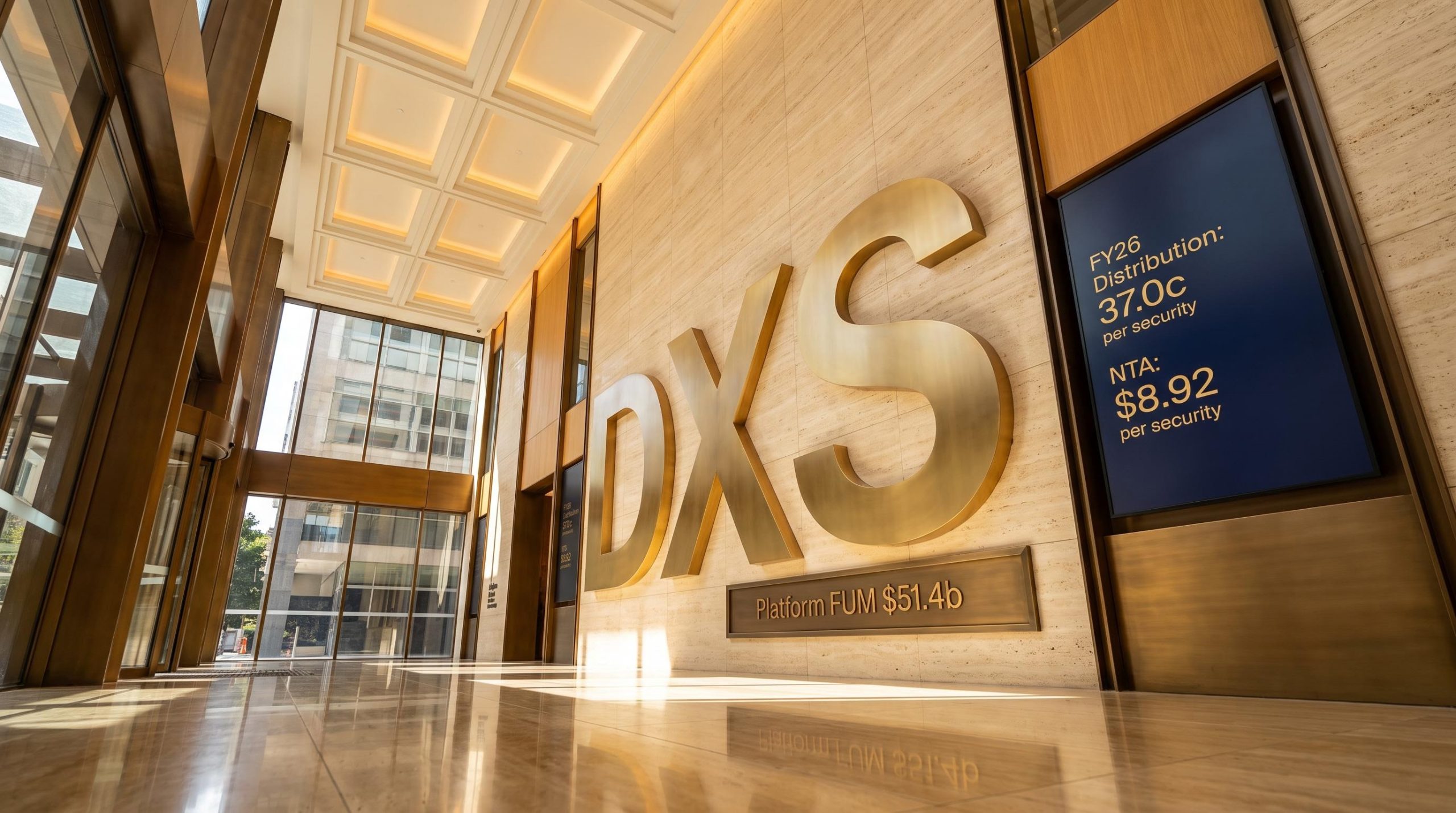
Dexus delivers FY26 results in line with guidance as buyback recommences
In its FY26 annual results presentation delivered on 20 August 2026, Dexus (ASX: DXS) reported Adjusted Funds From Operations (AFFO) of $483.9m, flat on FY25, and distributions of 37.0 cents per security, both in line with guidance.
Statutory net profit after tax (NPAT) recovered sharply to $482.2m, up from $136.1m in FY25. Management outlined results delivered while navigating headwinds, notably the APAC legal matter and a strategic review of infrastructure funds, alongside a renewed focus on closing the security price discount to net tangible assets (NTA) through a recommenced securities buyback.
The presentation confirmed total platform funds under management (FUM) of $51.4b, comprising a $15.3b listed investment portfolio and $36.1b of third-party FUM. With guidance met and the buyback restarting, management is addressing the 35% discount to NTA disconnect directly.
When big ASX news breaks, our subscribers know first
FY26 results at a glance
The group’s headline metrics reinforced the “in line with guidance” narrative, with AFFO and distributions per security both unchanged year-on-year.
| Metric | FY26 | FY25 | Change |
|---|---|---|---|
| AFFO | $483.9m | $483.9m | 0.0% |
| Underlying FFO | $626.8m | $673.3m | (6.9)% |
| FFO | $669.3m | $677.2m | (1.2)% |
| Distribution per security | 37.0c | 37.0c | 0.0% |
| AFFO per security | 45.0c | 45.0c | 0.0% |
| Statutory NPAT | $482.2m | $136.1m | — |
| NTA per security | $8.92 | $8.81 | — |
| Look-through gearing | 33.4% | 31.7% | — |
Operational highlights from the reporting period included:
-
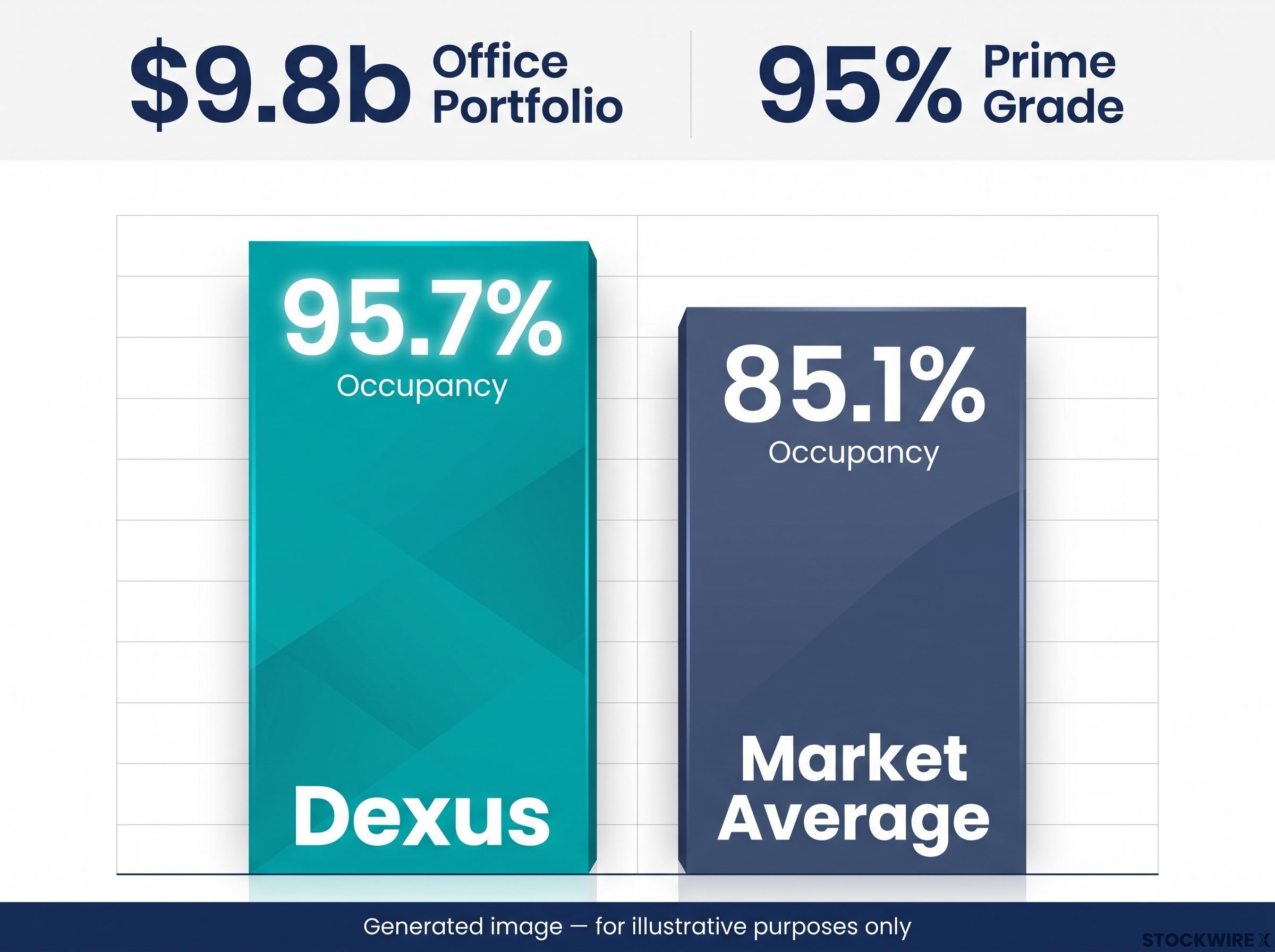
95.7% office occupancy, well above the market average of 85.1%
-
+8.3% industrial effective like-for-like income growth
-
99.7% rent collections
-
+1.0% property valuations, reflecting a stabilising market
-
c.$1.9b Dexus divestments in FY26, taking total divestments to c.$2.5b since FY24 and exceeding the c.$2b earmarked for FY25-27
Portfolio performance — office recovery and industrial rent growth
Office portfolio
The $9.8b Dexus office portfolio remained 95% prime grade, with 78% located in core CBDs. Occupancy of 95.7% was described as the company’s strongest outperformance versus the market in over 25 years of tracking.
A total of 158,400sqm was leased across 295 transactions. Total stabilised and development leasing volumes of 172,600sqm were 61% higher than FY25. The portfolio delivered a one-year total return of 5.4%. Management noted that office markets have commenced a recovery cycle, with low supply completions expected ahead.
Industrial portfolio
The $3.6b Dexus industrial portfolio comprised 89% core industrial. Effective like-for-like income growth of +8.3% was driven by strong leasing outcomes at select assets that experienced downtime in the prior period. The portfolio also achieved circa 24% releasing spreads across the stabilised portfolio, and recorded a one-year total return of 7.1%.
Data centre and e-commerce tailwinds were highlighted, with the presentation forecasting circa 60% less speculative supply over the next three years.
The sector figures indicate the “flight to quality” thesis is playing out, with prime, well-located assets outperforming a bifurcated market.
What “AFFO” and “NTA discount” mean for investors
AFFO (Adjusted Funds From Operations) is a REIT cash-earnings measure calculated as FFO less maintenance capital expenditure and leasing incentives. It underpins the distribution, and Dexus’s policy is to pay out 80-100% of free cash flow. In FY26, the AFFO payout ratio was 82.1%.
NTA (Net Tangible Assets) represents the underlying asset value per security, reported at $8.92. Yet DXS traded at a 35% discount to NTA (as at 18 August 2026), before any value ascribed to the funds management business.
Why does this matter? Management acknowledges the security price disconnect, and recent divestments support recommencement of securities buyback activity.
Balance sheet strength supports buyback recommencement
Look-through gearing of 33.4% sat toward the lower end of the 30-40% target range, with $2.5b of headroom including cash and an S&P/Moody’s credit rating of A-/A3 maintained.
During the period, Dexus issued A$500m of subordinated notes and secured more than $1.1b of new and extended bank debt, with tenors out to seven years. Post-balance-date asset sales of c.$1.1b are expected to reduce pro forma gearing by circa 3 percentage points.
Management framed recent divestments as supporting the recommencement of securities buyback activity, having regard to the capital allocation framework and subject to market conditions.
The Dexus divestment program reached its FY27 target ahead of schedule, with three office properties exchanged for a combined $715 million at pricing management described as a significant premium to the value implied by the current security price.
Management focus on value creation
Ross Du Vernet, Group CEO & Managing Director, outlined a short-term focus on closing the gap between security price and underlying value, including through implementing the securities buy back, alongside a longer-term focus on transitioning the balance sheet, expanding third-party capital partnerships and building a scalable platform.
Addressing the headwinds — APAC and the infrastructure fund review
Dexus manages infrastructure funds and mandates that transitioned via the 2023 AMP Capital transaction, representing $7.3b of third-party FUM, $260m of co-investment interests and $35m of management fee revenues.
In May 2026, the NSW Supreme Court found against the Dexus Bloc, a group of investors in APAC (owner of Melbourne and Launceston airports). Those investors are appealing, with a hearing scheduled for October 2026.
Dexus funded the legal action and has committed to fund the appeal, with a provision for legal costs reflected in NTA. Relevant employees have been stood down, and remuneration implications have been applied. A strategic review of infrastructure funds is underway, with investor consultation across more than 70 parties. Management indicated outcomes will be determined fund by fund and that final resolution may take time.
Separately, following an increased redemption queue, Dexus is in consultation with investors in the $1.1b Dexus Healthcare Property Fund (DHPF).
Funds management momentum and equity raising
The funds management business raised c.$2.0b of third party equity commitments over FY26, up from $1.1b in FY25, including facilitating more than $1.1b of secondary unit transactions.
Of this, $900m of new equity was raised, including c.$390m for DREP2 (taking total commitments above $870m, ahead of the >$600m initial target) and $220m for DSIT1, a new fund series seeded with a 25% interest in Westfield Chermside. Ten new private and institutional clients were added during the year.
Fund performance highlights included:
-
DWSF ranked 1st among wholesale funds across all sectors over the 1, 2 and 3-year periods, delivering a 12.1% total return
-
DWPF outperformed its benchmark over all time periods, delivering a 9.3% total return
-
Jandakot JV outperformed its benchmark over 1 and 3 years, and since inception
Growth pipeline and strategic priorities
The platform’s $12.8b real estate development pipeline underpins future growth. At Atlassian Central, Sydney, the asset is 100% pre-leased on a 15-year lease with 4% p.a. fixed increases, with practical completion on track for late 2026.
At Waterfront Brisbane, completion is now expected in late 2029, delayed due to build complexity and prior adverse weather. Pre-leasing has increased to 71%, and the project remains profitable with yield on cost expected to remain within the 5-6% range.
Dexus also established a strategic partnership with Boral at Ravenhall, a joint venture to develop a 630-hectare site with potential lettable area of up to 2.5 million sqm, subject to rezoning and business plan approvals. Management described this as providing capital efficient access to long dated development pipeline, with Boral retaining a 50% interest.
The Ravenhall logistics joint venture is structured so Dexus holds a minimum 10% direct interest per superlot with the remainder funded by third-party capital, limiting upfront balance sheet exposure while securing multi-decade management fee income across what is expected to become the largest institutionally held logistics precinct in Australasia.
The company outlined three refreshed strategic priority areas: transition the balance sheet, expand capital partnerships, and enhance platform efficiency.
FY27 outlook
For the 12 months ending 30 June 2027, Dexus expects AFFO of 37.5-39.5 cents per security and distributions of 37.0 cents per security, barring unforeseen circumstances.
Management flagged transparently that FY27 earnings will be lower, driven by an immaterial contribution from performance fees and trading profits following an elevated FY26, higher finance costs, practical completion of Atlassian Central, and a materially lower contribution from FUM under review, noting that no decisions have been made.
The company reiterated its target to release more than $2 billion of capital over FY27-28 through bringing third-party capital into core holdings and continued capital recycling. Management acknowledged the security price disconnect and is acting via the buyback and platform simplification, positioning the balance sheet now for durable growth later.
Stay Ahead on ASX Real Estate News
Get FREE breaking ASX announcements delivered to your inbox within minutes of release, complete with in-depth analysis already done for you. Join 20,000+ active subscribers who never miss a market-moving update. Click the “Free Alerts” button at StockWire X to start receiving alerts the moment news breaks.