A Federal Court judgment handed down today has determined that McPherson’s Limited, the ASX-listed health and beauty company, breached its continuous disclosure obligations and engaged in misleading or deceptive conduct, with the court concluding that the company concealed material information for weeks while investors kept trading on earnings guidance whose basis had already collapsed.
The finding centres on a period in late 2020 when McPherson’s put profit growth guidance before the market, backed by purchasing projections for its Dr LeWinn skincare brand in China, yet held back a correction after receiving information showing those projections had fallen apart. During the gap between what the company knew and what the market was told, McPherson’s reaffirmed its outlook at an annual general meeting, issued a cleansing notice asserting no undisclosed material information, and allowed investors to trade on a picture that no longer reflected reality.
Here is what today’s finding means for investors tracking ASX corporate governance risk, what the court determined, and what the penalty stage ahead will decide.
How a failed Chinese retail event brought McPherson’s guidance undone
At the start of the relevant period, McPherson’s put forward FY21 earnings guidance on 20 October 2020, with projected profit before tax growth resting on order volumes from its China joint venture partner, Access Brand Management (ABM), for the Dr LeWinn skincare line. The guidance leaned heavily on one assumption: that ABM purchasing volumes would hold.
They did not. Results from the 11/11 online retail sales event in China came in short of what had been anticipated for Dr LeWinn, with ABM purchasing projections revised downward in response. But the question of precisely when McPherson’s knew its guidance had lost a reasonable basis remains contested, and that question is central to how the breach is characterised.
The key timeline milestones run as follows:
- 20 October 2020: McPherson’s issues FY21 earnings guidance forecasting profit before tax growth.
- Around 30 October 2020: ASIC’s concise statement alleges McPherson’s received information indicating ABM sales were at risk of being significantly lower than the guidance assumed.
- 11 November 2020: The 11/11 online retail sales event in China concludes with Dr LeWinn sales coming in below the levels the guidance had assumed.
- 12 November 2020: An alternative date associated with the proceedings narrative for when McPherson’s became aware its guidance had lost a reasonable basis, though this conflicts with ASIC’s earlier date.
- 1 December 2020: McPherson’s withdraws and downgrades its earnings guidance.
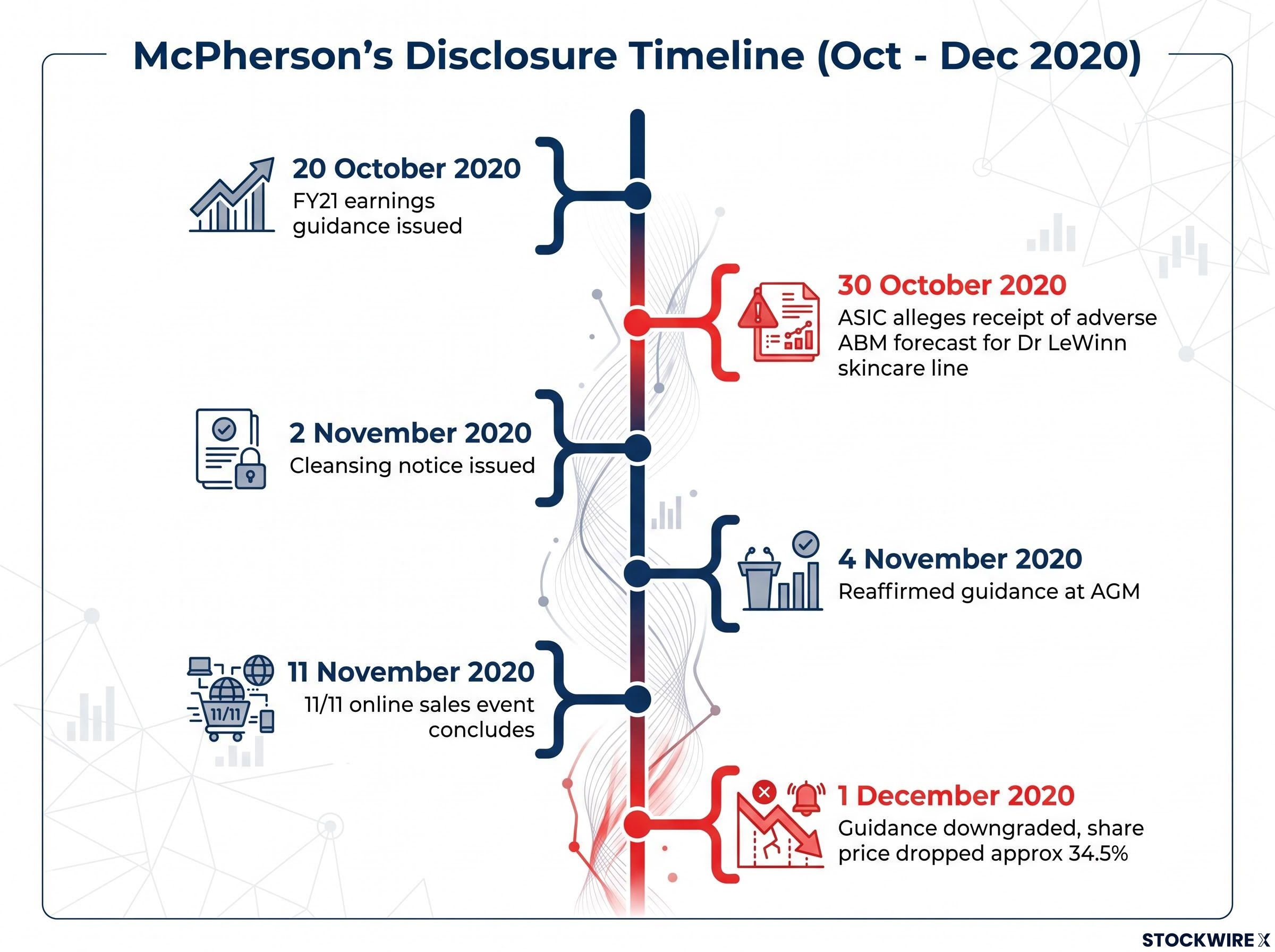
Whether the non-disclosure window started in late October or mid-November changes its length and severity. What is not contested is the gap itself: for weeks, investors traded without knowing the company’s earnings outlook had been materially compromised.
When big ASX news breaks, our subscribers know first
What McPherson’s did during the non-disclosure window
The failure to disclose would have been serious enough on its own. What drew ASIC’s enforcement action was what McPherson’s did while the adverse information sat undisclosed. Each act during the non-disclosure period reinforced the market’s belief that the October guidance remained valid:
- 2 November 2020: McPherson’s issued a cleansing notice, a formal market document asserting that the company had no undisclosed material information. ASIC alleges the company already had, or shortly after received, information indicating otherwise.
- 4 November 2020: At its annual general meeting, McPherson’s reaffirmed its growth forecasts and Dr LeWinn sales outlook to shareholders.
- 1 December 2020: McPherson’s finally withdrew and downgraded its guidance. ASIC alleges the withdrawal announcement was itself misleading about when the company first became aware of the need to downgrade. Former CEO Mr McAllister is alleged to have authorised that announcement.
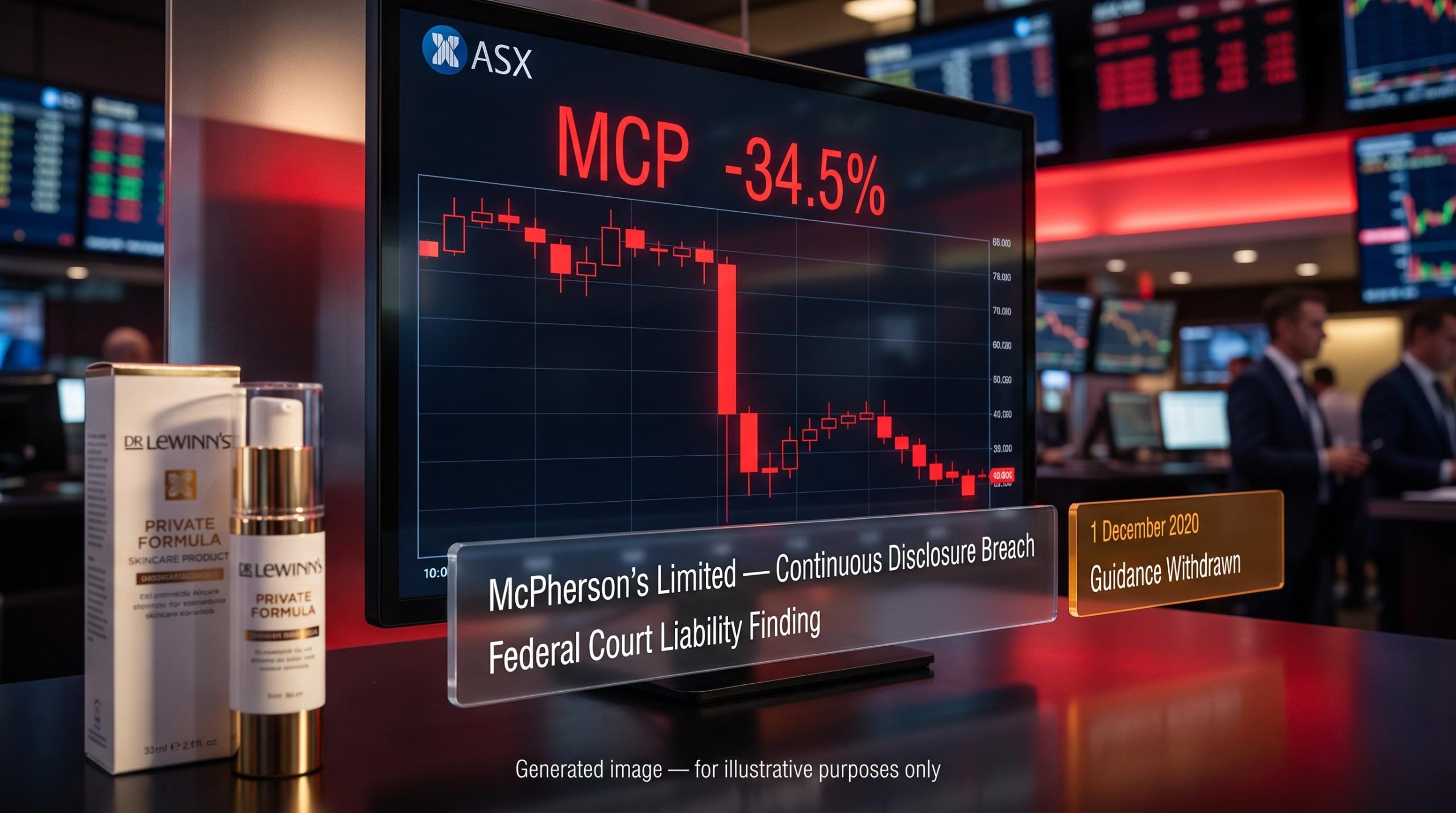
Upon withdrawing its earnings guidance on 1 December 2020, McPherson’s share price dropped by approximately 34.5%. This figure is attributed to the proceedings narrative and is not confirmed in ASIC’s published documents.
ASIC’s case is built on the cumulative effect of these acts. A company that simply failed to update the market would face one category of scrutiny. A company that actively reaffirmed guidance it knew was compromised, issued a formal notice asserting no undisclosed information, then delivered a withdrawal announcement that allegedly misrepresented the timing of its own awareness, faces another. Each act of reaffirmation extended the period during which investors could trade on outdated information.
What continuous disclosure law actually requires of ASX-listed companies
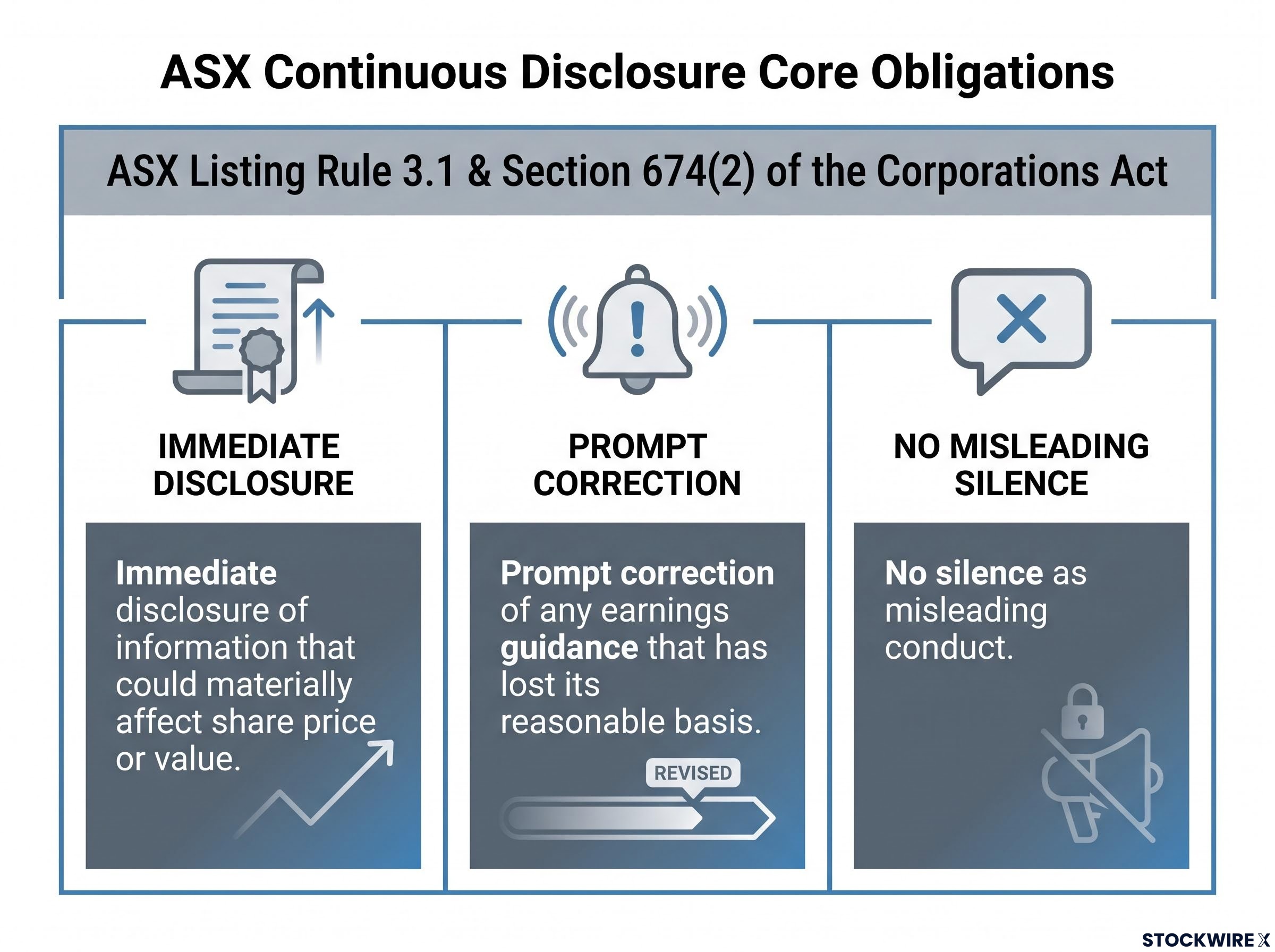
ASX Listing Rule 3.1 and section 674(2) of the Corporations Act create the core obligation: once a listed entity becomes aware of information that a reasonable person would expect to have a material effect on the price or value of its securities, it must immediately notify the ASX. “Immediately” means without unreasonable delay. It does not mean at the next results presentation, the next board meeting, or the next convenient reporting window.
The three obligations that matter here are:
- Immediate disclosure of information that could materially affect share price or value.
- Prompt correction of any earnings guidance that has lost its reasonable basis.
- No silence as misleading conduct: leaving a profit forecast on the market after its basis has collapsed, without corrective disclosure, can itself constitute misleading or deceptive conduct.
Recent legislative amendments have also raised the bar for ASIC. Civil penalty proceedings now require proof of a mental element, meaning knowledge, recklessness, or negligence, replacing the prior strict liability standard. A liability finding under this higher threshold carries more weight than it would have under the old regime, because the court must determine not just that the disclosure failed, but that the failure involved fault.
The continuous disclosure framework that McPherson’s breached also contains formally recognised gaps that can leave retail investors trading on asymmetric information even when companies are acting within the rules, including the Rule 3.1A carve-out that permits non-disclosure of incomplete, confidential proposals for extended periods.
When does the obligation to correct guidance kick in?
The trigger is awareness of materially adverse information that undermines the guidance basis, not receipt of a formal revised forecast document. ASIC’s framing of the McPherson’s case places the trigger as early as 30 October 2020, well before the 11/11 event itself. That timing illustrates how early the clock can start: a company does not need to wait for confirmation of a sales miss before the obligation to disclose bites. Awareness that the assumptions underlying guidance are materially at risk is enough.
The court’s findings and what ASIC’s action targeted
In its ruling, the Federal Court held McPherson’s to account on two distinct grounds: a contravention of section 674(2) of the Corporations Act (continuous disclosure) and misleading or deceptive conduct in breach of both the Corporations Act and the ASIC Act. ASIC commenced proceedings in 2022, documented in media release 22-346MR.
The ruling, catalogued under Corporations Law in the Federal Court latest judgments register as Australian Securities and Investments Commission v McPherson’s Limited FCA 1130, represents a liability determination under the higher fault-based threshold introduced by recent legislative amendments to continuous disclosure law.
The distinct findings break down as follows:
- Continuous disclosure breach: The court determined that McPherson’s had contravened its disclosure obligations by withholding the revised ABM purchasing forecasts and the updated Dr LeWinn sales results, and by leaving its October profit guidance in place without correction, across the contravention period.
- Misleading conduct by the company: The combination of keeping guidance on foot, issuing the cleansing notice, reaffirming forecasts at the AGM, and issuing an allegedly misleading withdrawal announcement constituted misleading or deceptive conduct.
- Officer liability: The court found that former CEO Mr McAllister breached his duty of care and diligence as a director and was responsible for the company providing false or misleading information to the ASX via the 1 December announcement.
Today’s ruling is the first of two stages. A penalty hearing will follow, and that is where the financial consequences for McPherson’s and Mr McAllister will be determined. The liability finding establishes the foundation; the penalty determination will set the price.
What investors who traded during the non-disclosure window should know
If you traded McPherson’s shares between late October and 1 December 2020, today’s liability finding has direct relevance. The recognised legal theory is straightforward: investors who buy, or fail to sell, during a period of non-disclosure do so on the basis of publicly available information that does not reflect the company’s actual position. You traded on guidance that the company knew had lost its basis.
The non-disclosure window runs from 30 October to 1 December 2020 per ASIC’s concise statement (or 12 November to 30 November per the alternative proceedings narrative). During that window, McPherson’s held adverse ABM forecast information that was not available to the market.
Following a liability finding of this kind, two pathways typically open:
- Monitor the penalty hearing for context on quantum and how seriously the court prices the conduct.
- Consider whether a private civil action or class action is available for investors who suffered loss during the non-disclosure window.
ASIC has publicly identified continuous disclosure, including the management of earnings guidance, as a priority enforcement area.
Today’s finding means the legal foundation for potential compensation claims now exists. The quantum and viability of any individual claim will depend on the penalty hearing outcome and any subsequent class proceedings.
The a2 Milk class action settlement of $62 million, reached in April 2026 and fully covered by insurance with no admission of liability, illustrates the commercial pathway that companies and their insurers typically negotiate after a liability finding establishes the legal foundation for investor compensation claims.
This article is for informational purposes only and should not be considered financial advice. Investors should conduct their own research and consult with financial professionals before making investment decisions.
What today’s ruling signals for how ASX companies manage earnings guidance
This ruling reinforces a principle that applies well beyond McPherson’s: the obligation to correct guidance is triggered at the point of awareness, not at a convenient reporting window. The combination of non-disclosure and public reaffirmation is treated by ASIC as a compound breach, not merely an oversight.
| Date or period | McPherson’s action | ASIC’s characterisation |
|---|---|---|
| 20 October 2020 | Issued FY21 earnings guidance | Guidance underpinned by ABM forecasts that subsequently failed |
| 30 October 2020 | Received adverse ABM forecast information (per ASIC) | Start of alleged contravention period |
| 2 November 2020 | Issued cleansing notice asserting no undisclosed information | Misleading: issued while adverse information allegedly held |
| 4 November 2020 | Reaffirmed guidance at AGM | Misleading: guidance basis already compromised |
| 1 December 2020 | Withdrew and downgraded guidance | Withdrawal announcement itself allegedly misleading on timing |
For investors evaluating ASX companies that have recently issued earnings guidance with narrow underlying assumptions, particularly those with concentrated exposure to a single market or product line, this ruling is a prompt to scrutinise how quickly those companies update the market when those assumptions are tested. Once guidance is issued, it must be actively managed. The cost of not doing so, measured in regulatory liability and share price impact, is now on the record.
After the liability finding, what comes next for McPherson’s and the market
The liability determination sets the stage. What follows is the penalty hearing, where the Federal Court will determine the financial consequences for both McPherson’s and former CEO Mr McAllister. Civil penalty proceedings follow a two-stage structure: liability first, then a separate hearing on penalties, which can be substantial for both entities and individuals under the Corporations Act.
Three forward-watch items for investors tracking this case:
- Penalty hearing timing: The hearing will set the financial cost of the breach and establish a benchmark for how Australian courts are pricing continuous disclosure failures.
- Officer liability determination for Mr McAllister: His individual penalty exposure is assessed separately from the company’s and will be determined by reference to the court’s finding that he breached his duty of care and diligence as a director in connection with the 1 December announcement.
- Class action potential: Investors who suffered loss during the non-disclosure window may pursue compensation through private civil action, a pathway that today’s liability finding materially strengthens.
Australia’s dual enforcement model runs company proceedings and individual officer proceedings simultaneously over the same underlying conduct, meaning a corporate penalty paid by McPherson’s shareholders does not resolve Mr McAllister’s separate personal exposure under the Corporations Act.
Past performance does not guarantee future results. These statements are subject to change based on market developments and court proceedings.
ASIC’s enforcement pattern suggests that companies with concentrated guidance risk will remain under scrutiny. Today’s ruling against McPherson’s sets a reference point, and the penalty hearing will determine how high the bar has been raised.
—