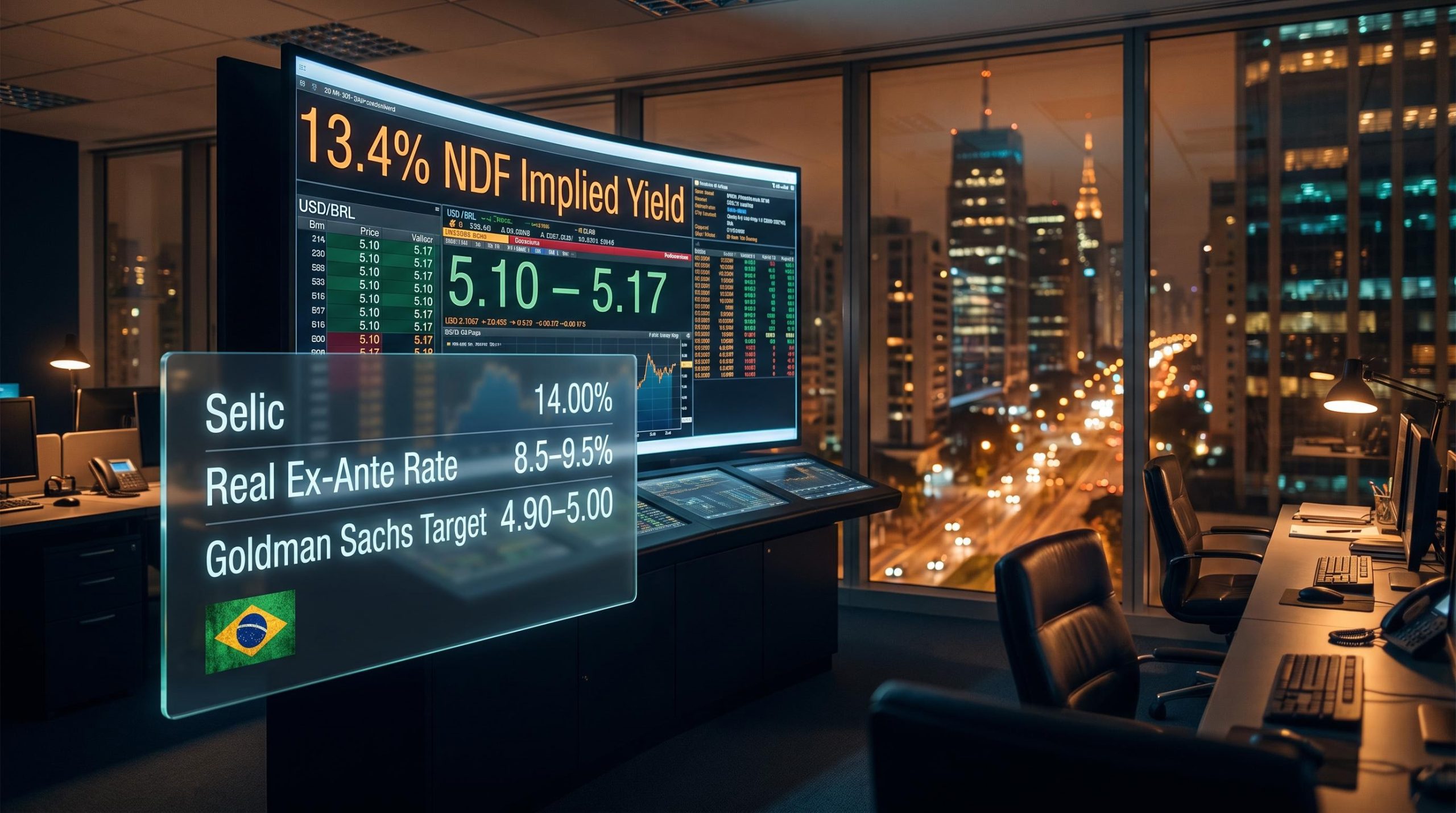
The Brazilian real offered one of the highest carry yields in emerging markets heading into this week. It also underperformed in a session where the dominant story should have been carry collection, not capital loss. Two catalysts hit simultaneously: one major broker reduced its Brazilian equities rating to neutral, stepping back from a prior overweight stance, while a newly published survey indicated President Lula consolidating his advantage over opposition candidates ahead of the October 2026 presidential vote. The contradiction between yield and price action in a single session is where the analytical signal lives.
For the first time in 2026, domestic Brazilian political developments have left a visible mark on BRL pricing. The question is not whether political risk exists. It plainly does. The question is whether it is large enough to overcome a 13.4% NDF implied yield buffer. Long BRL is a consensus emerging-market macro trade this year, and consensus trades that crowd do not unwind gradually. They snap.
Here is the framework for separating political noise (absorbable) from structural break conditions (trade-ending), built around the specific triggers, levels, and monitoring tools that determine whether the carry buffer holds or dissolves.
What the sell-off actually showed about BRL’s vulnerability
The session that rattled BRL traders carried two distinct catalysts arriving in the same window:
- Equity downgrade: One sell-side broker moved Brazilian stocks to a neutral rating, stepping back from overweight, which stripped away a layer of institutional flow support for BRL-denominated assets.
- Lula polling surge: Fresh survey data revealed Lula widening his margin over opposition candidates, bringing political uncertainty into focus for a market that had largely treated domestic politics as background noise.
Both hit at once. And yet USD/BRL remained near the middle of its recent range, trading around 5.10-5.17 as of mid-August 2026. The currency absorbed a dual negative catalyst without breaking its boundaries.
ING’s Chris Turner characterised the session as the first meaningful instance in 2026 where domestic politics materially affected BRL valuations, framing it as “a warning shot rather than a regime change.”
That framing matters. The carry buffer is doing real work right now, not just theoretical work on a spreadsheet. A currency with lower implied yields would have punched through resistance on the same news. BRL absorbed it. Overreacting to this session is as dangerous as ignoring it; the carry buffer held, but the fact that it was tested at all is the signal worth noting.
When big ASX news breaks, our subscribers know first
The mechanics of a 13.4% implied yield and why it creates a wide moat
A one-month non-deliverable forward (NDF) implied yield is the annualised return an offshore investor captures from holding a long BRL forward position, assuming the spot exchange rate does not move. An NDF is a currency contract settled in US dollars rather than in the local currency, which is how most offshore investors access BRL carry without needing onshore accounts.
The BIS framework for non-deliverable forwards establishes that NDFs are cash-settled in US dollars precisely because the underlying currency carries convertibility restrictions, which is why offshore investors use these contracts to access BRL carry without requiring onshore accounts or direct currency settlement.
At approximately 13.4% annualised, that translates to roughly 1.1% per month in carry. The arithmetic builds from Brazil’s Selic rate (the central bank’s benchmark interest rate) at 14.00% following the August 2026 cut, minus Brazilian CPI inflation running near 5%, which delivers a real ex-ante rate, the inflation-adjusted return before any currency movement, estimated at 8.5-9.5%.
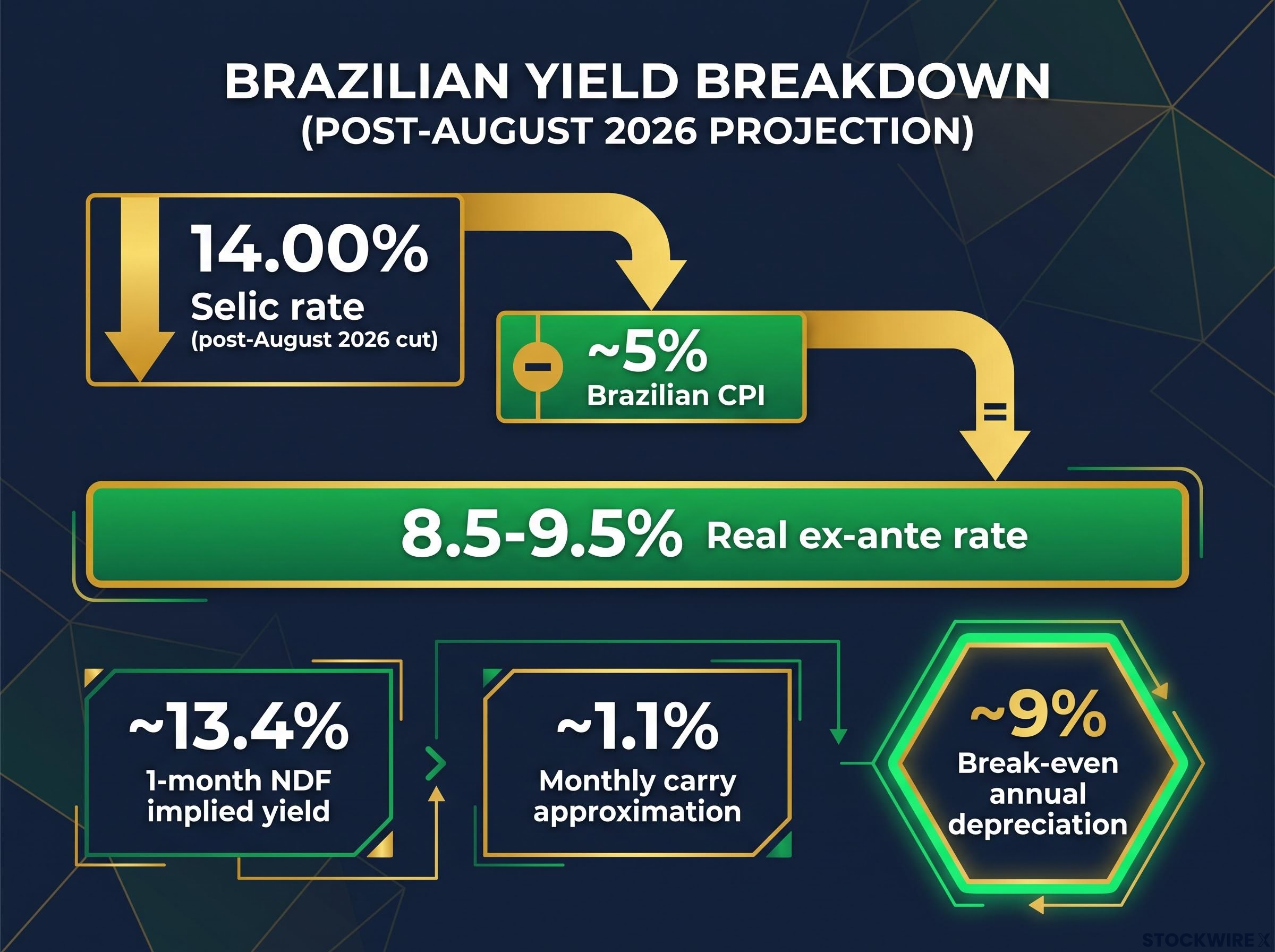
| Metric | Value |
|---|---|
| Selic rate (post-August 2026 cut) | 14.00% |
| Brazilian CPI | ~5% |
| Real ex-ante rate | 8.5-9.5% |
| 1-month NDF implied yield | ~13.4% |
| Monthly carry approximation | ~1.1% |
| Break-even annual depreciation | ~9% |
A real ex-ante rate near 9% means you need to believe BRL will depreciate by roughly nine percentage points in a year before carry breaks even. That is a high bar for a currency with strong export flows behind it.
Headline yield vs. what investors actually capture
The 13.4% headline does not land in your account untouched. Transaction costs on NDF rolls, withholding tax on certain structures, and funding spreads all trim the net figure. ING’s three-month BRL forward implied yield sits at approximately 13.3% per annum, broadly consistent with the one-month number but subject to the same friction costs.
The trimming does not eliminate the buffer. It does, however, contextualise the real-world risk-reward more accurately. The moat is wide; it is not quite as wide as the headline suggests.
Rate differential mechanics determine whether a carry trade survives a hiking cycle: even with the Bank of Japan raising to a 31-year high of 1%, a residual spread of approximately 2.5%-2.75% over US rates kept yen-funded carry positions structurally intact, illustrating how the absolute level of the high-yield rate matters far less than the gap that remains after the funding currency tightens.
Brazil’s commodity position as the structural floor that politics cannot easily remove
The rate mechanics explain one layer of BRL support. The trade balance explains the second, and it operates independently of political sentiment.
Brazil is a net energy and commodity exporter across energy, agriculture, and metals. That status creates persistent structural FX inflows that underpin the real regardless of whether Lula’s poll numbers are rising or falling. Three channels transmit this support:
- Current account inflows: Brazil runs a trade surplus driven by commodity export receipts. These flows provide a structural demand floor for BRL that political noise alone cannot remove.
- Commodity price correlation: Unlike net importers, BRL tends to strengthen when global commodity prices are firm. Rising export revenues attract capital inflows rather than repelling them, the inverse of the vulnerability that energy-importing economies face.
- Reduced domestic-political vulnerability: As long as export earnings remain strong, the structural FX floor holds, making incremental political developments absorbable rather than destabilising.
Even scenario work on tariffs supports this framing. Analysis suggests that a new 25% US tariff shock would be partly absorbed by exemptions and double-digit policy rates, keeping USD/BRL anchored near 5.1 in that scenario.
Brazil’s commodity export position underpins more than just current account arithmetic: foreign institutional inflows reached a record R$53.37 billion in Q1 2026 alone, surpassing full-year 2025 totals in a single quarter and confirming that global capital allocation is responding to the structural trade surplus story, not merely the yield.
Goldman Sachs has revised its 3-12 month USD/BRL target to 4.90-5.00, citing “robust trade flows and strong carry trade dynamics” as the structural anchors.
For a reader holding long BRL, the commodity export story means political noise has to be both large and sustained to overwhelm not just the carry buffer but also the structural trade-flow support beneath it. That is two independent lines of defence, not one.
The 5.22 level and the three external triggers that would actually break the trade
ING views the 5.22 USD/BRL resistance level as unlikely to break on domestic news alone. In their view, a generalised strengthening of the US dollar driven by external forces, rather than Brazil-specific headlines, is what would be required to push the pair through that level. Recent market commentary places USD/BRL moves “toward 5.22” during global inflation scares, describing it as an area where carry is stress-tested but not yet abandoned. Scenario analysis puts “real weakens” outcomes above 5.25-5.30, tied to external shocks rather than Brasília’s political calendar.
The three external catalysts that would actually break the trade, ranked by immediacy:
- Fed hawkishness and broad USD strength: US policy shifts and global rate repricing compress the differential that makes BRL attractive. ING flags this as a primary risk to Latam carry. This is the most direct transmission mechanism.
- Global risk-off: Emerging-market carry baskets fall in tandem during major risk episodes regardless of local fundamentals. A genuine global shock forces broad EM de-risking, BRL included. Historical precedent shows BRL moves above 5.70 in prior episodes attributed to global market turmoil, not domestic politics alone.
- Commodity price collapse: Brazil’s trade surplus is the structural floor. A sustained deterioration in commodity prices removes the buffer that currently makes political risk bearable and exposes the carry to reversal.
Watching Lula’s poll numbers is less useful than watching the Fed’s next communication and the next global risk sentiment indicator. External triggers are where the real break risk lives.
The domestic equivalents that could match external shock severity
Two domestic risks can replicate the severity of an external shock, though they operate on a slower timeline.
Fiscal credibility is the first. Slippage in the arcabouço framework (Brazil’s fiscal rule), election-year spending expansion, and primary balance deterioration all erode the foundation on which the Selic rate’s credibility rests. If the market stops trusting the fiscal trajectory, the carry yield becomes compensation for risk rather than a source of excess return.
Central bank independence is the second. If post-election policy signals erosion of BCB autonomy, the Selic rate’s role as a carry anchor is undermined at its source. These risks are slower-moving than external shocks, but more permanent in their carry-trade damage if they materialise.
Crowded positioning as the multiplier that turns any trigger into a disorderly exit
All of the triggers described above carry greater destructive potential when positioning is stretched, and BRL longs are now heavily concentrated across the emerging-market carry universe. BRL and ZAR are cited as the top emerging-market carry trades this year, which means the consensus is wide and the exits are narrow.
Historical precedents show what happens when consensus carry trades unwind. The 2015 emerging-market selloff and the ARS 2018 collapse both produced sharp, one-sided moves precisely because positioning was uniformly long and the reversal compressed exit liquidity.
Carry trade complacency is a recurring failure mode in mid-year windows: Bank of America’s analysis finds no statistical support for the thesis that summer markets are safer for carry positions, and three August blowups in 2007, 2015, and 2024 each materialised inside the calendar window that consensus treated as low-risk.
Consensus trades do not unwind gradually. Once the trigger arrives, whether it is external or domestic, the crowding dynamic transforms a moderate shock into a stampede.
The monitoring implication is specific. Forward market repricing in NDF yields is typically the first place carry premiums compress before spot FX adjusts. A reader who monitors NDF forward repricing rather than waiting for spot USD/BRL to move has a measurable informational edge over investors reacting to headlines.
Four variables to track:
- NDF implied yield: Compression here is the earliest warning that the carry buffer is eroding.
- Opinion polling trajectory: Relevant as a trigger for rapid repositioning in a crowded trade, not as a standalone valuation driver.
- Fiscal data and primary balance: The single most important domestic variable for BRL beyond the policy rate.
- Fed communications and US inflation data: The primary external driver of EM carry flows, transmitted directly via rate differential compression.
Holding the position versus reducing exposure: what the data actually tells you right now
The carry buffer is intact at 13.4% implied yield. The structural trade-flow support remains strong. The sell-off was absorbed within the existing range. None of the three external break conditions, Fed hawkishness, global risk-off, or commodity collapse, are currently active. The trade holds under present conditions.
The near-term volatility window is specific: Brazil’s presidential election first round falls on 4 October 2026, with a potential runoff on 25 October 2026. ING’s stance is that using domestic political developments as a reason to add BRL short exposure is not warranted. Goldman Sachs maintains a 4.90-5.00 USD/BRL target over 3-12 months, anchored by trade flows and carry dynamics.
| Condition | Present | Absent |
|---|---|---|
| Fed/USD environment supportive | Carry differential holds; trade remains attractive | Differential compresses; BRL yield advantage narrows |
| Commodity prices firm | Structural FX floor intact via export receipts | Trade surplus erodes; second line of defence removed |
| Fiscal credibility maintained | Selic rate credible as carry anchor | Yield becomes risk compensation, not excess return |
| Global risk sentiment stable | EM carry flows continue; positioning holds | Crowded exit risk activates; disorderly unwind possible |
The election calendar gives you a concrete near-term window to assess positioning size. The question is not whether to hold the carry trade. It is whether your current position sizing accounts for the elevated volatility of an election window where a real ex-ante rate of 8.5-9.5% provides the break-even context.
This article is for informational purposes only and should not be considered financial advice. Investors should conduct their own research and consult with financial professionals before making investment decisions. Forward-looking statements, including price targets and rate projections, are subject to change based on market developments and various risk factors.
What changes after October, and what probably does not
Political risk fired a warning shot in August 2026. It did not change the regime. The carry buffer at 13.4% implied yield and the structural commodity-export floor remain intact, and the data shows that BRL absorbed a dual negative catalyst without breaking its recent range. The real break risks sit outside Brasília: Fed communications, global risk sentiment, and commodity prices are the variables with the power to compress the carry or trigger disorderly outflows from a crowded trade.
If the October election resolves without surprises on fiscal policy or BCB independence, the carry trade’s dominant thesis survives into the next phase. If post-election signals point toward fiscal slippage or erosion of central bank autonomy, the risk framework shifts meaningfully, because those domestic risks, unlike polling noise, attack the carry anchor directly.
Two monitoring tools remain highest-signal: NDF forward repricing, which moves before spot, and Fed communications, which transmit to BRL via the rate differential that makes the entire trade work. Watch those, not the headlines.