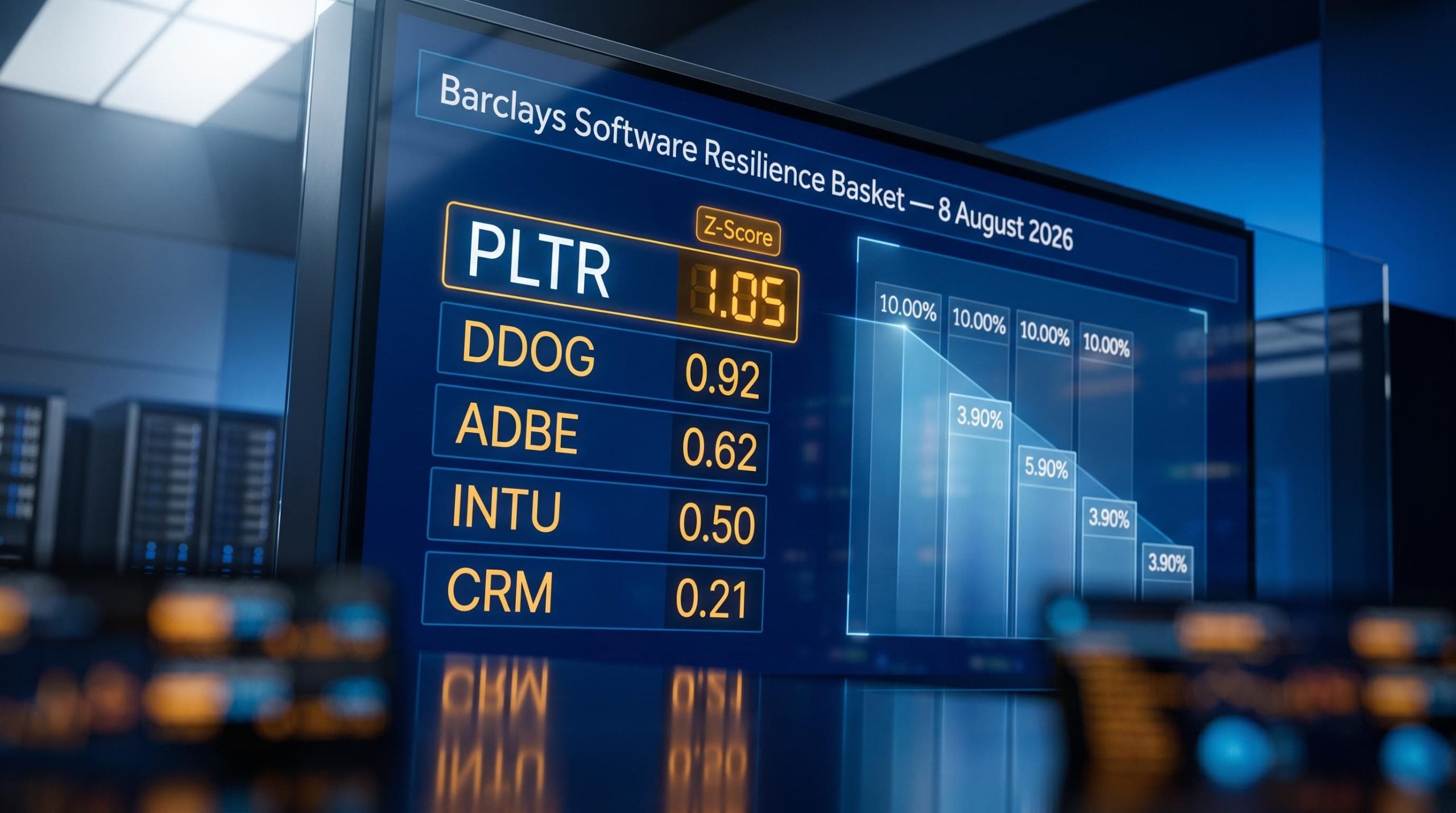
A Barclays strategy note circulating as of 8 August 2026 names 20 software stocks it considers built to survive monetary tightening, ranking them by a Z-Score resilience metric that places Palantir at the top and Salesforce at the bottom of the initial tier. That is a specific, actionable claim, and it deserves scrutiny before anyone builds a position around it.
Rate-sensitive software equities have been a persistent pain point for investors navigating the current tightening environment. The promise of a rules-based, bank-constructed shortlist cuts through the noise, which is exactly why the sourcing and methodology behind this basket matter.
This piece tells you what the basket claims, what can and cannot be verified about its Barclays attribution, and how to use the underlying rate-resilience logic as a screening tool regardless of the attribution question.
What the basket actually claims: stocks, weightings, and Z-Scores
The basket is described as a 20-stock, long-only software portfolio updated as part of a Barclays strategy revision dated 8 August 2026. Five names sit in the top tier at equal 10.00% weightings, but their Z-Scores, the metric ranking their resilience to rate pressure, are not equal at all. Weightings across the broader basket range from 3.90% for Fair Isaac Corp (FICO) to that 10.00% ceiling, a spread that signals deliberate conviction hierarchy rather than arbitrary allocation.
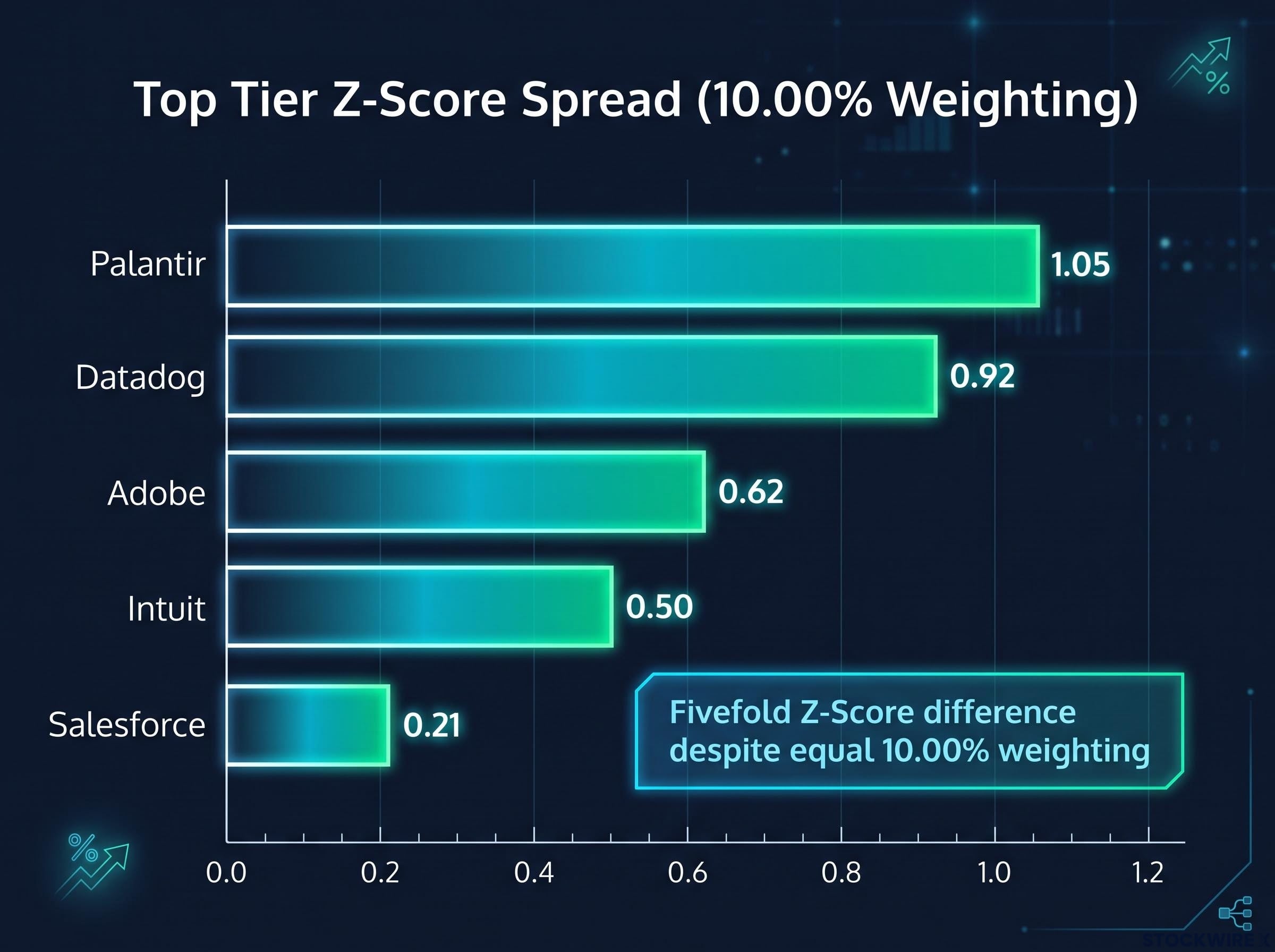
Not all 20 holdings are fully enumerated in the available source material, and Z-Score data is missing for several names. What is reported:
| Stock | Ticker | Weighting | Z-Score |
|---|---|---|---|
| Palantir Technologies | PLTR | 10.00% | 1.05 |
| Datadog | DDOG | 10.00% | 0.92 |
| Adobe | ADBE | 10.00% | 0.62 |
| Intuit | INTU | 10.00% | 0.50 |
| Salesforce | CRM | 10.00% | 0.21 |
| Cadence Design Systems | CDNS | 9.00% | 0.31 |
| Fortinet | FTNT | 8.99% | 0.41 |
| Zscaler | ZS | 6.38% | N/A |
| Autodesk | ADSK | 5.87% | N/A |
| Fair Isaac Corp | FICO | 3.90% | N/A |
The Z-Score spread within the top tier tells the story. Palantir sits at 1.05; Salesforce at 0.21. Both carry the same 10.00% weighting, but the framework sees a fivefold difference in their rate-resilience quality. Palantir’s top ranking is a specific bet on resilience characteristics, not a generic software call.
The weighting and scoring structure is where the real thesis lives. Understanding that hierarchy tells you where the framework places its highest conviction, not just which names cleared the inclusion bar.
When big ASX news breaks, our subscribers know first
The attribution problem every investor needs to understand
No public Barclays research note, structured product filing, or press release matching this 20-stock basket description has been independently located as of 8 August 2026. The specific Z-Score values, differentiated weightings, and software-only scope are not confirmed against any available Barclays disclosure.
That does not make the attribution implausible. Barclays does use equity baskets in structured products, and Palantir appears in at least one confirmed Barclays-linked basket. Three verified 2026 Barclays basket structures exist in public filings:
The Barclays equity outlook published in late June 2026 placed Technology, Media and Telecoms at overweight while naming a confirmed collapse in earnings growth as the sole trigger for reducing that exposure, a framing that adds useful context to any rate-resilience screen applied to software names.
- A 10-name energy and industrial basket, equally weighted at 10% each, linked to a PLUS structured note
- A 4-name bank stock basket, equally weighted at 25% each, linked to a separate structured note
- A 5-name technology basket including Palantir, Meta, Nvidia, Reddit, and Vertiv, equally weighted and used for a structured product
The structural contrast matters. Every confirmed Barclays basket uses equal weighting across all constituents. The described software basket uses differentiated weights ranging from 3.90% to 10.00%. That divergence is the single clearest reason to treat the specific numbers with caution.
For you as an investor, this verification gap means the basket should be treated as a credible analytical framework and a useful starting list for research, not as a certified Barclays product with institutional backing behind every weighting decision.
Why rate resilience in software is a real concept worth your attention
The attribution question is worth raising. But the rate-resilience framework underneath this basket stands on its own merits, and understanding it helps you evaluate any software position, not just the names listed here.
Why software is especially rate-sensitive
Software companies with a high proportion of their total value concentrated in far-future cash flows carry the greatest exposure to rising discount rates. This is duration risk: the longer the average time horizon of a company’s expected cash flows, the more its current share price drops when rates rise and those future earnings are discounted more heavily. A high-multiple, low-current-profitability name can lose 20-30% of its valuation on rate expectations alone, while a high free cash flow (FCF) generator with near-term earnings realisation absorbs the same rate move with far less damage.
Software sector dispersion in 2026 reached a record 133 percentage points between the top and bottom deciles of US technology stocks, a spread that illustrates precisely why a rules-based resilience filter separates differently from a broad sector buy call.
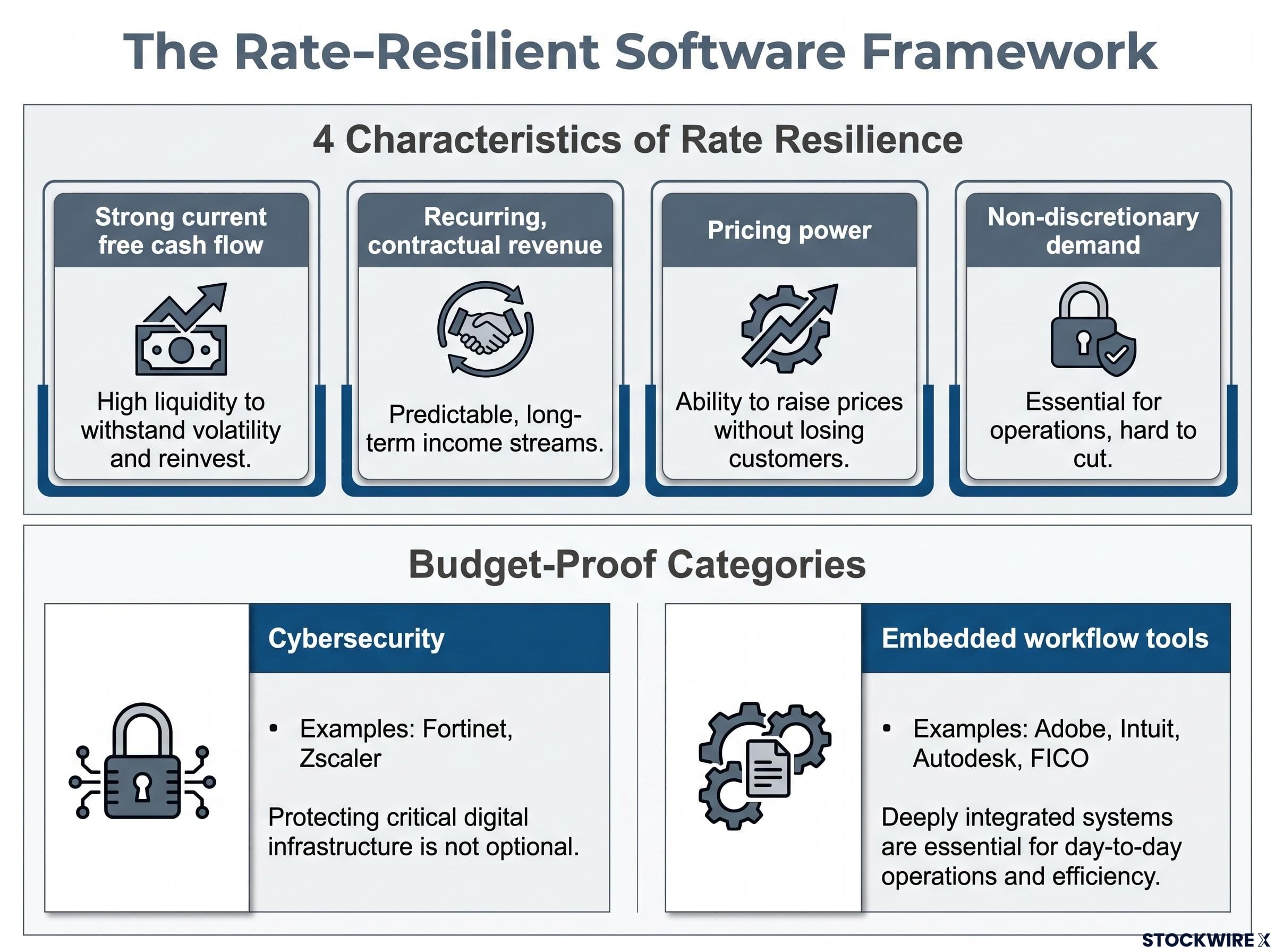
The four characteristics professional investors screen for when identifying rate-resilient software names:
- Strong current free cash flow, reducing dependence on far-future value
- Recurring, contractual revenue, providing earnings visibility that lowers discount rate risk
- Pricing power, enabling margin defence when input costs rise
- Non-discretionary demand, meaning customers cannot easily cut the product from budgets
The two budget-proof software categories
Cybersecurity (Fortinet, Zscaler in the described basket): Security software is functionally non-discretionary. Regulatory requirements, breach liability, and operational dependency make cybersecurity spending among the last items cut in enterprise budget reviews.
Embedded workflow tools (Adobe, Intuit, Autodesk, FICO): These products are deeply integrated into customer operating workflows. Switching costs are high because customers typically lose more productivity by removing the tool than they save on subscription costs, making churn unlikely even in constrained budgets.
If your software holdings skew toward high-multiple, low-FCF names, a tightening cycle is precisely the environment where that exposure becomes a valuation liability. The basket’s selection criteria give you a concrete checklist for identifying where you are most vulnerable.
How the Z-Score ranking stacks up against Barclays’ verified software calls
Cross-referencing the described basket against Barclays’ confirmed 2026 software research sharpens the picture of what this framework is actually selecting for.
Salesforce is the clearest point of overlap: it appears both in the basket (at 10.00% weighting with a Z-Score of 0.21) and in Barclays’ verified 2026 software coverage as a confirmed top pick. The alignment ends there.
Oracle and DigitalOcean both feature in Barclays’ verified 2026 software recommendations, with emphasis on AI-driven growth, valuation reset, and remaining performance obligation re-acceleration. Neither appears in the described basket. Their absence suggests the basket is applying a stricter rate-resilience filter than a standard analyst buy list, one that may exclude names whose growth profile depends on factors other than the four resilience criteria.
The legacy software repricing that erased approximately $2 trillion in US market value in early 2026 concentrated losses on per-user licensing models, reinforcing why the basket’s preference for high-FCF, contractually supported names reflects a deliberate departure from the segment most exposed to both rate pressure and AI displacement simultaneously.
| Stock | In described basket | In verified Barclays 2026 research | Notes |
|---|---|---|---|
| Salesforce | Yes (10.00%, Z-Score 0.21) | Yes (top pick) | Present in both; lowest Z-Score among top tier |
| Oracle | No | Yes (top pick) | Absent from basket despite verified recommendation |
| DigitalOcean | No | Yes (top pick) | Absent from basket despite verified recommendation |
| Palantir | Yes (10.00%, Z-Score 1.05) | In a 5-name tech structured product | Top-ranked in basket; confirmed in Barclays-linked product |
Palantir’s dual appearance is the strongest data point linking the described basket to Barclays: top-ranked in the software basket at a Z-Score of 1.05 and independently confirmed in a Barclays-linked five-name technology structured product.
That distinction between a rate-resilience filter and a standard buy list matters for how you use these names. The basket and Barclays’ verified research may simply be answering different questions, one about durability, the other about growth potential.
What this basket gives you, and what to verify before acting on it
The analytical tension running through this basket is straightforward: the framework is credible, the specific attribution is not confirmed. Converting that into a practical decision:
- Verify the basket’s current status directly through Barclays research access before treating any weightings or Z-Scores as live recommendations. The specific composition and scoring methodology are not independently confirmed as of 8 August 2026.
- Use the rate-resilience criteria as a personal screening filter independent of the basket. Strong current FCF, recurring contractual revenue, pricing power, and non-discretionary demand are the four characteristics professional investors screen for in tightening environments, and they work whether or not this basket carries a verified bank stamp.
- Treat the Z-Score hierarchy as a hypothesis about relative resilience, not a certified ranking. The spread from Palantir’s 1.05 to Salesforce’s 0.21 is an invitation to interrogate the scoring rationale, not to accept it as settled analysis.
Barclays’ confirmed software coverage preference for Salesforce, Oracle, and DigitalOcean gives you a cross-reference point. The basket hands you a research agenda, not a trade signal, and the difference between those two things determines whether the attribution question matters to your next move.
The SaaS pricing regime is shifting structurally beneath this resilience framework: AI-native competitors are entering enterprise markets with consumption-based models designed to undercut incumbent costs by 80-90%, which means the switching-cost moat underpinning the basket’s embedded workflow category faces a durability test that the Z-Score methodology does not appear to capture.
This article is for informational purposes only and should not be considered financial advice. Investors should conduct their own research and consult with financial professionals before making investment decisions.
A credible framework in a market that rewards precision
The rate-resilience framework described in connection with Barclays is conceptually sound and professionally consistent. The named software companies, Palantir, Datadog, Adobe, Intuit, Salesforce, Fortinet, Cadence, Zscaler, Autodesk, and FICO, represent a coherent thesis about non-discretionary, high-FCF, contractually revenue-supported software exposure in a tightening cycle. The specific Barclays attribution and Z-Score values require independent verification before being treated as authoritative data.
What to watch from here: how these names perform relative to high-multiple, low-FCF peers if the rate environment tightens further, and whether Barclays publishes a verifiable version of this basket through official research channels. The framework may prove more durable than the attribution question, and that is where the investment value sits.