The loudest critics of Kevin Warsh’s July press conference are, almost to a person, the same class of market observers who spent the last two decades watching the Federal Reserve promise things it could not deliver. They watched Bernanke set a threshold he later abandoned, Yellen offer a timeline she could not keep, and Powell dismiss inflation he would then spend two years fighting. Now they are alarmed that a Fed chair has stopped making promises altogether.
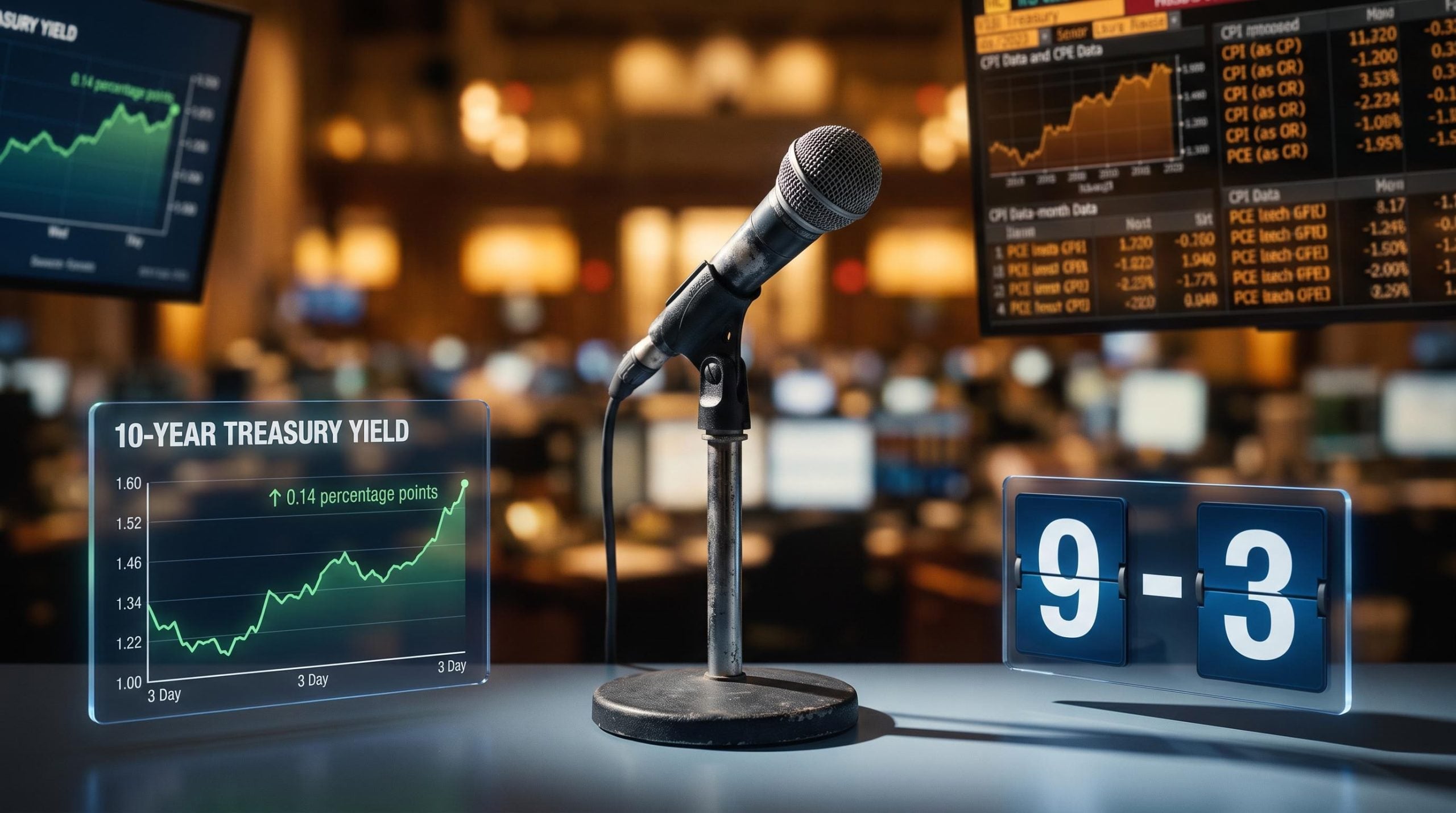
Here is what actually happened. The FOMC voted 9-3 on 28-29 July 2026 to hold the federal funds rate at 3.50%-3.75%. Warsh stripped forward guidance from the statement, declined to release the dot plot, and told reporters the statement would contain “only factual information, not forecasts.” Within days, commentators across CNBC, Forbes, and international outlets declared the move a credibility crisis. The 10-year Treasury yield moved 0.14 percentage points across a three-day window. Calling that a crisis misreads what bond markets were actually doing; it is adaptation, not alarm.
This piece gives you a grounded framework for judging whether the criticism of Warsh reflects legitimate institutional risk, or a press corps habituated to a guidance model that never delivered what it promised.
What Warsh actually said, and what he deliberately did not
The July 28-29 meeting produced a rate hold, a bare-bones statement, and no dot plot. The vote was 9-3, meaning three FOMC members dissented, but the majority endorsed the posture. Warsh’s press conference offered no hints about the next move, no conditional triggers, and no timeline for rate changes. What it did offer was a repeated, explicit commitment to the 2% inflation target and a pledge that the Fed “will not hesitate to act” to achieve price stability.
The distinction matters. Critics have treated the absence of rate-path signals as a silence on policy itself. It is not. Warsh has reduced one category of communication while reinforcing another:
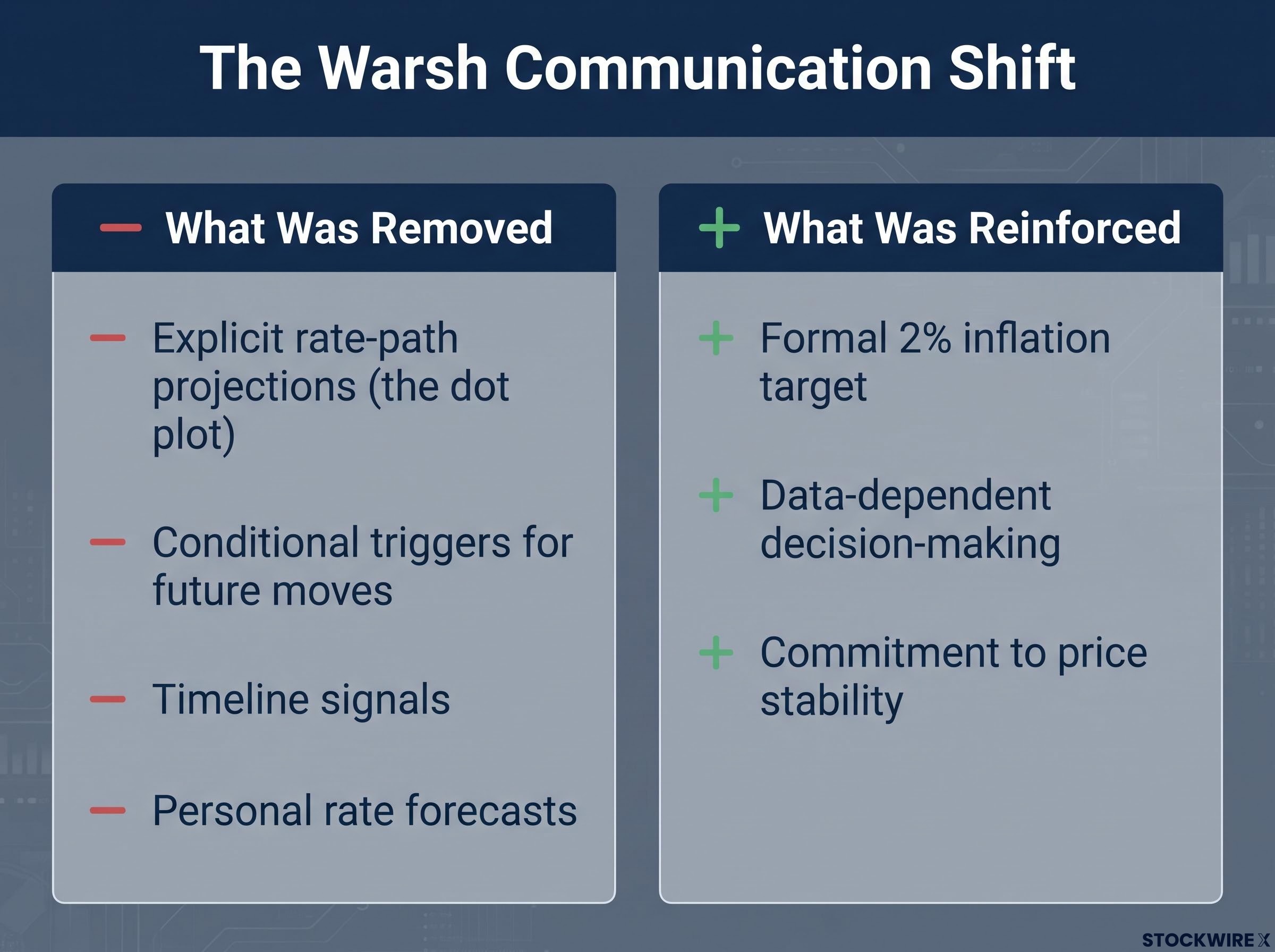
What Warsh removed:
- Explicit rate-path projections (the dot plot)
- Conditional triggers or thresholds for future moves
- Timeline signals for the next rate decision
- Personal rate forecasts from the chair
What Warsh reinforced:
- The formal 2% inflation target as the sole objective
- A data-dependent decision-making process
- The commitment to price stability as non-negotiable
- The Fed’s willingness to act decisively when data warrants it
A pattern established before July, not a one-meeting surprise
This posture did not materialise at the July press conference. At the ECB’s Sintra Forum earlier in 2026, Warsh told the audience directly: “I am not going to give forward guidance.” At his first FOMC meeting as chair, he stripped forward guidance from the statement and declined to submit a personal dot-plot projection. By July, the dot plot was not released at all. Warsh said he was “satisfied that markets did not rely on” it. This is a designed communication regime, not an improvisation.
The June FOMC statement, running just 130 words against Powell’s 300-340 word norm, was the first concrete demonstration of this regime: forward guidance removed entirely, Warsh’s own dot-plot projection withheld, and a unanimous 12-0 rate hold that made the communication overhaul the primary market event of the day.
What this tells you as an investor: Warsh has not gone silent. He has changed the signal. If you are still parsing Fed statements for rate-path clues, you are listening for a frequency he has deliberately switched off.
When big ASX news breaks, our subscribers know first
Two decades of broken promises: the guidance record the media ignores
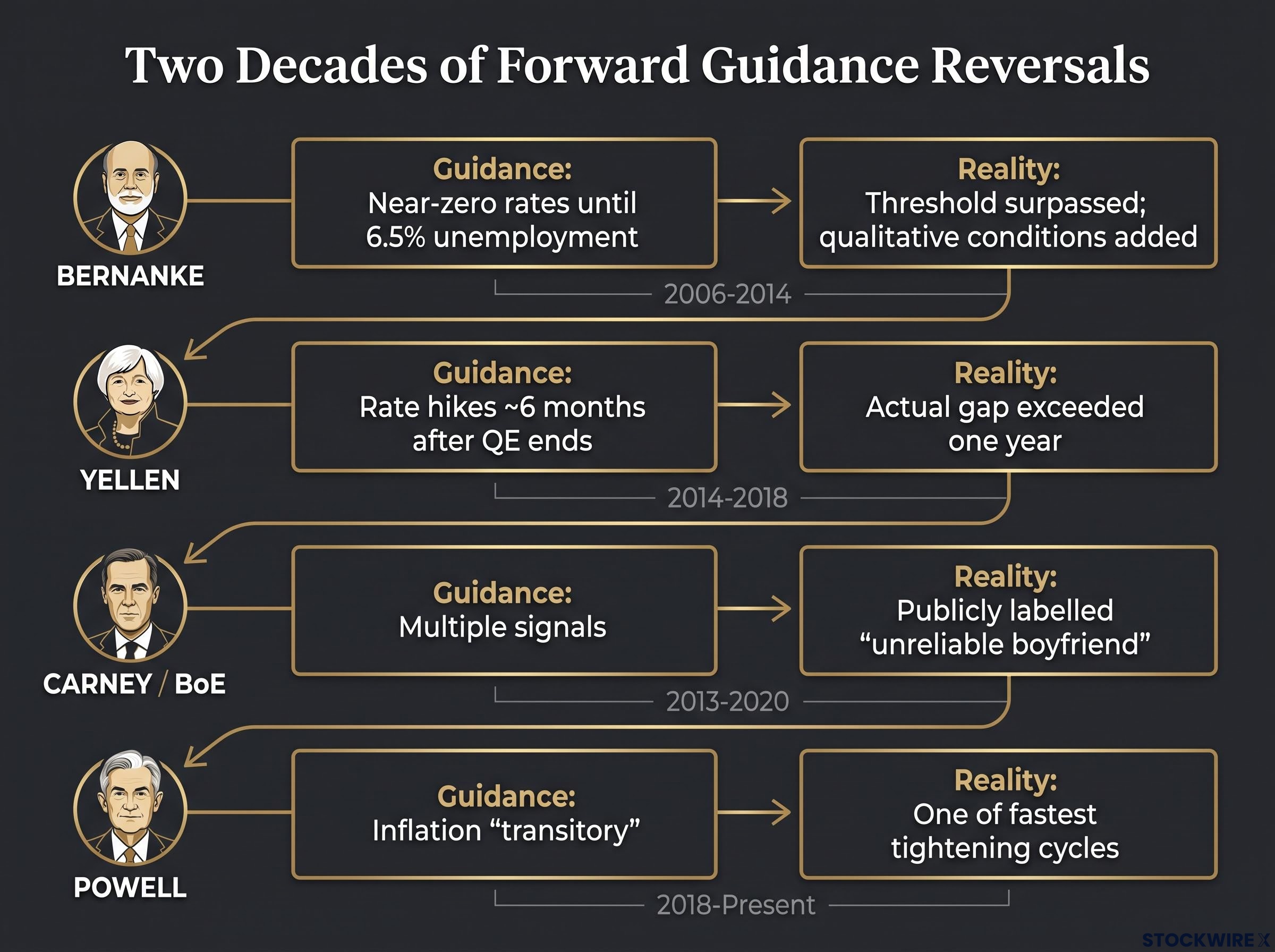
The criticism of Warsh assumes that forward guidance was working. The historical record suggests otherwise. Four consecutive chairs made explicit commitments about the future path of policy. Each time, reality forced a reversal.
The Fed forward guidance history documented across the Bernanke, Yellen, and Powell eras shows that statements grew from roughly 130 words in 2002 to nearly 900 words at their 2014 peak, tracking the balance sheet expansion that transformed an emergency tool into an institutional fixture.
Ben Bernanke pledged that the Fed would keep rates at near-zero levels until the unemployment rate fell to 6.5%. When the threshold approached, the Fed supplemented it with qualitative conditions that diluted the original commitment. The precise, numerical promise that was supposed to anchor expectations became a moving target.
Janet Yellen put forward guidance suggesting that rate increases would arrive roughly half a year after quantitative easing (QE, the Fed’s programme of large-scale bond purchases to stimulate the economy) concluded. The actual gap between the end of QE and the first rate hike exceeded one year, forcing significant market repricing by participants who had taken Yellen at her word.
Mark Carney at the Bank of England shifted his forward guidance positions so repeatedly that a sitting UK Parliament member publicly branded him an “unreliable boyfriend,” a phrase that stuck in markets as a byword for the credibility damage that inconsistent guidance can inflict.
Jerome Powell played down the prospect of rate rises in early 2022, framing the inflation of that period as a temporary phenomenon. He then executed one of the fastest tightening cycles in modern Fed history.
Powell’s “transitory” framing may be the most consequential guidance failure for current investors. The word became a commitment that shaped positioning across equity, bond, and currency markets. When it was abandoned, the repricing was violent and broad.
| Chair | Guidance given | What actually happened | Credibility cost |
|---|---|---|---|
| Bernanke | Near-zero rates until 6.5% unemployment | Threshold surpassed; qualitative conditions added | Numerical precision abandoned when tested |
| Yellen | Rate hikes ~6 months after QE ends | Actual gap exceeded one year | Significant market repricing required |
| BoE / Carney | Multiple forward guidance signals | Repeated inconsistencies with subsequent policy | Publicly labelled “unreliable boyfriend” by Parliament |
| Powell | Inflation “transitory”; rate hikes unlikely | One of fastest tightening cycles in modern history | Broad, violent repricing across asset classes |
Each reversal followed the same pattern: a specific commitment promised more precision than the underlying economic uncertainty could support. Warsh has called this pattern by name, arguing that forward guidance made the Fed “inflexible” and obscured the market signals policymakers needed to read. If you have ever repriced a portfolio around a Fed commitment that was later reversed, the historical record is not abstract. It is a direct argument for why a less committal Fed might carry lower tail risk, not higher.
Why forward guidance felt credible even when it was not
If guidance failed this consistently, why did it persist? The answer lies in the specific emergency that produced it. After the 2008 financial crisis, the Fed’s policy rate hit the zero lower bound, the point at which conventional rate cuts are no longer possible. With no room to cut further, forward guidance became the primary lever for influencing longer-term interest rate expectations. Telling markets explicitly that rates would stay low for years was designed to push down borrowing costs across the economy when the rate tool itself was exhausted.
Federal Reserve research on forward guidance origins confirms that the tool entered regular FOMC use specifically in 2008, when the federal funds rate hit its effective lower bound and conventional rate cuts were no longer available as a stimulus mechanism.
The logic was genuine and, in the immediate crisis context, defensible. When the Fed says what it plans to do, markets can price efficiently, reducing short-term volatility. Transparency felt like a permanent upgrade to monetary policy communication. The problem is that this emergency tool became a standing institution. Even as rates moved well above zero and the original justification evaporated, the expectation that the Fed would signal its next move persisted.
The Washington Post put it directly: “The Fed is staying quiet. And that’s a good thing.” The argument is that less pre-commitment can strengthen credibility by avoiding promises that prove impossible to keep.
There is a counter-model that worked for decades. Under Alan Greenspan, Fed statements were short, forward-looking language was limited, and markets inferred policy from economic conditions rather than explicit promises. As Fisher Investments has noted, Warsh’s approach mirrors that Greenspan-era communication style, not a novel error. That era was not characterised by persistent market dysfunction. What the media treats as the natural state of Fed communication is, in fact, a two-decade experiment shaped by a specific emergency, and the experiment’s track record includes the reversal pattern documented above.
What the market data actually shows after Warsh’s July press conference
The loudest alarm came from commentators. The market’s own verdict was quieter.
According to Finaeon, Inc. figures covering 28-31 July 2026 (as of 2 August 2026), the US 10-year Treasury yield climbed 0.14 percentage points across that period. That is a real move, but it is not the dislocation the media coverage implied. No coverage cited evidence of disorderly bond markets, breakdowns in policy transmission, or stress indicators flashing red.
JP Morgan analysts, quoted in Chosun Ilbo, called the statement “unexpected” and noted there was “no concrete explanation” of how price stability would be achieved. This framing captures the critic’s position: that clarity about objectives is insufficient without clarity about the path.
The gap between the media reaction and the market reaction is the most instructive data point of the entire episode. Here is where the specific claims fall against the evidence:
- Claim: Dropping guidance will create damaging uncertainty. Evidence: Yield movement of 0.14 percentage points over three days, with no bond-market dislocation reported. Gap: The uncertainty is real but contained, not destabilising.
- Claim: Markets will be left guessing until meeting days. Evidence: As Forbes noted, markets may speculate about Fed decisions “right up until the meeting days.” Gap: Harder forecasting for analysts is a cost, but it is not the same as impaired policy transmission to the real economy.
- Claim: Warsh’s credibility is in question. Evidence: A 9-3 vote to hold rates, a consistent 2% inflation target, repeated pledges to act decisively. Gap: Credibility on objectives is intact; what has been withdrawn is pre-commitment on timing.
A 0.14 percentage point yield move over three days, in the context of a major communication regime shift, tells you that markets are adapting to a new information environment, not pricing in institutional failure. If you followed the media coverage and expected a disruptive reaction, the data suggests recalibrating your sense of the noise-to-signal ratio in this commentary.
What the Warsh framework requires investors to do differently
The test of Warsh’s approach is straightforward: not how much he says, but whether his actual decisions remain internally consistent, data-responsive, and anchored to the 2% inflation target. His Congressional testimony and public remarks have reinforced this framework consistently, with no dovish pivot, no backtracking on price stability, and a repeated willingness to act.
Fisher Investments has argued that Warsh may rebuild Fed credibility precisely by avoiding the cycle of commitment and reversal that defined the last two decades. If that thesis holds, the practical shift for investors is significant. Under the prior regime, Fed statement language was a leading indicator. Under this one, it is not. The information set that matters has changed:
The strategic ambiguity regime that replaced explicit guidance has a direct market transmission consequence: every CPI print, PCE release, and jobs report now carries more pricing weight precisely because the Fed is no longer pre-interpreting data for investors, effectively converting the communications channel from a volatility dampener into a source of event risk.
- CPI and PCE inflation data: These are now the primary signal for the Fed’s next move, because Warsh has told you he will respond to the data, not telegraph his response in advance.
- Employment reports: Labour market conditions directly inform the Fed’s assessment of whether price stability is threatened, making jobs data more important relative to statement parsing.
- Actual rate decisions: What the FOMC does at each meeting becomes the signal, not what the chair says between meetings.
- Consistency between stated objectives and actions: The cumulative pattern of decisions, measured over quarters, is how Warsh’s credibility will be tested.
The risk scenario that would prove the critics right
The genuine risk is not ambiguous statements. It is decisions that appear arbitrary or politically driven. If rate moves begin to look disconnected from incoming data, or if the 2% target is quietly softened without acknowledgement, the reduced communication would amplify confusion rather than reduce it. That is the failure mode worth monitoring, not the absence of a dot plot.
Central bank independence is the structural backdrop against which every Warsh decision will be assessed: with Trump’s documented pressure campaign on Powell as a direct historical reference point, any rate move that appears to track political preferences rather than incoming data will be repriced across bond yields, the dollar, and equity valuations simultaneously.
The silence may age better than the promises did
Three threads converge. Warsh has built a communication framework centred on objective clarity without path signaling. The historical record shows that the alternative, explicit guidance about future rate paths, produced a pattern of commitment and reversal that damaged the very credibility it was designed to build. And the market data after the July press conference shows adaptation, not dislocation: a 0.14 percentage point move in the 10-year yield, not a crisis.
The 9-3 vote is worth noting. The communication shift is not universally embraced within the FOMC itself, and three dissents signal that the internal debate is live. The media’s concern is not without a kernel of legitimacy either: harder rate forecasting creates real costs for analysts and institutional planning, and those costs are not trivial even if they are not the same as institutional failure.
The variable that determines whether Warsh’s approach succeeds is consistency between stated objectives and actual decisions, measured over the next 12-18 months. If rate moves track the data and the 2% target holds as the anchor, Warsh will have demonstrated that the Fed can operate credibly with less verbal commitment. If they do not, the critics will have earned their alarm.
For now, the evidence supports a calibrated judgment. The media’s alarm is disproportionate to the market’s actual response. But the success of Warsh’s approach depends on execution consistency that can only be demonstrated through future decisions, not current statements. The silence is a bet. The historical record suggests it is a better bet than the promises were.
This article is for informational purposes only and should not be considered financial advice. Investors should conduct their own research and consult with financial professionals before making investment decisions.
These statements are speculative and subject to change based on market developments and Fed policy decisions. Past performance does not guarantee future results.