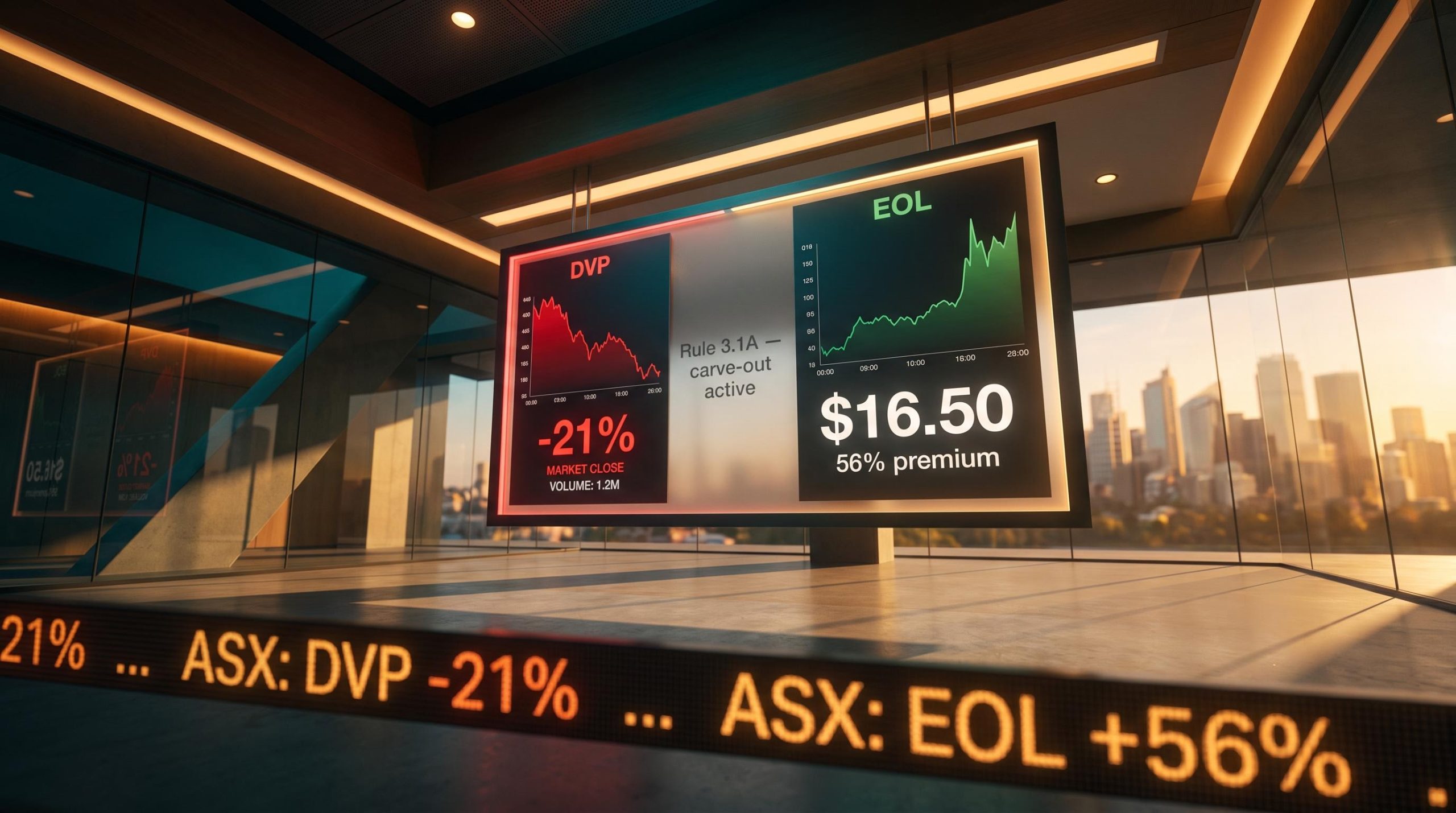
In the same week, Develop Global (ASX: DVP) dropped 21% across a two-hour window with no corresponding company announcement to account for the move. EnergyOne (ASX: EOL) sat quietly on an undisclosed takeover approach worth a 56% premium to a share price that retail investors were trading without knowing the bid existed.
Both episodes share the same structural feature: a gap between what ASX continuous disclosure rules require and what retail investors actually see in real time. That gap is not accidental. It is built into the framework, and understanding it requires understanding how the rules are constructed, not just whether they were followed.
Here is how the disclosure obligation actually works, where the legitimate carve-outs sit, and why the framework can leave you exposed even when no rule has been technically breached.
What the rules actually require: ASX Listing Rule 3.1 explained
The obligation is broader and more immediate than most investors realise. ASX Listing Rule 3.1 places an obligation on a listed entity to notify the exchange without delay upon becoming aware of information that a reasonable person would expect to materially affect the price or value of its securities. There is no internal approval step built into the trigger. The moment awareness exists, the clock starts.
“Immediately” does not mean instantaneously. ASX’s own guidance defines it as “promptly and without delay.” But there is no room for deliberate deferral while a board convenes, a lawyer reviews, or a management team decides how to position the announcement. The obligation activates at the point of awareness, not the point of internal comfort.
The materiality test itself has three components:
- The information would, or would be likely to, influence a reasonable investor’s decision to buy or sell the securities
- The information would be expected to have a material effect on the price or value of the securities
- Materiality is assessed against an objective reasonable person standard, not the company’s own subjective view
ASX’s abridged guide makes the scope explicit: the obligation covers information “from any source and of any character,” provided it meets the materiality threshold. That breadth matters. It means a company cannot argue that information received informally, or from an external party, falls outside the rule simply because it was not generated internally.
For you as an investor, one practical implication is worth noting: if a company knew something on Tuesday and announced on Friday, the question of when awareness arose is material in itself. “The board hadn’t formally considered it yet” is not a permitted reason for non-disclosure once the awareness trigger is met.
The Corporations Act dimension: why ASIC has standing to act
Section 674 of the Corporations Act mirrors the Listing Rule obligation, creating a separate statutory basis for civil penalty proceedings. This dual framework means a company can face both ASX compliance action under the Listing Rules and ASIC enforcement under the Act for the same disclosure failure. The statutory mirror is what gives ASIC its enforcement teeth; without it, continuous disclosure would depend entirely on ASX’s market-based compliance tools.
When big ASX news breaks, our subscribers know first
The carve-out that allows silence: how Rule 3.1A works
Rule 3.1A is not a loophole. It is a deliberate design choice, a conditional and temporary exemption from immediate disclosure. It exists because some categories of information, particularly incomplete proposals, would be distorted or destroyed by premature public release. But the exemption is narrow by intention, even if it does not always feel narrow in practice.
For the carve-out to apply, all three of the following must be satisfied simultaneously and continuously:
- One of five specified situations applies (see below)
- The information is confidential, and ASX has not formed the view that confidentiality has been lost
- A reasonable person would not expect the information to be disclosed in the circumstances
All three limbs must hold at the same time, and they must continue to hold. A carve-out that was valid on Monday can cease to apply on Wednesday if circumstances change. This is not a “set and forget” exemption.
The five specified situations under 3.1A.1 are:
- It would be a breach of law to disclose the information
- The information concerns an incomplete proposal or negotiation
- The information comprises matters of supposition or is insufficiently definite to warrant disclosure
- The information has been generated for internal management purposes
- The information is a trade secret
For takeover scenarios like the EnergyOne episode, the second category, “incomplete proposal or negotiation,” is the one that does the most work.
ASX guidance explicitly states that loss of confidentiality switches Rule 3.1A “off” and immediately revives the Rule 3.1 obligation.
That formulation matters. A media leak does not just make disclosure embarrassing; it makes it legally mandatory. Companies that treat confidentiality as something to be managed rather than something that objectively exists are taking a legal risk. And for you, this gives you a practical lens for interpreting trading halts: a halt triggered by a media report is often the moment the carve-out dissolved, not the moment the news was created.
EnergyOne and the 28-day gap: what the carve-out looks like under pressure
EOL was the subject of an acquisition approach on 6 July 2026, when it received an offer at $16.50 per share that was unsolicited, non-binding, and conditional in nature. It did not disclose the approach to the market. Under Rule 3.1A, it had grounds not to: the approach was incomplete, conditional, and confidential.
For 28 days, that carve-out held. Retail investors who bought or sold EOL shares during that period did so without knowing the approach existed. The share price reflected whatever the market could see. What it could not see was a bid sitting at a meaningful premium.
| Date | Event | Rule 3.1A Status | Retail Investor Position |
|---|---|---|---|
| 6 July 2026 | EOL receives $16.50 unsolicited, non-binding, conditional approach | Carve-out active (incomplete proposal, confidential) | Unaware of approach; trading on public information only |
| 6 July – c. 31 July 2026 | No public disclosure; approach remains confidential | Carve-out continues (all three limbs satisfied) | Trading without knowledge of a bid at a significant premium |
| c. 31 July 2026 | AFR reports a Norwegian acquirer has approached EOL at $17.00 per share (c. 56% premium) | Carve-out extinguished (confidentiality lost) | Information now public; trading halt imposed |
The timeline illustrates a specific feature of the framework. Retail investors holding EOL between 6 July and approximately 31 July were trading in a market where institutional players who had been approached, or who had access to rumour channels, may have known something they did not. No rule required that information to reach them during that period.
When the carve-out ends: the AFR report as a legal trigger
The Australian Financial Review’s report on the subsequent $17.00 per share approach by a Norwegian acquirer was not merely inconvenient for EnergyOne. It was the objective event that extinguished confidentiality under the third limb of Rule 3.1A. Once confidentiality is lost, the entity has no discretion. Disclosure is required immediately under Rule 3.1, and that is exactly what triggered the trading halt.
EnergyOne’s own published continuous disclosure policy expressly adopts ASX Listing Rule 3.1 as company policy. In this case, the internal policy and the external rule pointed in the same direction. The question was never whether the rule applied; it was whether the carve-out’s conditions still held.
Develop Global and the broker note blind spot
The DVP episode asks a different question entirely. On approximately 30 July 2026, DVP shares shed as much as 21% across two hours of trading, without any company announcement, regulatory filing, or material public news accompanying the decline.
The explanation, when it emerged, was a Bell Potter broker note in which the firm cut its price target by 9.7% to $6.50 per share. Institutional clients with access to that research received the information before the market opened. Retail investors without that access did not.
ASX issued a price and volume query after market close. By that point, the intraday damage had already been executed. DVP’s response to the query could point only to the broker note as a possible explanation.
Here is the structural point: Rule 3.1 covers information “concerning” the entity that the entity itself is aware of. It does not cover third-party analyst research that the company did not generate.
- What Rule 3.1 covers: information the entity is aware of and that concerns it, including internal developments, financial results, material contracts, and acquisition approaches
- What Rule 3.1 does not cover: third-party broker research, analyst downgrades, and institutional-only information circulation
For retail investors, the practical reality is stark: a stock can shed 21% across two hours of trading in a situation where no rule has been breached and no announcement was required of the company. The absence of a public announcement is not evidence that no information is being acted upon.
This is not a disclosure failure. It is a structural limit in what the rules require companies to disclose at all. The question it raises is not “has a rule been broken?” but “what information is circulating that you structurally cannot see?”
Who enforces what, and what that means in practice
Two bodies share responsibility for continuous disclosure, but their roles are distinct and their powers are different. Understanding the division helps you calibrate what to expect when something goes wrong.
| Dimension | ASX | ASIC |
|---|---|---|
| Legal basis | ASX Listing Rules (3.1, 3.1A, 3.1B) | Corporations Act s674 |
| Key tools | Price queries, direction to announce, suspension of quotation, direction to correct or retract | Civil penalty proceedings against companies and officers |
| Penalty powers | Market-based sanctions (suspension, de-listing); no criminal penalties | Civil penalties under the Corporations Act |
| Enforcement trigger | Reactive; typically responds to price movements or market inquiries | Threshold for litigation is relatively high; fact-intensive assessment |
| Limitations | Cannot impose criminal penalties; cannot act as plaintiff for investors; no obligation to act before a price move occurs | Finite capacity; not every arguable breach will be litigated |
ASIC’s enforcement record shows that carve-out analysis is genuinely contested in practice. ASIC v Nuix illustrates the kind of case where the regulator tested whether information properly fell within Rule 3.1A, challenging the boundary between legitimate use of the carve-out and a failure to disclose. The analytical structure in that case is directly relevant to takeover approach scenarios.
For you, the practical implication is straightforward: regulatory action is a possible but not guaranteed response to a disclosure failure. ASIC’s threshold for litigation is high, and many borderline cases are addressed through less visible channels, or not at all. Pricing in the assumption that the regulator will always act is not a reliable risk management strategy.
Five things retail investors should take from both episodes
- An unexplained price move is itself an information signal. When a stock drops sharply with no company announcement, the absence of an explanation tells you something: information you cannot see may be circulating among participants who can. The DVP episode is a direct illustration.
- The Rule 3.1A carve-out is real, but it is bounded. Companies are not indefinitely shielded from disclosure. The three-limb test must be satisfied continuously, and any event that breaks confidentiality, such as a media report, immediately revives the disclosure obligation. The EOL timeline shows this mechanism in action.
- Takeover contexts carry asymmetric information by design. Sophisticated participants often operate with richer information sets than retail investors, particularly around corporate transactions. A 28-day gap between a takeover approach and public disclosure is not unusual; it is the framework operating as intended.
- Trading halts are prospective tools, not retrospective ones. A halt stops trading from the point it is imposed forward. It does not unwind the trades that occurred while information was asymmetric. If a stock has already moved before the halt, the halt addresses future trading, not past damage.
- ASIC enforcement is a backstop, not an automatic corrective. Regulatory capacity is finite. Not every arguable breach of s674 or Rule 3.1 will be litigated. You cannot rely on enforcement action as a substitute for your own awareness of how the rules work and where they stop.
What both episodes signal about where the framework goes from here
DVP and EOL expose different edges of the same framework. One reveals a structural gap: third-party broker research can move a stock 21% in two hours, and no rule requires the company to disclose it. The other reveals the designed but consequential operation of the Rule 3.1A carve-out: a 56% premium bid can sit undisclosed for nearly a month while retail investors trade in the dark.
Neither episode, on the available evidence, necessarily involved a rule breach. That is precisely what makes reform harder to advocate on incident-specific grounds, and more pressing on structural ones. The unanswered question is whether the broker research asymmetry exposed by DVP is a policy gap worth addressing, or a structural feature of tiered market access that regulators have accepted.
The rules permit information gaps by design. Retail investors operate within those gaps whether or not they know it.
Understanding these limits is not a reason to avoid ASX-listed equities. It is a reason to price in the information asymmetry the framework openly acknowledges. The dual enforcement architecture of ASX and ASIC has finite capacity. EnergyOne’s own published disclosure policy layers internal commitment on top of the Listing Rules, but the carve-out operated regardless.
Investors who understand where the framework’s edges sit are better positioned to ask the right questions, set realistic expectations of enforcement, and make disclosure-aware portfolio decisions. The framework’s limits are known, debated, and partly intentional, which means your protection under it is partly a matter of personal knowledge and partly a matter of regulatory priority.
This article is for informational purposes only and should not be considered financial advice. Investors should conduct their own research and consult with financial professionals before making investment decisions.