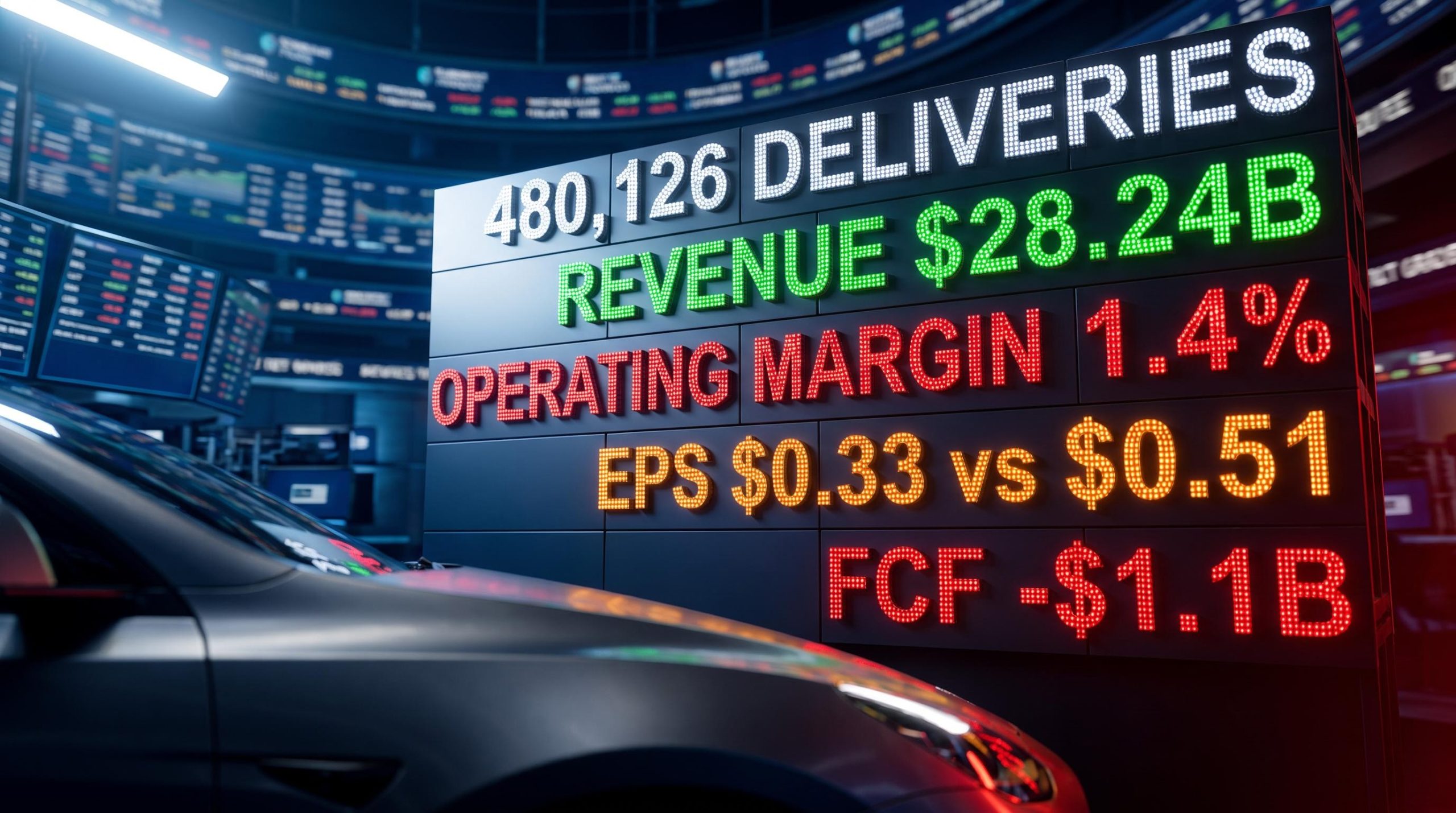
Tesla just posted its best Q2 delivery number in company history and its worst operating margin in years, all in the same quarter.
The contradiction is not a data error. It reflects a deliberate and costly strategic repositioning: Tesla is channelling record revenue into more than $25 billion of annual capital expenditure targeting AI, robotaxis, and humanoid robotics, compressing near-term profits in pursuit of a longer-term technology platform thesis.
For investors holding or watching TSLA on earnings day, the Q2 2026 results demand a clear-eyed read of what the numbers actually say. This piece separates the delivery headline from the profit reality, walks through what the $25 billion is actually being spent on, and identifies the specific milestones that will determine whether this bet pays off.
Tesla beat on deliveries and revenue, but the profit picture tells a different story
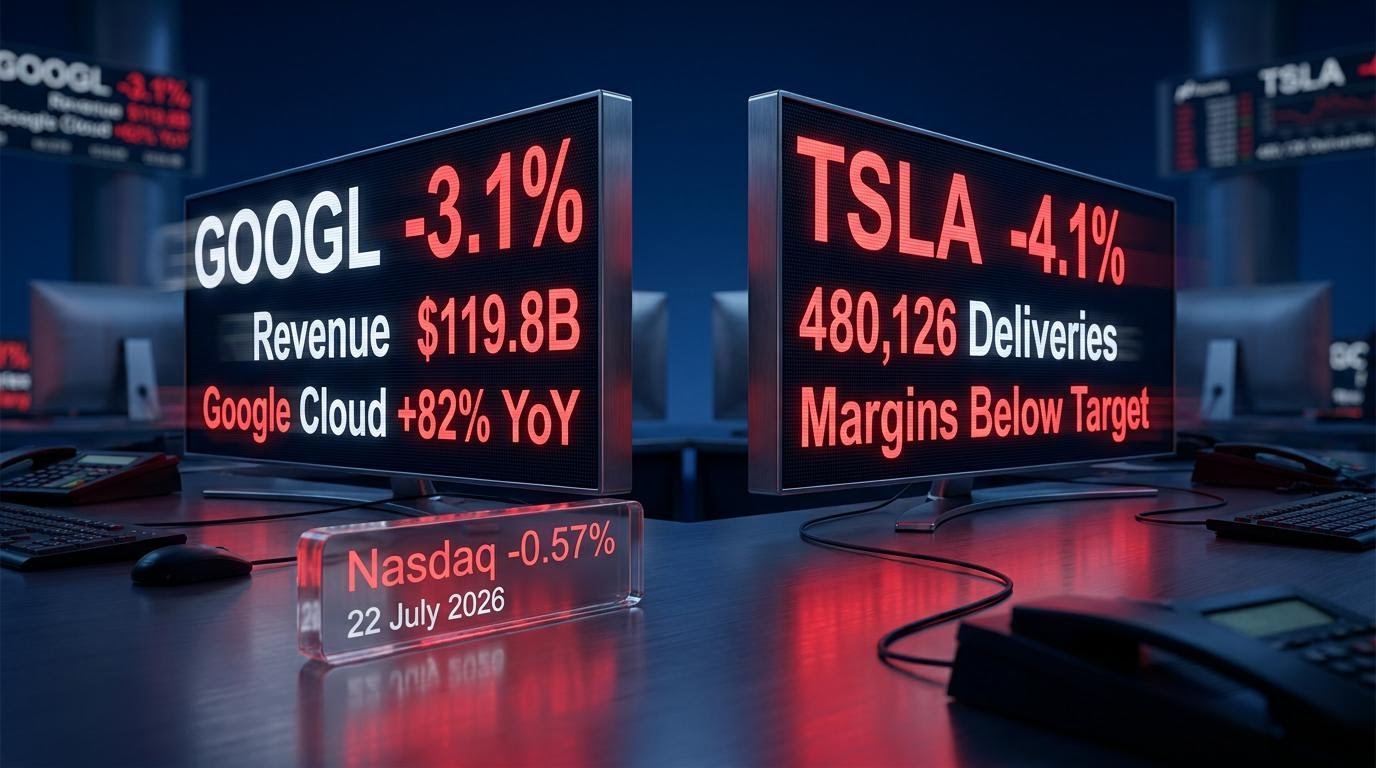
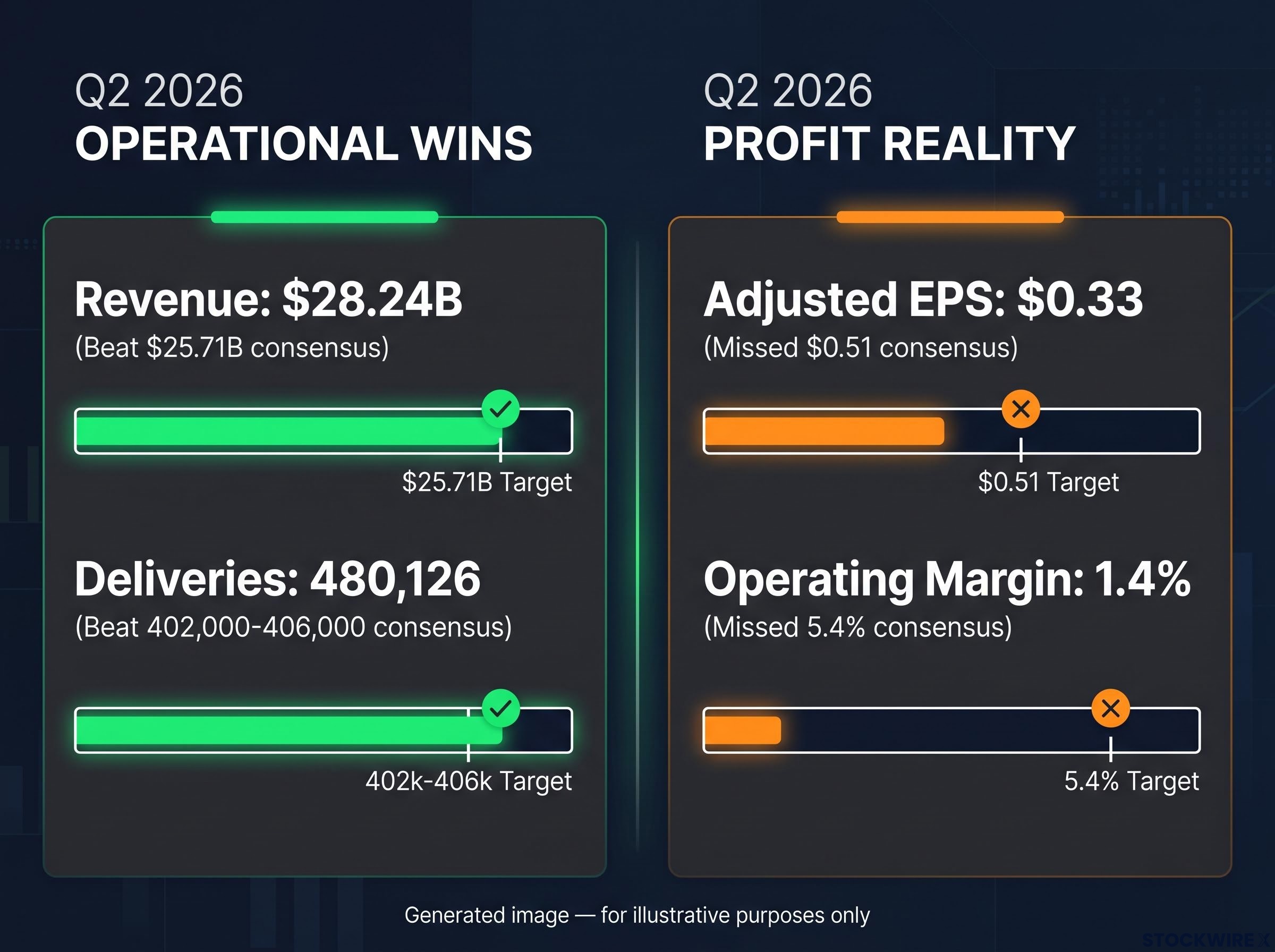
Start with what went right. Tesla delivered 480,126 vehicles in Q2 2026, smashing analyst expectations. Revenue hit $28.24 billion, up approximately 26% year-over-year and comfortably above the Wall Street consensus of $25.71 billion. On the top line, this was a genuine operational win.
Then came the earnings line. Adjusted EPS landed at $0.33, well below the analyst consensus of approximately $0.51. Operating income was just $398 million, producing an operating margin of 1.4%, a fraction of the 5.4% the Street had priced in.
The number that matters most: Adjusted EPS of $0.33 versus a consensus of $0.51. The gap is not noise. It reflects a cost structure fundamentally different from what the market expected.
| Metric | Analyst consensus | Actual result | Direction |
|---|---|---|---|
| Revenue | $25.71B | $28.24B | Beat |
| Adjusted EPS | $0.51 | $0.33 | Miss |
| Gross margin | ~19.5% | 16.8% | Miss |
| Operating margin | ~5.4% | 1.4% | Miss |
That margin gap tells you Tesla is running a fundamentally different cost structure than the Street priced in, and it will not close until the AI and autonomy investments start generating returns.
When big ASX news breaks, our subscribers know first
480,000 deliveries and what the rebound actually signals
The delivery number is legitimately impressive. 480,126 vehicles in a single quarter represents:
- Tesla’s best Q2 for deliveries in company history
- The sharpest year-on-year delivery growth recorded since Q3 2023
- A recovery following two successive quarters in which deliveries came in below analyst forecasts
- A beat of approximately 75,000-78,000 units above the analyst consensus of roughly 402,000-406,000 vehicles
Production came in at 451,758 vehicles, meaning deliveries exceeded production by over 28,000 units as Tesla drew down accumulated inventory. Energy storage deployments reached 13.5 GWh.
Energy storage revenue represents a third angle on Tesla’s platform thesis that neither the Q2 earnings beat nor the capex headlines fully capture; Tesla deployed 13.5 GWh in Q2, and Oppenheimer’s 2026 bull case assigns Megapack, growing 49% year-over-year in 2025, a more central role than FSD or Optimus in the near-term margin recovery.
Why more cars did not mean more profit per car
Volume strength did not translate into proportional profitability, and the explanation is structural. Over the past 18 months, Tesla has pursued aggressive price cuts and incentive programmes to defend market share against intensifying competition, particularly from Chinese EV manufacturers. More vehicles are selling, but at lower per-unit margins.
Chinese EV competition has been the primary pressure on Tesla’s per-unit margins over the past 18 months, but that competitive dynamic operates under a US regulatory structure that completely insulates the domestic market: a 100% tariff, a connected vehicle software ban, and a federal tax credit exclusion that block Chinese manufacturers regardless of price.
Regulatory credit revenue, which is income Tesla earns from selling emissions credits to other automakers, fell to approximately $146 million, down roughly 67% year-over-year. That ancillary revenue stream had previously provided meaningful margin support.
A 25% delivery surge with a 67% collapse in regulatory credit revenue in the same quarter tells you Tesla is selling far more cars but capturing less ancillary margin per vehicle sold. That combination explains the profitability paradox without invoking demand weakness.
What Tesla’s $25 billion capital expenditure commitment actually buys
CEO Elon Musk announced in April 2026 that Tesla would spend more than $25 billion in capital expenditure for the full year. Q2 confirmed the pace: approximately $5.8 billion in a single quarter, more than double recent prior quarters.
Where is the capital going? The stated investment priorities break into six categories:
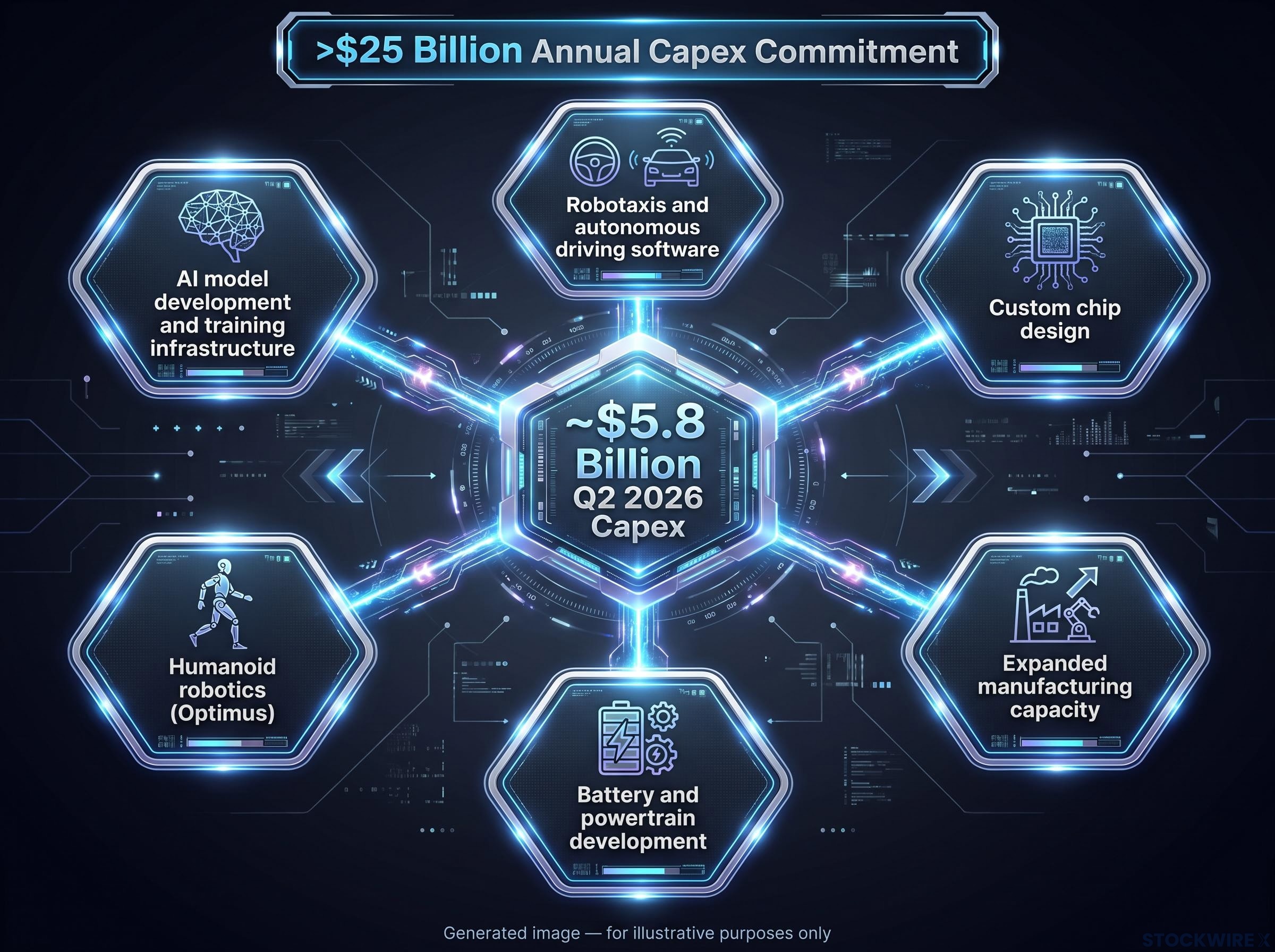
- AI model development and training infrastructure
- Robotaxis and autonomous driving software
- Custom chip design
- Humanoid robotics (Optimus)
- Battery and powertrain development
- Expanded manufacturing capacity
Cash flow signal: Free cash flow in Q2 was approximately -$1.1 billion, Tesla’s first negative FCF quarter since early 2024.
The identity shift is explicit. Tesla is investing as an AI and autonomy platform that also manufactures vehicles, not as an automaker investing selectively in adjacent technology. A quarterly capex run rate of $5.8 billion against operating income of $398 million means Tesla spent roughly 14 times its operating profit on investment in a single quarter. That gives you a concrete sense of how aggressively the company is front-loading this bet.
Why Tesla is spending like a tech company before it earns like one
Traditional automakers operate with high capital expenditure, but their returns come from volume-driven margins on physical vehicles. Technology platforms operate differently: they absorb heavy upfront investment, then generate scalable, high-margin revenue from software, services, and licensing once the platform reaches critical mass.
Tesla’s current capital profile matches the tech model. Its current revenue mix still resembles the automotive model. That mismatch is the source of valuation tension. Gross margin held at 16.8%, better than the feared collapse but well below where the company needs to be for tech-style returns. Management has signalled that negative free cash flow is expected for the remainder of 2026.
The Tesla valuation tension between an automotive revenue profile and a technology platform multiple did not originate in Q2; Q1 2026 produced a clean earnings beat on every consensus metric yet left the same structural question unanswered, because a high forward P/E prices future business lines that the income statement does not yet reflect.
The three conditions that determine whether the bet pays off
The $25 billion investment cycle validates only if three things happen:
- Robotaxis and Full Self-Driving must progress from pilots and optional add-ons into scaled commercial networks or licensing arrangements that generate dense, recurring revenue
- Optimus and industrial robotics must advance beyond development demonstrations into repeatable commercial deployments with disclosed unit economics
- Software and services revenue, including autonomy subscriptions and licensing, must scale against Tesla’s installed vehicle base to offset manufacturing-heavy economics
Tesla’s valuation only makes sense if the platform thesis is correct. That thesis requires visible revenue from robotaxis, Optimus, or software subscriptions within the next 12-24 months to remain credible. This is the framework for evaluating Tesla’s investment case going forward, which is how the company itself is asking to be assessed.
After-hours drop and what the market is actually pricing
TSLA fell 3.4% in after-hours trading following the earnings release. The decline was not a reaction to a delivery miss (there was none) or a revenue miss (there was none). It was a direct response to the profit miss and negative free cash flow.
Tesla carries a premium valuation consistent with a high-margin technology platform. Record deliveries and 26% revenue growth were not enough to offset the reality that adjusted EPS fell approximately 18% year-over-year while operating margin compressed to 1.4%.
The contradiction in one line: Revenue up 26% year-over-year. Adjusted EPS down approximately 18% year-over-year.
The 3.4% drop tells you that at Tesla’s current valuation, record deliveries are not justification for compressed margins and negative cash flow. The market is demanding evidence of the AI and autonomy payoff, not just evidence that the investment is underway.
What to watch over the next 12 to 24 months
The next 12-24 months represent the window during which Tesla’s strategic bet will either start producing visible financial returns or face mounting investor pressure to rebalance toward profitability. Five specific milestones will determine the outcome:
- Robotaxi programme progress: regulatory approvals, timeline disclosures, and commercial network unit economics
- Optimus deployment: the shift from trial-phase demonstrations to repeatable commercial deployments with disclosed economics
- Free cash flow trajectory: whether capex can moderate in 2027 without stalling AI and robotics development
- Software and services revenue growth: whether autonomy subscriptions and licensing are scaling against the installed vehicle base
- Full-year capex trajectory: whether the $25 billion+ commitment is maintained, accelerated, or moderated
Each of these is a data point you can track quarterly, giving you a structured way to assess whether the platform thesis is on track without waiting for the market to render a verdict first.
For investors wanting a structured framework to apply these milestones to an actual investment decision, our comprehensive walkthrough of scenario-based stock valuation uses Tesla’s forward P/E and capex cycle as a live case study in probability-weighted scenario construction.
A record quarter with an unresolved question at its centre
Q2 2026 delivered record deliveries, record Q2 revenue, the deepest operating margin compression in recent memory, and Tesla’s first negative free cash flow since early 2024. All in the same quarter.
The $25 billion capex commitment is either a disciplined investment in Tesla’s next identity or an unsustainable compression of near-term returns. Q2 alone cannot resolve that question. The evidence that settles it will arrive in the form of robotaxi revenue, Optimus deployments, and software margins, not in delivery counts.
The framework for tracking that evidence is now in front of you. The verdict is not.
This article is for informational purposes only and should not be considered financial advice. Investors should conduct their own research and consult with financial professionals before making investment decisions. Past performance does not guarantee future results. Financial projections are subject to market conditions and various risk factors.
—