
Janison wraps FY26 with four major programs delivered and AI platform live
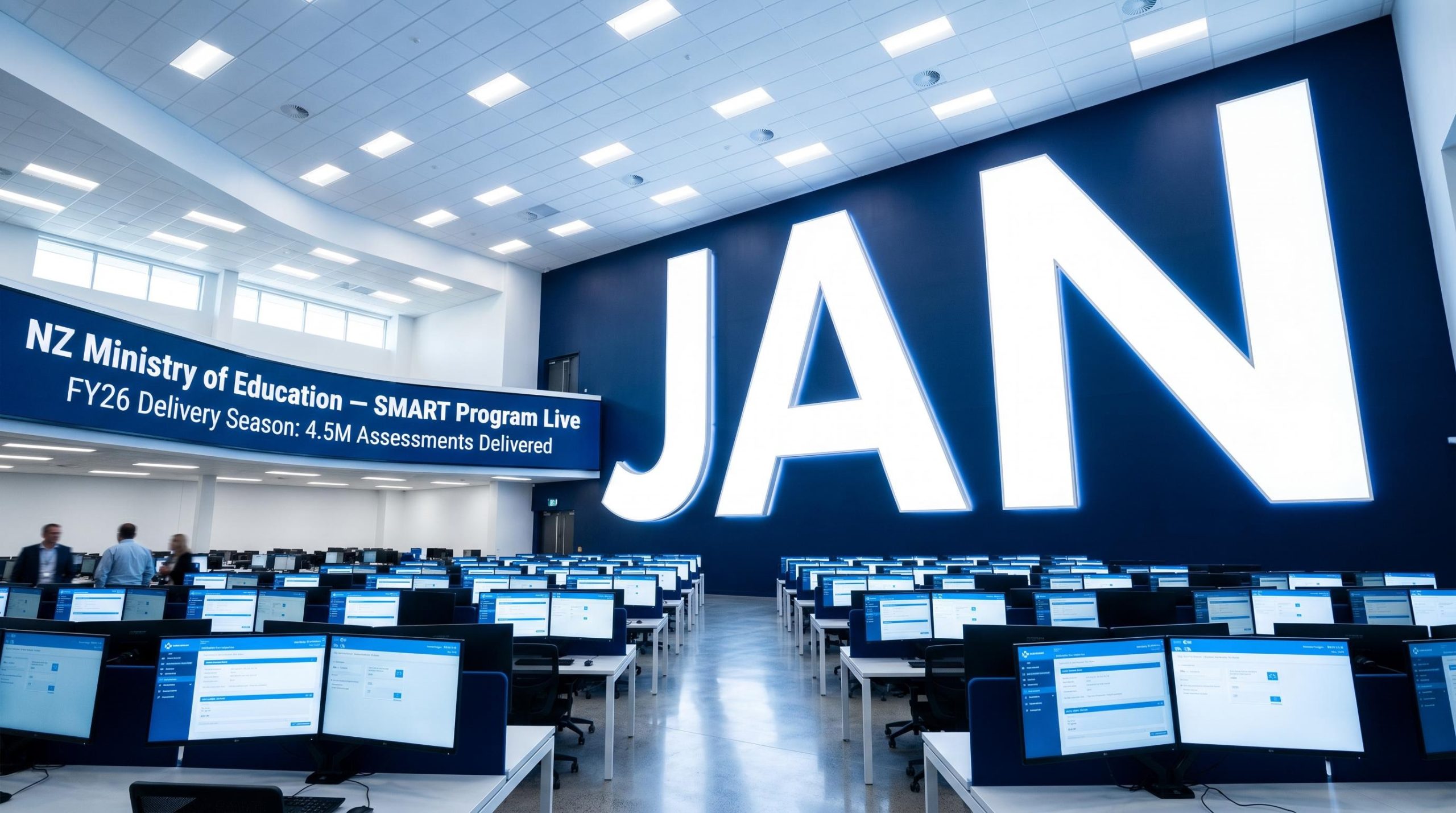
In its 2 June 2026 investor presentation, Janison Education Group Limited (ASX: JAN) confirmed the completion of its major FY26 assessment delivery season, spanning four large-scale programs across the same operational window: NAPLAN 2026, CA ANZ, NSW Department of Education Year 2, and the inaugural New Zealand Ministry of Education (NZ MoE) event.
Management framed FY26 as a deliberate investment year, with the period establishing the operational and contractual foundations for FY27 operating leverage. Two financial dynamics are central to understanding the year’s numbers: a ~$3M revenue reduction from the NSW DoE venue hire exit, partially offset by NZ MoE onboarding revenue.
When big ASX news breaks, our subscribers know first
Inside Janison’s FY26 delivery season — the scale behind the numbers
The presentation highlighted a set of delivery statistics that underscore the operational complexity Janison managed across FY26:
- NAPLAN 2026: approximately 4.5 million assessments delivered, across 9,368 schools, with approximately 256,000 peak concurrent students
- CA ANZ: approximately 17,000 candidates assessed in FY26, across 10 testing events under a 5-year partnership
- NSW DoE Year 2: 28,384 students assessed across SHS and OC tests, delivered across approximately 300 test venues
According to the presentation, three large-scale programs were delivered within the same operational period for the first time. The Day 1 NAPLAN disruption, which affected morning sessions, was resolved within approximately two hours, with subsequent testing proceeding without interruption. Management noted that NAPLAN 2027 planning is already underway, with a sharpened focus on risk management and continuous improvement.
NZ Ministry of Education: largest-ever international contract goes live
The NZ MoE milestone was presented as a standout strategic achievement for the period. Janison’s largest-ever international contract, a 5-year agreement with a total contract value of more than A$20M, saw its inaugural assessment event delivered within a compressed 6-month onboarding timeline.
The program, known as SMART (Student Monitoring, Assessment and Reporting Tool), covers bilingual assessment in English and te reo Māori for Years 3–10, delivered on a twice-yearly cadence across New Zealand schools. Hybrid delivery and integrated third-party AI marking were noted as active features supporting the program.
Management framed the successful onboarding as a demonstration of Janison’s capability to deliver at pace in complex environments, and as the foundation for a recurring, predictable revenue stream over the five-year contract term.
CEO Sujata Stead
“This period has demonstrated Janison’s capability in a market where very few providers can deliver high-stakes digital assessments at scale. Our team delivered multiple complex programs across the same operational period, drawing on our technology platform, customer partnerships and delivery experience. Where issues arose, they were resolved with partners, and learnings are being applied as we plan for FY27.”
What AI actually means for Janison’s platform today
The presentation outlined two reinforcing tracks that define Janison’s AI strategy: AI embedded in the product across the assessment value chain, and AI applied internally to support delivery quality and operational efficiency.
For investors less familiar with edtech AI applications, AI-assisted item development refers to tools that help assessment authors create, review, and refine test questions more efficiently, reducing the time and cost of content production without removing human oversight. “Humans in the loop” means that a qualified person reviews and approves AI outputs before they are used, which is considered the appropriate approach in high-stakes assessment contexts where errors carry real consequences for students.
The presentation mapped Janison’s AI capabilities across four stages:
| Status | Capability |
|---|---|
| In Production | AI-assisted item development (Jai) — live with customers, with continued investment to extend across more item types and subject areas |
| In Production | Operational and internal-productivity AI — applied to support, delivery quality and internal workflow, enabling parallel program delivery |
| Prototyping | Adaptive practice platforms and student-facing AI — practice-material generation and adaptive tools, opening new potential revenue streams |
| On Roadmap | AI marking (own capability) and insights AI — Janison developing its own AI-supported marking; insights AI to turn assessment data into targeted learning recommendations |
Notably, AI marking is already live in the NZ MoE SMART program via third-party integration, while Janison’s own AI marking capability remains in development.
CEO Sujata Stead
“For Janison, AI is applied thoughtfully and with humans in the loop, given the stakes involved, and is focused on solving real customer problems and improving efficiency. This is how we believe AI can help the Company scale safely and sustainably.”
FY26 financials and what FY27 looks like from here
The numbers investors need to understand
The presentation summarised FY26’s financial position across three observations:
-
Revenue: FY26 revenue reflects a ~$3M reduction from the NSW DoE, where Janison no longer provides venue hire services, partially offset by NZ MoE onboarding and continued delivery across other programs and customers. The full-year revenue outcome will be confirmed at FY26 results.
-
EBITDA: FY26 EBITDA reflects Year 1 NZ MoE onboarding mix, the NSW DoE venue hire exit, and investment in delivery capability. FY27 will carry some incremental costs from FY26 capability investments, but management notes these lay the foundation for operating leverage as clients move toward a more predictable, recurring revenue profile.
-
Cash: Closing cash is expected to remain in the ~A$10M range, supporting continued investment in the platform and AI capability.
The NSW DoE venue hire exit was presented as a strategic positive. By stepping back from venue hire services, Janison refocused on its core competencies of platform, invigilation, and test content, an outcome management described as fully aligned with the company’s strategic priorities.
Why FY27 is the leverage year
The presentation identified three FY27 priorities under the headings of Delivery, Platform, and Strategy. On delivery, FY27 builds on a proven capacity to run multiple large-scale programs in parallel. On platform, hybrid delivery, enhanced reporting, AI marking, and AI-assisted item development are all now in production, with the FY27 roadmap focused on scalability and global architecture. On strategy, the pipeline focus shifts toward converting momentum into repeatable, scalable contracts across APAC, UK, K-12, and Professional Accreditation markets.
The NZ MoE contract moving into steady-state delivery is a key driver of the recurring revenue thesis management outlined. Janison enters FY27 with capability, momentum, and a clear roadmap.
Don’t Miss the Next ASX EdTech Opportunity
Big News Blast delivers FREE breaking ASX announcements straight to your inbox within minutes of release, complete with in-depth analysis already done. Join 20,000+ subscribers staying ahead of market-moving news across Tech, Healthcare, and beyond. Click the “Free Alerts” button at Big News Blast to start receiving alerts the moment news breaks.