

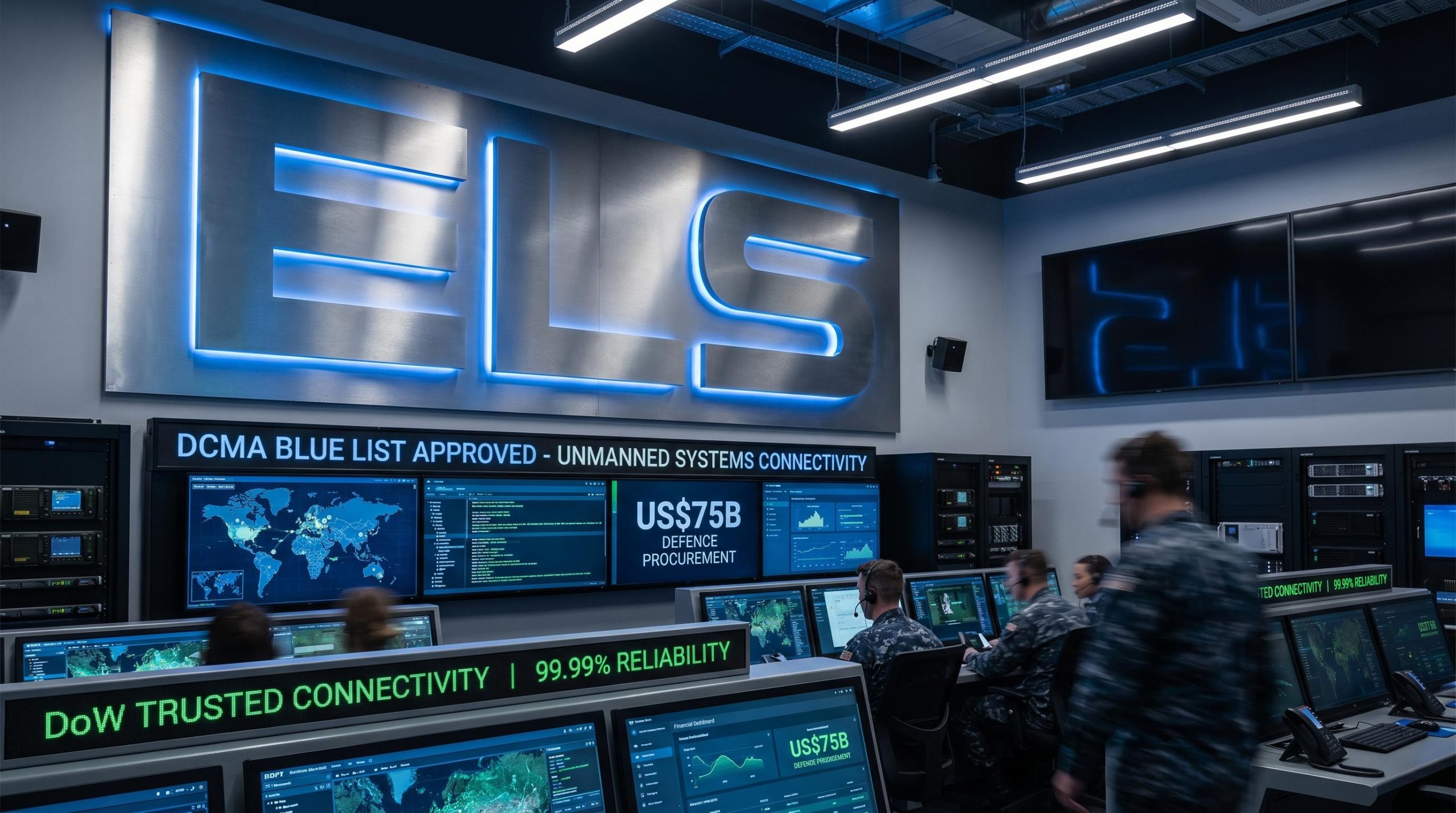
Elsight Halo secures US Blue List approval for accelerated military procurement
Elsight Limited has secured inclusion on the US Department of War’s Defense Contract Management Agency (DCMA) Blue List, positioning its Halo connectivity platform for rapid procurement across American military drone programmes. The approval arrives as the US defence sector enters its largest-ever drone spending cycle, with the FY2027 budget allocating approximately US$75 billion (A$105 billion) to drone and counter-drone capabilities, representing a tripling of expenditure relative to FY2026 levels.
The Blue List functions as the DoW’s directory of National Defense Authorization Act (NDAA)-compliant unmanned systems approved for rapid acquisition. Halo’s designation confirms the platform meets stringent operational reliability, cybersecurity, data integrity, and supply chain requirements imposed by defence procurement authorities.
For military buyers, Blue List inclusion removes traditional procurement friction. Units can now acquire Halo-equipped systems directly through the DCMA marketplace, bypassing multi-year acquisition cycles that typically govern defence contracts.
The approval carries immediate strategic weight. ASX: ELS has secured market access at the precise moment when Pentagon spending on autonomous systems is scaling to unprecedented levels, creating a direct sales channel into rapidly expanding military drone programmes.
When big ASX news breaks, our subscribers know first
What is the DCMA Blue List and why does it matter?
The DCMA Blue List operates as a centralised marketplace managed by the Defense Contract Management Agency under its US-X programme. The framework evolved from the earlier Blue UAS Cleared List developed by the Defense Innovation Unit, designed to create a trusted pipeline of compliant unmanned systems and components.
The programme’s core purpose centres on reducing acquisition friction for military units. By maintaining a pre-vetted directory of approved technologies, the Blue List compresses contracting timelines and ensures warfighters gain rapid access to battlefield-ready systems without navigating traditional procurement bureaucracy.
NDAA compliance requirements embedded in the Blue List framework exclude Chinese-manufactured platforms and components from consideration. This restriction concentrates demand among approved providers, creating a narrower competitive field for systems that pass certification thresholds.
Halo’s addition to the Blue List places Elsight among select vendors holding this authorisation. The designation functions as both technical validation and commercial enabler, signalling to procurement officers that the platform has cleared the DoW’s rigorous standards for operational deployment.
For investors assessing market access, the distinction matters because traditional government procurement cycles extend across multiple years and involve extensive compliance review. Blue List inclusion allows military units to procure directly, transforming a lengthy qualification process into immediate purchasing authority.
US defence drone spending enters historic expansion
The FY2027 budget request announced on 21 April 2026 outlines the largest proposed defence allocation in over a generation, with the total Department of War budget reaching approximately US$1.5 trillion, a 42% increase over current levels. Within this request, spending on drone and counter-drone capabilities represents one of the most dramatic funding accelerations.
| Metric | FY2026 | FY2027 Request | Change |
|---|---|---|---|
| Total DoW Budget | ~US$1.06 trillion | ~US$1.5 trillion | +42% |
| Drone/Counter-Drone | ~US$25 billion | ~US$75 billion | 3x increase |
| DAWG Allocation | US$225.9 million | ~US$54.6 billion | ~240x increase |
| Target Autonomous Systems | — | 200,000+ by 2027 | Pentagon target |
The single largest year-over-year increase within the request is the approximately US$54.6 billion allocation for the Defense Autonomous Warfare Group (DAWG), a consolidated funding mechanism for autonomous systems procurement operating under US Special Operations Command. This represents a 240-fold increase from the FY2026 baseline of US$225.9 million.
Separately, the Pentagon has stated a target of procuring over 200,000 autonomous systems by 2027 under its broader Drone Dominance agenda, reflecting a structural shift in how uncrewed platforms are being integrated across all branches of the armed services.
This is not incremental budget growth. The scale of spending increase signals a strategic pivot toward autonomous warfare capabilities, with funding concentrated on systems that can be fielded rapidly and at volume.
CEO commentary on timing and market positioning
Yoav Amitai, Elsight CEO
“Halo’s inclusion on the Blue List arrives at a moment when U.S. defence drone procurement is scaling at an unprecedented pace. With approximately US$75 billion (A$105 billion) proposed for drone and counter-drone capabilities in FY2027 alone, the pathway from Blue List approval to operational deployment has never been shorter or more clearly defined. This milestone validates Halo as a trusted backbone for the next generation of U.S. defence programs.”
The convergence of approval timing with unprecedented procurement scale creates a compressed timeline from certification to operational deployment. Where traditional defence procurement cycles stretch across years, the current environment favours platforms already holding Blue List designation when acquisition budgets are released.
What Halo delivers and why defence programmes need it
Halo operates as a multi-link bonding platform that provides carrier-agnostic connectivity for drones and unmanned systems. The core technology aggregates cellular, satellite, and RF communications into a unified link, delivering resilient connectivity across diverse operational environments.
The platform’s technical specifications address the reliability and security requirements imposed by defence procurement standards:
- 99.99% reliability with cyber-secured connectivity
- Aggregates cellular + satellite + RF communications
- Form factors: sub-100g card or boxed ground version
- Serves stationary, portable, or actively mobile requirements
As defence drone programmes scale from pilot phases to fleet-level deployments, the requirement for secure, resilient, and scalable connectivity grows proportionally. Halo addresses a critical infrastructure need rather than a discretionary feature, functioning as the communication backbone that enables persistent command and control across distributed autonomous systems.
The form factor options allow deployment across varied platforms. The sub-100g card version supports weight-sensitive aerial drones, whilst the boxed ground version accommodates stationary or vehicle-mounted operations. This flexibility positions Halo for integration across the spectrum of unmanned systems the Pentagon intends to procure.
Strategic outlook and deployment expectations
Elsight expects to see increased demand and accelerated deployment velocity for Halo-equipped systems across US armed services following the Blue List designation. The approval creates a direct procurement pathway that bypasses traditional acquisition timelines, allowing military units to select connectivity solutions from a pre-vetted directory of compliant technologies.
The addressable market extends beyond US armed services to allied defence partners operating under similar NDAA compliance frameworks. Chinese-manufactured platforms are excluded under the American Security Drone Act and NDAA provisions, concentrating procurement among approved Western providers.
Blue List approval functions as a market access milestone rather than a revenue guarantee. The commercial impact depends on conversion to procurement orders, but the designation removes a significant barrier to participation in the largest defence drone spending cycle in US history.
Elsight is positioned to participate in what is expected to be a sustained, multi-year acceleration in US defence drone procurement, with the FY2027 budget request signalling structural rather than cyclical spending growth. As programmes expand from pilot phases to fleet-level deployments, the requirement for connectivity infrastructure that meets operational reliability and cybersecurity standards scales in proportion.
Want the Next Defence Tech Winner in Your Inbox?
Join 20,000+ investors receiving FREE breaking ASX news within minutes of release, complete with in-depth analysis. Click the “Free Alerts” button at Big News Blast to get alerts the moment market-moving announcements hit—before the broader market reacts.