
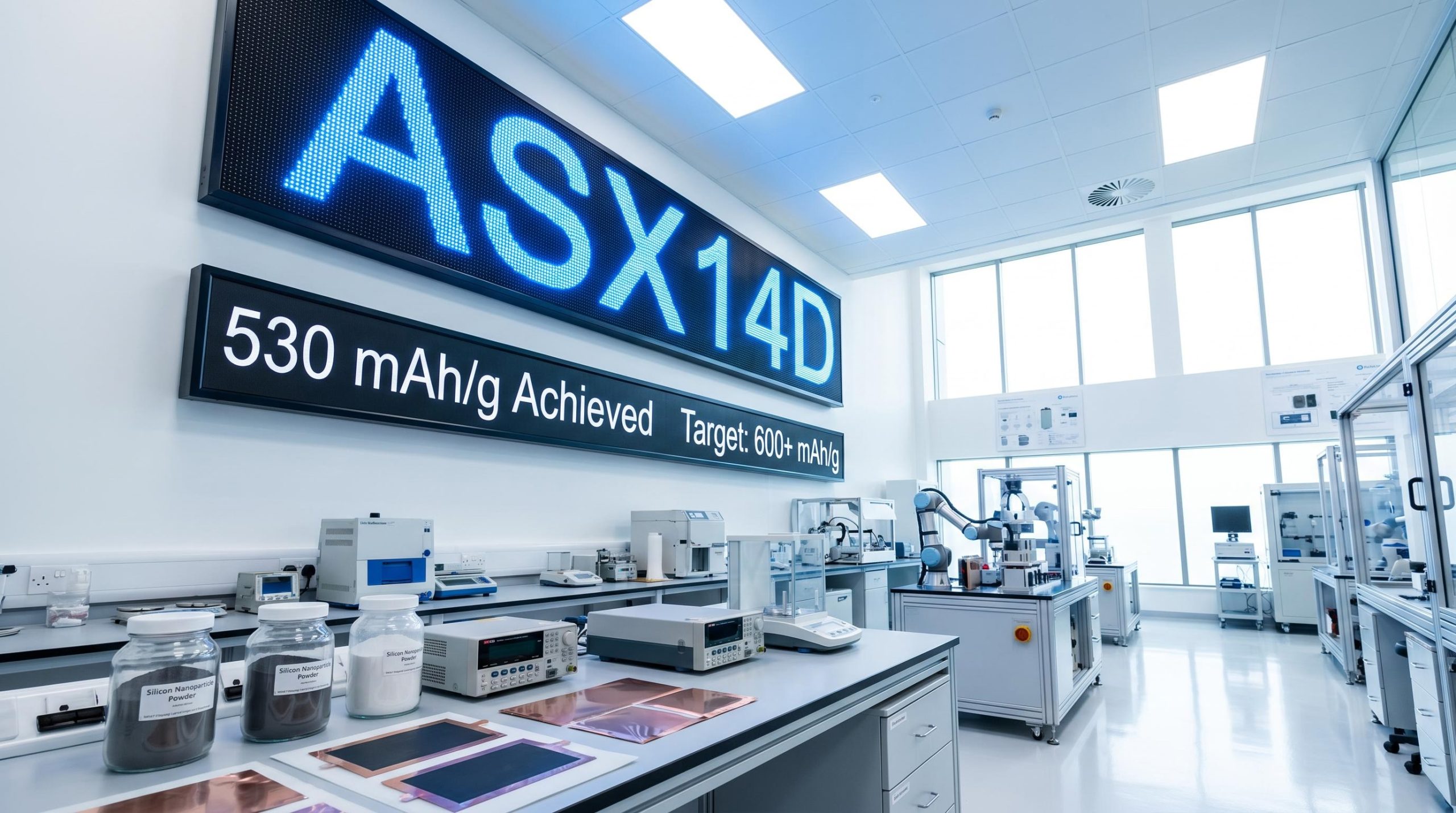
1414 Degrees targets drone battery market with SiNTL silicon anode technology
1414 Degrees (ASX: 14D) is preparing to engage the drone and unmanned aerial vehicle (UAV) battery supply chain as the first commercial target for its SiNTL silicon nanoparticle anode technology. The silicon-enhanced anode is designed as a drop-in upgrade to traditional graphite-based lithium-ion batteries, with the Company reporting specific capacity of 530 mAh/g in test cells to date and targeting 600 mAh/g and beyond. Traditional graphite anodes typically deliver approximately 350 mAh/g, whilst theoretical silicon capacity is 10 times that of graphite. The global commercial and military drone market is forecast to reach approximately US$160 billion by 2030, driven by geopolitical tensions, defence sector focus, and commercial logistics expansion.
The move represents a shift toward a defined commercial pathway for the Company’s battery materials platform. By targeting the drone sector, where energy density requirements are high but cycle life thresholds are lower than electric vehicle applications, 14D is positioning SiNTL for near-term market entry whilst continuing development toward the larger EV opportunity.
When big ASX news breaks, our subscribers know first
What is SiNTL and why does it matter for battery performance?
Battery anodes function as the storage component that accepts lithium ions during charging. Traditional graphite anodes have limited energy capacity, constraining how long a battery can operate before requiring recharge. Silicon offers significantly higher theoretical capacity but has historically faced stability issues due to volume expansion during charging cycles, which degrades performance over time.
SiNTL addresses this technical challenge through an aluminium coating applied to silicon nanoparticles, which mitigates volume expansion and maintains cycle stability. The technology is designed for compatibility with existing battery manufacturing processes, allowing integration without costly equipment changes or production line retooling.
SiNTL’s core advantages over graphite anodes:
- Improved energy capacity, delivering superior battery life
- Faster charging capability
- Maintained cycle stability through volume expansion mitigation
The manufacturing compatibility angle reduces barriers to adoption. Battery manufacturers can integrate SiNTL without the capital expenditure typically required for high-silicon anode technologies that rely on complex nanostructures. The Company has demonstrated successful coating of SiNTL anode material onto copper foil using conventional slurry-based processing methods, confirming compatibility with standard lithium-ion battery manufacturing.
Why drones and UAVs are the first target market
Drones represent an attractive entry market because they prioritise energy density whilst having lower cycle life requirements than electric vehicles. For drone operators, the practical benefits include extended range, increased payload capacity, and shortened charging times. EV applications demand higher cycle life thresholds, which the Company continues to develop toward.
The drone market offers strong commercial fundamentals. Forecast growth to approximately US$160 billion by 2030 is underpinned by ongoing geopolitical tensions, rising defence sector focus, and increasing uptake in the commercial logistics and delivery sector.
Benefits SiNTL offers drone operators:
- Extended drone range through improved energy capacity
- Increased payload capacity due to higher energy density per unit weight
- Shortened charging times from faster charging capability
By targeting a market with lower technical thresholds initially, the Company can potentially generate early commercial traction whilst continuing development toward the larger EV opportunity. The drone sector entry strategy balances near-term revenue potential with longer-term technology development requirements.
Manufacturing pathway designed for scale
The SiNTL production process deliberately uses utility-grade materials and simpler processes than competing high-silicon anode technologies. This approach differentiates SiNTL from costly alternatives that require complex manufacturing pathways. Focus is shifting from pure materials development to process optimisation and defining a scalable manufacturing pathway, including considerations such as precursor utilisation and material recovery.
Peter Yaron, Chief Technology and Operations Officer
“A key advantage is that SiNTL is designed to integrate with existing battery manufacturing processes, rather than requiring a complete redesign of the anode. This matters to manufacturers who need to move quickly. We’re now moving beyond pure materials development and into the next phase of aligning our experimental program with real-world applications and defining what a scalable production process looks like.”
Investment thesis — where SiNTL fits in 14D’s broader strategy
SiNTL represents one platform within 1414 Degrees’ integrated clean energy and industrial decarbonisation strategy. The Company’s approach centres on silicon-based materials engineering applied across multiple sectors, with SiNTL adding optionality to the portfolio through potential growth in the battery materials space.
The technology platform is unified by a single materials approach, leveraging silicon to store, convert and enhance energy across grid-scale storage, industrial heat, hydrogen production, and battery applications. SiNTL operates alongside the Company’s near-term infrastructure revenue from the Aurora Energy Precinct Battery Energy Storage System (BESS) project, which provides revenue visibility whilst technology commercialisation pathways develop.
| Platform | Function | Status |
|---|---|---|
| SiBrick | Silicon-based thermal storage media | Foundation technology |
| SiBox | Long-duration energy storage for industrial heat | Development stage |
| SiPHyR | Methane pyrolysis for hydrogen production | Development stage |
| SiNTL | Silicon-enhanced battery anode | Engaging supply chain |
The Company’s strategy combines near-term infrastructure revenue with scalable technology commercialisation. SiNTL represents a technology commercialisation pathway that could deliver growth catalysts in the battery materials sector whilst the core energy infrastructure business provides baseline revenue. The drone and UAV sector engagement marks the first step in commercial pathway development, with ongoing work toward higher cycle life thresholds required for electric vehicle applications continuing in parallel.
Want the Next Battery Tech Breakthrough in Your Inbox?
Join 20,000+ investors getting FREE breaking ASX news delivered within minutes of release, complete with in-depth analysis. Click the “Free Alerts” button at StockWire X to start receiving alerts the moment market-moving technology and industrial news breaks.