
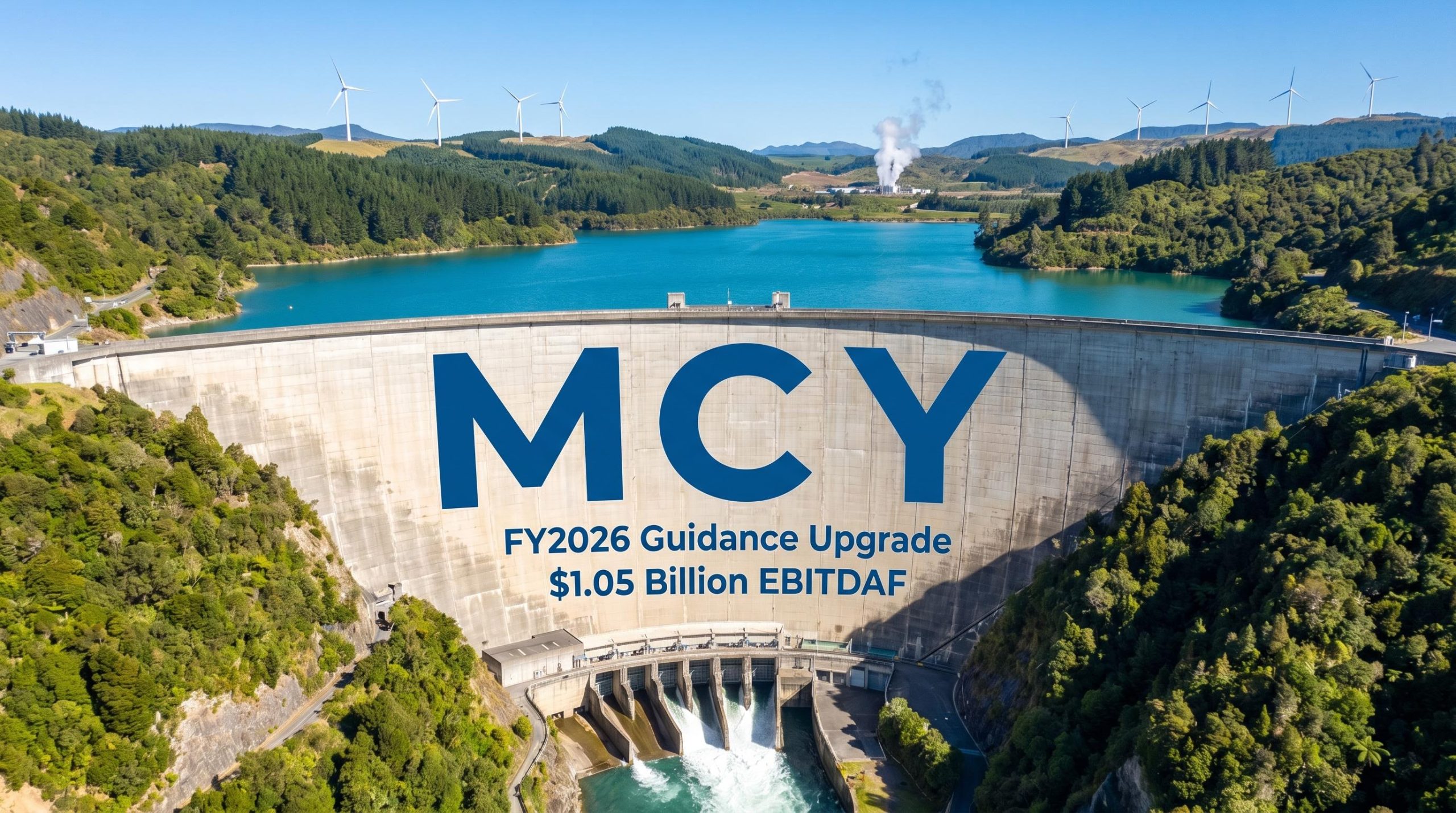
Mercury NZ has upgraded its FY2026 earnings guidance to $1.05 billion, representing a $50 million increase from the previous forecast of $1.0 billion. The 5% uplift reflects disciplined portfolio management and higher forecast renewable generation from hydro and new generation capacity, announced on 22 April 2026.
Mercury upgrades FY2026 earnings guidance to $1.05 billion
The upgraded EBITDAF guidance of $1.05 billion marks a significant increase from the company’s original $1.0 billion forecast, representing a $50 million or 5% improvement. Management attributed the upgrade to two key operational drivers: disciplined portfolio management across its generation and retail business, and higher forecast renewable generation from both hydro assets and recently commissioned generation capacity.
The guidance upgrade demonstrates operational performance exceeding original expectations. While Mercury noted the forecast remains subject to standard caveats including material events and changes to hydrological conditions, the mid-year revision signals management confidence in the earnings trajectory for the full financial year.
When big ASX news breaks, our subscribers know first
What is EBITDAF and why it matters for utility investors
EBITDAF measures Earnings Before Interest, Tax, Depreciation, Amortisation, and Fair value movements. Utilities use this metric because it removes non-cash accounting items and fair value volatility, isolating the underlying operational cash generation capacity of the business. For a capital-intensive renewable generator like Mercury, EBITDAF reflects the cash-generating power of hydro, geothermal and wind assets before financing costs and accounting adjustments are applied.
Drivers behind the guidance upgrade
Mercury identified two primary factors supporting the upgraded forecast:
- Disciplined portfolio management — operational efficiency and optimisation of the balance between generation output and retail customer demand
- Higher forecast renewable generation — hydro assets and new generation capacity contributing above original expectations
The company’s 100% renewable generation profile spans three sources: hydro, geothermal and wind. The reference to “new generation” indicates recently commissioned renewable assets are performing ahead of initial forecasts, though the announcement did not specify individual projects.
Guidance upgrades driven by core operational factors rather than one-off accounting adjustments suggest the earnings improvement reflects sustainable operational performance rather than temporary market conditions.
Mercury’s renewable energy profile
Mercury operates 100% renewable generation assets across hydro, geothermal and wind sources. Beyond electricity generation, the company retails electricity, gas, broadband and mobile services to customers across New Zealand. The company maintains dual listings on the NZX and ASX under ticker MCY, with foreign exempt listed status on the Australian exchange. The New Zealand Government holds a legislated minimum 51% shareholding in Mercury.
| Metric | Detail |
|---|---|
| FY2026 EBITDAF Guidance | $1.05 billion |
| Previous Guidance | $1.0 billion |
| Upgrade Amount | $50 million (5%) |
| Generation Sources | Hydro, Geothermal, Wind |
| Government Ownership | Minimum 51% |
Investment outlook and what to watch
The guidance upgrade positions FY2026 earnings on a stronger trajectory than initially forecast. Mercury’s forecast remains subject to hydrological conditions—a standard caveat for hydro-dependent generators where water inflows directly impact generation capacity. The company’s majority government ownership provides defensive portfolio characteristics, though this structure also constrains potential merger and acquisition activity.
Three factors warrant investor attention:
- EBITDAF upgrade driven by operational factors, not one-offs
- Renewable-only generation profile aligns with decarbonisation trends
- Government majority stake provides stability but limits M&A optionality
The operational nature of the upgrade—higher generation output and portfolio optimisation—suggests the earnings improvement reflects core business performance rather than temporary market dynamics.
Get Utilities News Before the Market Reacts
Join 20,000+ investors receiving FREE breaking ASX utilities news delivered within minutes of release, complete with in-depth analysis. Click the “Free Alerts” button at Big News Blast to start getting real-time alerts on Mercury and other utilities stocks the moment market-moving announcements drop.