How $4B in Fuel Costs Erased American Airlines’ Record Q1
18 mins ago


Amazon announced a $5 billion immediate investment in Anthropic on 20 April 2026, bringing its total committed capital to $13 billion when combined with a prior $8 billion stake. The partnership includes potential for up to $20 billion more tied to performance milestones, plus Anthropic’s reciprocal commitment to spend over $100 billion on AWS infrastructure over the next decade. Amazon’s shares rose 2.3% in after-hours trading as investors absorbed the scale of the deal.
The announcement positions Amazon’s custom AI silicon strategy, centred on its Trainium chips, as a direct competitive response to Microsoft’s GPU-reliant Azure OpenAI alliance. Anthropic’s commitment to use Trainium processors for training and inference workloads for up to a decade locks in frontier AI compute on Amazon’s proprietary hardware, testing the thesis that custom silicon can compete with Nvidia GPUs at lower cost. This analysis unpacks what the deal’s three-tier structure reveals about risk management, why the Trainium hardware commitments matter more than the headline dollar figures, and what investors should watch as the partnership unfolds.
The partnership is structured in three tiers, each managing a different exposure profile for Amazon.
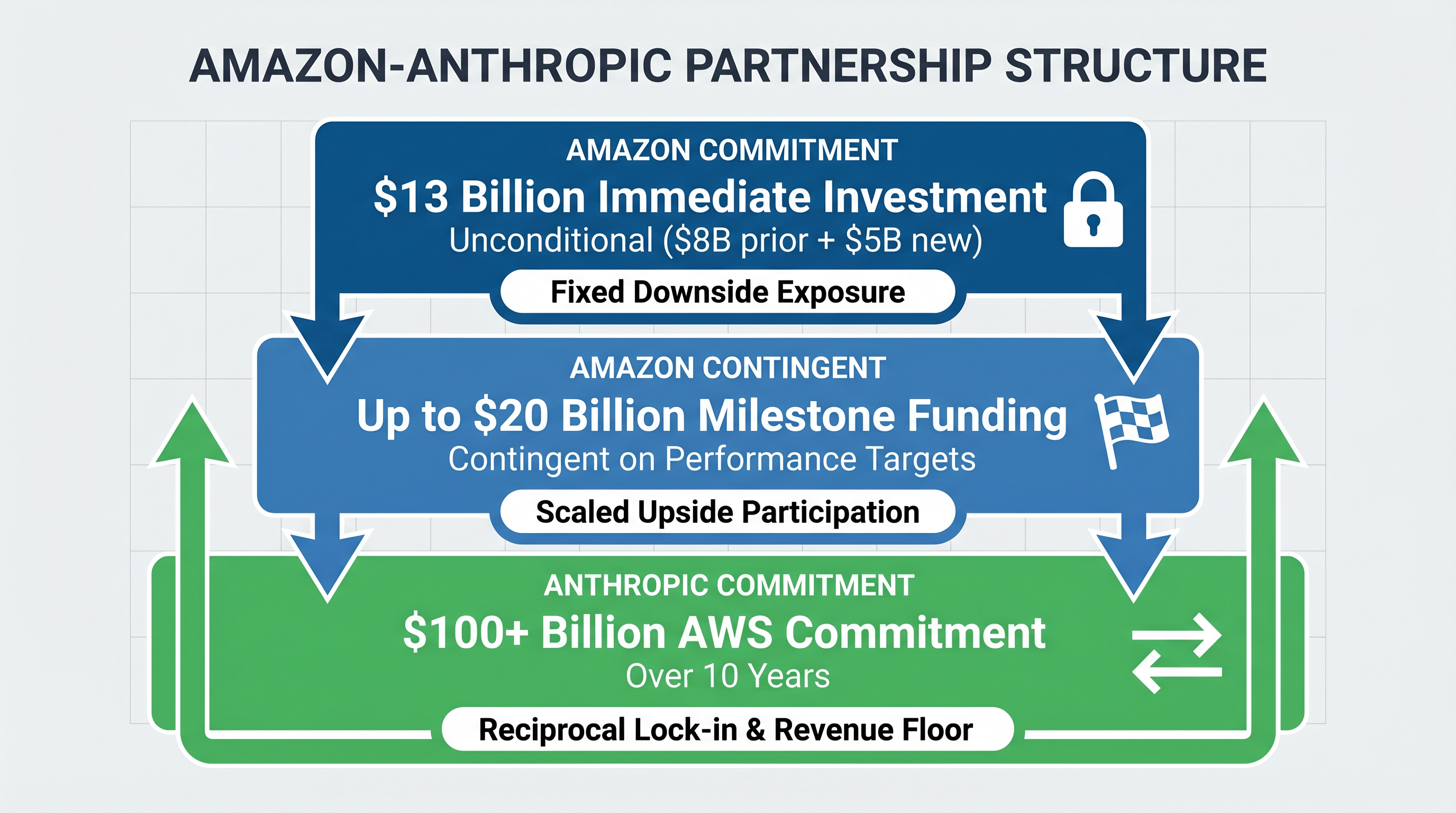
The $13 billion immediate commitment combines the new $5 billion investment with Amazon’s prior $8 billion stake, establishing the floor of Amazon’s capital at risk. This portion is unconditional and locked in regardless of Anthropic’s commercial performance. The second tier, an additional up to $20 billion in milestone-linked funding, operates as performance insurance. Amazon’s capital flows only if Anthropic delivers on specific commercial targets, meaning the company scales its investment in proportion to proof of success rather than committing blind.
The third tier shifts the obligation to Anthropic. The startup has committed to spend over $100 billion on AWS over the next 10 years, securing up to 5GW of Trainium capacity across current and future chip generations. This reciprocal lock-in makes the investment structure work for both parties. Amazon caps its downside to the initial $13 billion whilst retaining upside participation through milestone funding. Anthropic secures the infrastructure it requires to scale Claude, but only if it can afford that scale through commercial revenue.
| Tier | Amount | Conditions | Risk Profile |
|---|---|---|---|
| Immediate Investment | $13 billion | Unconditional (prior $8B + new $5B) | Fixed downside exposure |
| Milestone Funding | Up to $20 billion | Contingent on Anthropic performance targets | Scaled upside participation |
| AWS Commitment | $100+ billion over 10 years | Anthropic infrastructure spend obligation | Reciprocal lock-in, revenue floor for AWS |
For investors evaluating Amazon’s AI capital allocation, the tiered structure shows disciplined risk management. The company has committed $13 billion outright, but the next $20 billion flows only if Anthropic proves its models can generate revenue at scale. The $100 billion AWS commitment from Anthropic, meanwhile, provides forward visibility on AI infrastructure demand from a single customer alone.
Amazon’s Trainium bet mirrors the strategic pattern established by Broadcom’s $100 billion OpenAI custom chip partnership, where frontier AI companies are committing decade-long infrastructure spend in exchange for purpose-built silicon optimised for their specific workloads.
The financial headlines obscure the strategic core of the partnership, which is hardware, not capital.
Anthropic has committed to use Amazon’s Trainium chips for both training and inference workloads across current and future generations, including Trainium2, Trainium3, Trainium4, and beyond. The commitment spans the full 10-year duration of the AWS spend agreement, locking in frontier AI compute on Amazon’s proprietary silicon for a decade. Amazon will deploy nearly 1GW of Trainium2 and Trainium3 capacity by the end of 2026, with the full partnership securing up to 5GW total over time. Anthropic will also use Graviton processors for inference workloads, further deepening the integration.
CEO Commentary Andy Jassy, Amazon’s Chief Executive Officer, characterised Trainium’s value proposition as delivering “high performance at significantly lower cost” compared to GPU-dependent infrastructure.
The Trainium lock-in is the moat. If Anthropic’s Claude models prove their commercial value whilst running on Trainium infrastructure, Amazon will have a decade-long proof point that custom silicon can handle frontier AI workloads at lower cost than Nvidia GPUs. That proof point becomes the sales pitch for other AI companies considering AWS. The hardware commitment also creates switching costs. Once Anthropic optimises Claude for Trainium, moving to different hardware would require re-engineering the model, creating natural retention.
Trainium generation roadmap secured in partnership:
For investors, the Trainium commitment is the structural differentiator. The $13 billion buys Amazon a stake in Anthropic, but the decade-long hardware lock-in buys validation of its custom silicon strategy. If that validation holds, it unlocks a competitive advantage that capital alone cannot replicate.
AI model training and inference require massive parallel computation, traditionally handled by Nvidia GPUs. GPUs dominate because they were designed for the parallel processing tasks that neural networks demand, but they come with two constraints: high cost and supply bottlenecks. Custom silicon like Trainium is designed specifically for AI workloads, offering potential cost and efficiency advantages when optimised for particular use cases.
Beyond cost leadership, the energy efficiency advantages of custom AI silicon are becoming critical for AI companies managing data centre power consumption at scale, with purpose-built chips like Nanoveu’s EMASS demonstrating 20x efficiency gains over general-purpose processors in edge AI workloads.
The trade-off is software and model optimisation. A GPU is general-purpose hardware that works with most AI frameworks out of the box. Custom silicon requires the AI company to engineer its models to run efficiently on that specific chip architecture. This creates switching costs, but it also creates performance advantages once the optimisation is complete. The $100 billion, 10-year AWS spend from Anthropic represents the scale required to justify that optimisation effort.
Anthropic will use both Trainium for training and inference and Graviton processors for inference-only workloads, indicating that the partnership involves optimising Claude across Amazon’s full custom silicon stack rather than relying on third-party GPUs.
The three-step logic of custom silicon economics:
Once Anthropic optimises Claude for Trainium, moving to different hardware would require significant re-engineering. Neural network performance depends on how efficiently the model’s computations map to the chip’s architecture. Changing chips means re-tuning those mappings, a process that can take months and degrade performance during the transition.
This dynamic is the same reason Nvidia’s CUDA ecosystem remains sticky for its customers. CUDA is Nvidia’s software layer that lets developers write code for its GPUs. Thousands of AI researchers have built models optimised for CUDA, and switching to a competitor’s hardware means rewriting that code. Amazon is attempting to replicate that lock-in with Trainium by securing Anthropic as a flagship customer whose success on the platform validates the hardware for others.
For investors, understanding custom silicon economics explains why the Anthropic partnership is strategic, not just financial. Amazon is building proof that its chips can handle frontier AI workloads. That proof is the prerequisite for convincing other AI companies to migrate from Nvidia-based infrastructure, which would shift AWS’s competitive positioning from price competition on commodity GPUs to differentiation through proprietary hardware.
The three largest cloud providers have made different bets on AI infrastructure, and the differences reveal distinct competitive strategies.
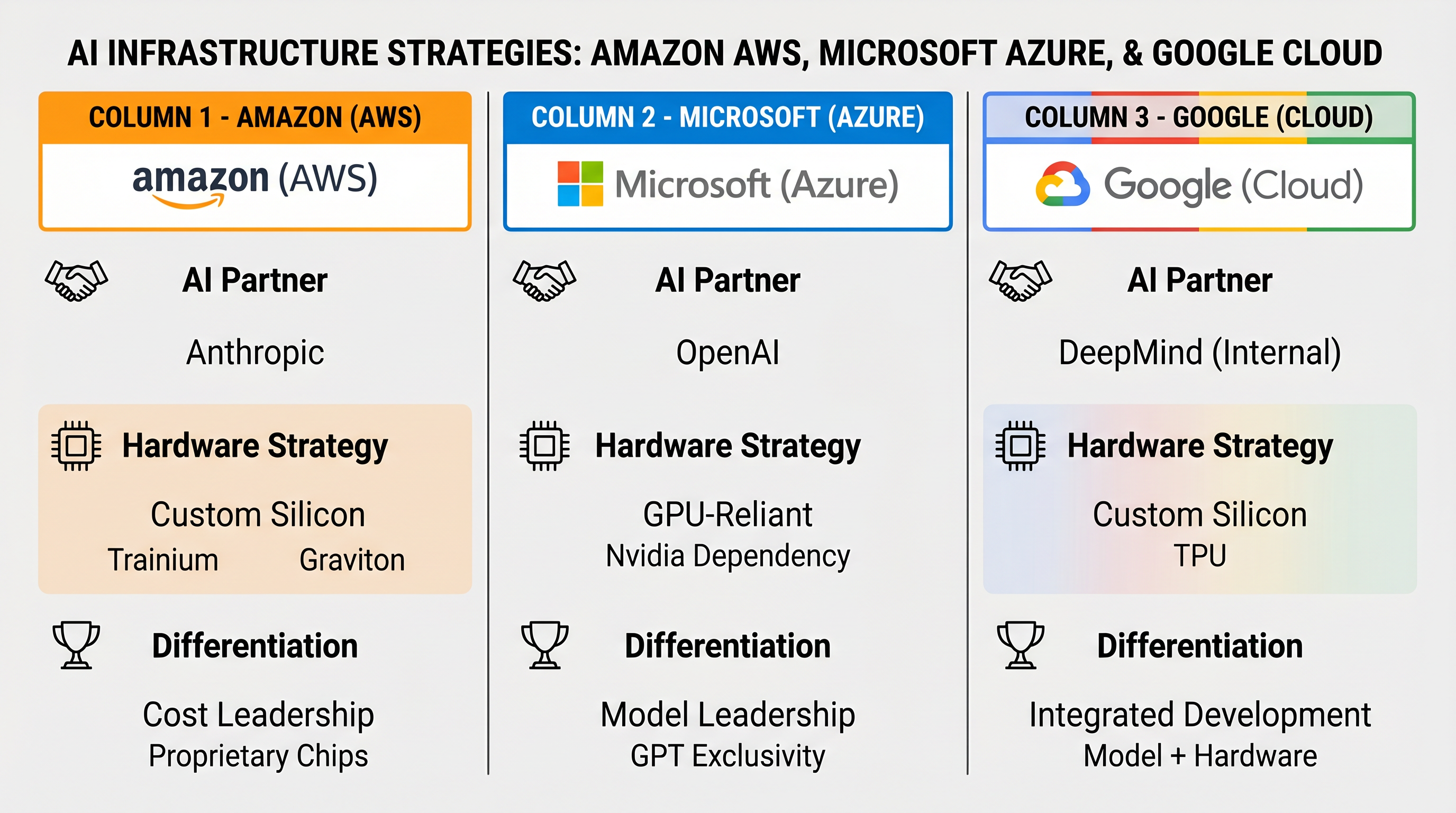
Amazon’s Trainium approach contrasts sharply with Microsoft’s Azure OpenAI partnership, where Microsoft depends on Nvidia GPU supply and passes those costs through to customers. Microsoft’s differentiation is model access (OpenAI’s GPT models) rather than infrastructure efficiency. Google occupies a middle position with its own TPU (Tensor Processing Unit) silicon and DeepMind integration, making it the other major custom silicon player, but its model partnership structure differs from Amazon’s Anthropic arrangement.
| Provider | AI Partner | Hardware Strategy | Differentiation |
|---|---|---|---|
| Amazon (AWS) | Anthropic | Custom silicon (Trainium, Graviton) | Cost leadership through proprietary chips |
| Microsoft (Azure) | OpenAI | GPU-reliant (Nvidia dependency) | Model leadership (GPT exclusivity) |
| Google (Cloud) | DeepMind (internal) | Custom silicon (TPU) | Integrated model and hardware development |
Amazon’s bet is that cost leadership through proprietary hardware will win enterprise customers if Anthropic’s models prove competitive. The partnership has already demonstrated traction. Over 100,000 customers are running Claude models (Opus, Sonnet, Haiku) on Amazon Bedrock, the platform through which Claude is now fully integrated. Lyft reported 87% faster customer service resolution using Claude, providing a tangible case study of enterprise value. Anthropic is expanding international inference capabilities in Asia and Europe, indicating geographic scaling of the Bedrock integration.
CEO Commentary Dario Amodei, Anthropic’s Chief Executive Officer, characterised Claude as “essential” for users, directly tying the model’s growth to AWS infrastructure capabilities.
For investors comparing cloud AI positions, the strategic divergence is clear. Amazon is betting on cost leadership through proprietary hardware. Microsoft is betting on model leadership through OpenAI. Google is hedging with both custom silicon and internal model development. The Lyft case study and 100,000+ customer figure suggest Anthropic’s models can win enterprise deals when delivered on AWS infrastructure, but the long-term test is whether Trainium can match GPU performance at lower cost as models scale.
The $100 billion, 10-year AWS commitment from Anthropic is a forward revenue visibility anchor for Amazon’s cloud business.
Divided evenly, the commitment represents roughly $10 billion annually from a single customer on AI infrastructure alone. That figure is a floor, not a ceiling. If Anthropic’s commercial success accelerates, the spend could front-load. If growth is slower, the spend stretches across the full decade. Either way, the contractual commitment provides AWS with predictable AI infrastructure revenue independent of broader cloud trends.
The commitment also signals the scale of enterprise AI infrastructure demand. A single AI company is contractually obligating itself to $100+ billion in compute spend over 10 years, indicating that training and inference workloads for frontier models require infrastructure planning measured in decades, not quarters. The 5GW of Trainium capacity Amazon is securing for Anthropic represents data centre power consumption equivalent to a small city, underscoring the physical infrastructure required to support large language models at scale.
Three demand signals embedded in the partnership:
For AWS revenue modelling, the Anthropic partnership provides a tangible anchor point. Even if no similar partnerships emerge, $10 billion annually from Anthropic alone represents meaningful AI infrastructure revenue. If other AI companies follow with comparable commitments, the custom silicon strategy could drive a structural shift in AWS’s revenue mix towards proprietary hardware-enabled services.
The revenue flows over a decade, not immediately. Anthropic’s commercial success determines how quickly the $100 billion commitment materialises. If Claude adoption accelerates and training workloads scale rapidly, AWS could see front-loaded revenue in the partnership’s early years. If adoption is slower, the spend stretches across the full 10-year term.
As of 21 April 2026, post-announcement analyst projections on AWS revenue impact are not yet available. Investors should monitor upcoming AWS earnings calls for commentary on Anthropic-related revenue and watch for disclosure of how the partnership affects AWS’s AI infrastructure backlog.
The headline figures matter, but the structural elements tell the investment story. Amazon has designed a three-tier deal that caps downside to $13 billion, scales upside through $20 billion in milestone funding, and secures a $100 billion AWS commitment from Anthropic as reciprocal lock-in. The Trainium hardware commitments, spanning a decade and up to 5GW of capacity, are the strategic core. If Anthropic’s Claude models succeed on Amazon’s custom silicon, the company will have validated a cost-leadership thesis that could differentiate AWS from GPU-dependent competitors.
The competitive bet is clear. Amazon is betting that custom silicon can deliver AI infrastructure at lower cost than Nvidia GPUs, with Anthropic as the proof point. Microsoft is betting on model exclusivity through OpenAI. Google is hedging with both. The 100,000+ Bedrock customers and case studies like Lyft’s 87% faster resolution times suggest Anthropic’s models can win enterprise deals on AWS infrastructure, but the long-term test is execution.
Comprehensive analyst assessments, competitor responses, and regulatory commentary will emerge in coming weeks. The key metrics to watch are Anthropic’s commercial traction, Trainium performance benchmarks versus GPUs, and whether other AI companies follow with similar AWS commitments. Investors should monitor AWS earnings calls for Anthropic-related revenue commentary and watch for disclosed Trainium performance data as Claude models scale on the infrastructure.
This article is for informational purposes only and should not be considered financial advice. Investors should conduct their own research and consult with financial professionals before making investment decisions.
Amazon has committed a total of $13 billion to Anthropic, combining a prior $8 billion stake with a new $5 billion investment announced on 20 April 2026, with potential for up to $20 billion more tied to performance milestones.
Trainium is Amazon's custom AI silicon designed specifically for training and inference workloads; Anthropic has committed to use Trainium chips across multiple generations for a full decade, giving Amazon a long-term proof point that its proprietary hardware can compete with Nvidia GPUs at lower cost.
Amazon is betting on cost leadership through its proprietary Trainium chips, while Microsoft relies on Nvidia GPUs and differentiates through exclusive access to OpenAI's GPT models, representing fundamentally different infrastructure and competitive strategies.
Anthropic has agreed to spend over $100 billion on AWS infrastructure over 10 years, representing roughly $10 billion annually from a single customer and providing Amazon with forward revenue visibility on AI infrastructure demand independent of broader cloud trends.
Investors should monitor AWS earnings calls for Anthropic-related revenue commentary, Trainium performance benchmarks versus Nvidia GPUs, and whether other AI companies make comparable long-term AWS commitments following this deal.