Tech Stocks Split: Apple Rises on China, Netflix Drops 10%

Key Takeaways
- The S&P 500 rose 0.3% to 7,041.28 and the VIX fell to a seven-week low below 18 as a 10-day Israel-Lebanon ceasefire reduced geopolitical risk premiums and drove capital back into tech and growth sectors.
- Apple reported record Q1 FY2026 iPhone revenue of $85.3 billion, up 23% year-over-year, with Greater China sales surging 38% to $25.5 billion and market share reaching 19% — just one point behind Huawei.
- Netflix fell nearly 10% in pre-market trading after Q2 guidance came in below analyst consensus and co-founder Reed Hastings announced his departure as chairman, despite the company maintaining full-year revenue growth guidance of 12% to 14%.
- OpenAI launched GPT-Rosalind, a life sciences-focused AI model targeting drug discovery inefficiencies, ahead of a potential year-end IPO as the company diversifies into high-value enterprise applications.
- Kering and Google announced a partnership to develop Gucci-branded smart glasses launching in 2027, targeting Meta's 80%-plus market share in AI-enabled eyewear using Google's Android XR platform.
Tech stocks drove broader market gains on 17 April 2026, with major indices extending their rally following a 10-day ceasefire agreement between Israel and Lebanon that reduced geopolitical risk premiums. The S&P 500 climbed 0.3% to 7,041.28, while the NASDAQ advanced 0.4% to 24,102.70 and the Dow Jones added 0.2% to 48,578.72. The VIX volatility index fell below 18, marking a seven-week low and signalling reduced market anxiety as capital rotated from safe-haven assets back into growth and technology sectors.
While the S&P 500 crossed 7,000 on broad market strength, investors should carefully assess tech rally valuations before committing additional capital to growth stocks at current levels.
Today’s tech stock news featured sharply divergent company-specific stories, with Apple gaining on strong China performance while Netflix tumbled on disappointing guidance and leadership changes.
Apple Gains Ground in China’s Smartphone Battle
Apple achieved its strongest quarterly performance in China with 20% year-over-year iPhone shipment growth in Q1 2026, nearly overtaking Huawei for market leadership. The company captured 19% market share, closing the gap with Huawei’s 20% to just one percentage point. This success is particularly notable given the overall Chinese smartphone market declined 4% during the period, demonstrating Apple’s competitive resilience in its most scrutinised growth market. AAPL shares rose 0.44% in pre-market trading on the news.
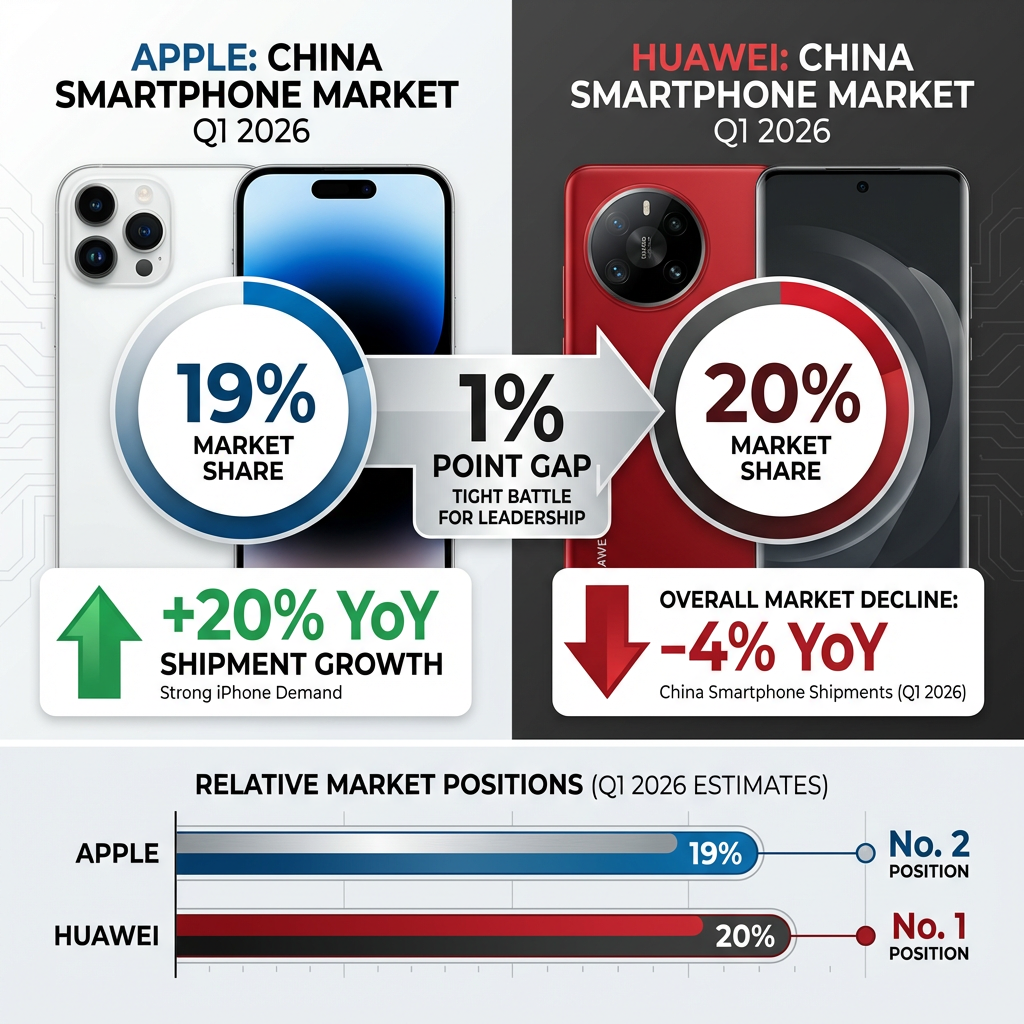
The performance reflected broader strength in Apple’s Q1 FY2026 earnings, which significantly exceeded Wall Street expectations. Total revenue reached $143.8 billion, beating consensus estimates of $138.5 billion, while earnings per share of $2.84 surpassed the expected $2.67. iPhone revenue hit a record $85.3 billion, up 23% year-over-year, whilst Greater China sales climbed 38% to $25.5 billion.
| Metric | Q1 FY2026 Result | Expectation/Comparison |
|---|---|---|
| Total Revenue | $143.8B | Beat $138.5B expected |
| EPS | $2.84 | Beat $2.67 expected |
| iPhone Revenue | $85.3B | +23% YoY (record) |
| Greater China Sales | $25.5B | +38% YoY |
| China Market Share | 19% | vs Huawei 20% |
China sales rose 23% in the first nine weeks of 2026 whilst the overall market contracted 4%, positioning Apple competitively against domestic rival Huawei. Separately, the company announced the departure of Stan Ng, longtime marketing leader for Apple Watch and AirPods, after 31 years with the firm, marking a notable personnel change alongside the positive earnings results.
Apple’s strong China performance occurs against a backdrop of evolving semiconductor supply chain dynamics that affect both component availability and competitive positioning in the region.
When big ASX news breaks, our subscribers know first
Why Tech Earnings Drive Stock Movements
Tech stock prices reflect future expectations rather than past performance alone. Quarterly earnings reports influence investor sentiment primarily through forward guidance that updates expectations about future growth, profitability, and market positioning. This explains why stocks can move dramatically even when headline financial results appear solid.
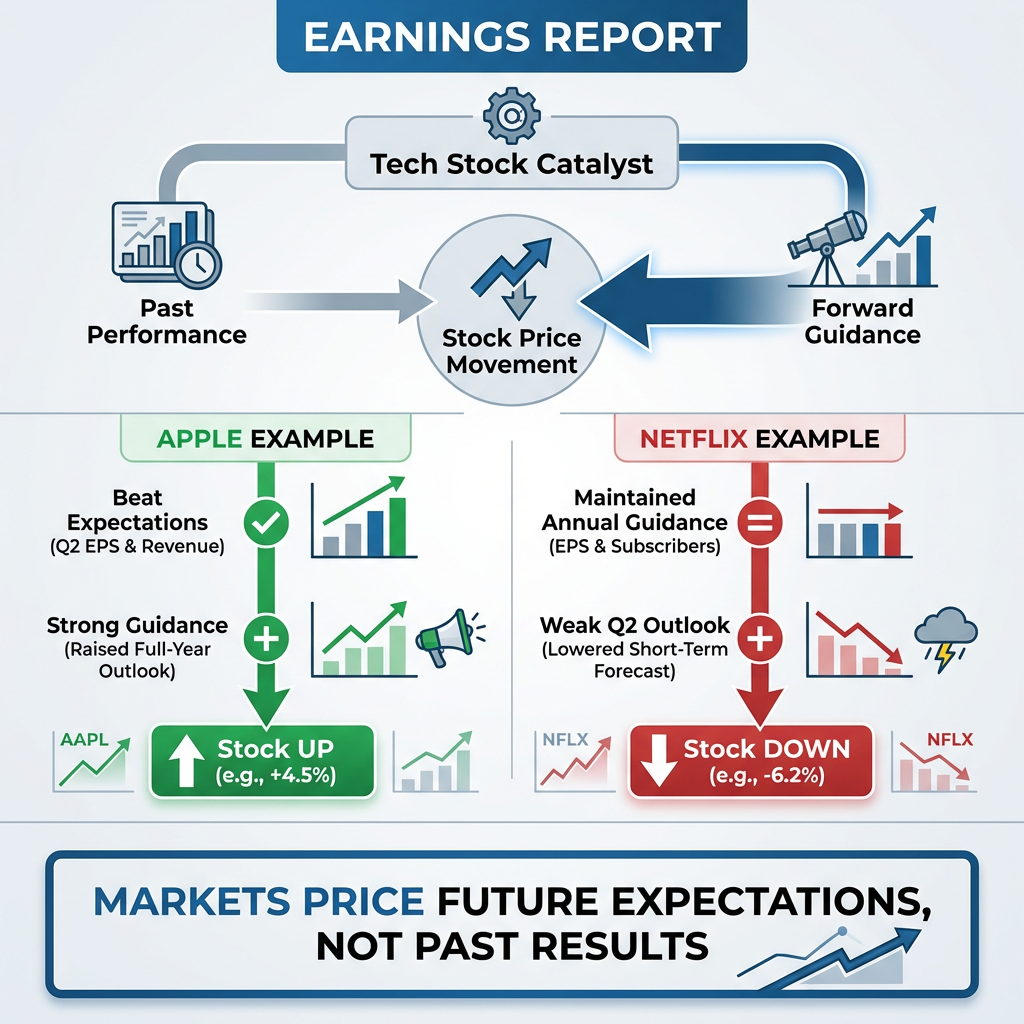
Today’s contrasting examples illustrate this dynamic clearly. Apple exceeded both revenue and earnings expectations whilst providing context for sustained China momentum, resulting in pre-market gains. Netflix, conversely, maintained its full-year revenue growth guidance of 12% to 14% but disappointed investors with Q2 projections below consensus estimates, triggering a sharp decline despite the company’s overall financial stability.
Leadership transitions can compound market reactions to earnings guidance, particularly when they coincide with operational concerns. Netflix’s announcement that co-founder Reed Hastings would step down as chairman occurred simultaneously with soft near-term guidance, amplifying investor concerns about the company’s strategic direction and advertising monetisation timeline.
Netflix Slides on Soft Guidance and Hastings Exit
Netflix shares fell nearly 10% in pre-market trading after the company reported Q2 revenue and earnings guidance below Wall Street expectations and announced co-founder Reed Hastings would step down as chairman. Investors focused on slower-than-anticipated progress on advertising revenue monetisation and subscriber growth, despite the company receiving a $2.8 billion breakup fee from the failed Warner Bros. Discovery acquisition attempt.
> CEO Commentary
> Chief Executive Ted Sarandos stated that Hastings’ departure was unrelated to the unsuccessful Warner Bros. Discovery bid, seeking to separate the leadership transition from the strategic setback.
Key financial developments included:
- $2.8 billion breakup fee received from failed Warner Bros. Discovery bid
- Full-year revenue growth guidance of 12% to 14% maintained
- Q2 revenue and earnings projections came in below analyst consensus
- Investor concerns centred on advertising monetisation pace and near-term subscriber additions
The contrast between maintained annual targets and disappointing near-term projections highlighted execution concerns around Netflix’s advertising strategy, which the company has positioned as a key growth driver for future quarters.
OpenAI Launches Life Sciences AI Model Ahead of Potential IPO
OpenAI announced GPT-Rosalind, an AI model specifically designed for life sciences research, marking a strategic expansion into the healthcare and pharmaceutical sector. The model, named after chemist Rosalind Franklin known for her contributions to understanding DNA structure, is designed to support evidence synthesis, hypothesis generation, and experimental planning across drug discovery and clinical research applications.
The FDA guidance on AI and machine learning in drug development establishes the regulatory framework for how artificial intelligence tools are evaluated for pharmaceutical research and clinical trial applications, providing clarity on validation requirements and evidence standards.
The life sciences sector presents significant commercial opportunity due to persistent inefficiencies in drug development. Average drug development costs reach approximately $1.4 billion per approved therapy, with timelines often exceeding a decade. More than 90% of drugs entering clinical trials fail to receive regulatory approval, creating demand for tools that can improve research efficiency and reduce failure rates. The sector’s recession-resistant characteristics and high-value enterprise applications make it attractive for AI commercialisation.
The peer-reviewed research on pharmaceutical development costs and clinical trial success rates published in Nature Reviews Drug Discovery validates these industry benchmarks, showing costs ranging from $1.4 billion to $2.6 billion per approved therapy with failure rates exceeding 90% in clinical phases.
The launch comes as OpenAI reportedly considers an initial public offering potentially before year-end, according to industry reports. The expansion into specialised vertical applications such as life sciences demonstrates the company’s strategy to diversify beyond consumer-facing AI products ahead of potential public market scrutiny.
OpenAI’s expansion into life sciences represents a strategic bet on enterprise applications within the broader AI investment landscape, where capital deployment has reached unprecedented levels but returns remain uncertain.
Tech Giants Pursue Smart Glasses and Delivery Deals
Beyond earnings reports, strategic partnerships and acquisitions are reshaping competitive dynamics in emerging technology markets. Kering announced a partnership with Alphabet’s Google to develop Gucci-branded smart glasses launching in 2027, targeting Meta’s dominant position in AI-enabled eyewear. The collaboration will utilise Google’s Android XR platform and represents part of Chief Executive Luca de Meo’s strategy combining Italian design with artificial intelligence and augmented reality technology. Meta currently holds more than 80% market share in AI eyewear, according to industry estimates. In pre-market trading, GOOG rose 0.30% whilst META gained 0.20%.
In the food delivery sector, consolidation activity accelerated as companies positioned for European market dominance. Uber acquired an additional 4.5% stake in Delivery Hero from Prosus for €270 million at €20 per share, bringing its total ownership to 7%. Prosus is divesting the stake due to European Union regulatory requirements following its €4.1 billion acquisition of Just Eat Takeaway. The transaction reflects broader North American expansion into European food delivery markets, exemplified by DoorDash’s completed £2.9 billion purchase of Deliveroo.
The next major ASX story will hit our subscribers first
What Tech Investors Should Watch Next
Today’s tech stock news highlights the sector’s complexity, with strong fundamental performance at Apple contrasting with execution concerns at Netflix, whilst strategic expansion by OpenAI and consolidation plays by Uber demonstrate varied growth strategies across technology subsectors. Investors should monitor whether Apple sustains its China momentum in subsequent quarters, particularly as competition with Huawei intensifies. Netflix’s path to advertising monetisation remains critical to justifying its valuation, with Q2 results likely to determine whether today’s sell-off represents a buying opportunity or signals deeper challenges.
Investors evaluating tech stock positions should incorporate free cash flow considerations into their analysis, particularly as capital-intensive AI investments may pressure near-term profitability metrics across the sector.
OpenAI’s timeline toward a potential year-end initial public offering will depend on market conditions and the company’s ability to demonstrate commercial traction beyond consumer applications, with the GPT-Rosalind launch serving as an early indicator of enterprise diversification. The Kering-Google smart glasses partnership’s 2027 product launch will test whether established technology platforms can challenge Meta’s first-mover advantage in AI-enabled wearables.
Frequently Asked Questions About Today’s Tech Stock News
Why did Apple stock rise on China news?
Apple’s 20% iPhone shipment growth in China occurred whilst the overall market declined 4%, demonstrating competitive strength against Huawei in a challenging environment. The company narrowed the market share gap to just one percentage point (19% versus 20%), suggesting momentum toward potential market leadership in China. This performance exceeded investor expectations and validated Apple’s strategy in its most scrutinised international market.
Why did Netflix drop nearly 10% if it maintained full-year guidance?
Whilst Netflix maintained its 12% to 14% full-year revenue growth target, Q2 guidance specifically came in below Wall Street expectations. Investors reacted to the combination of near-term disappointment on advertising monetisation progress and the announcement of Reed Hastings stepping down as chairman. Markets price stocks based on expected future performance rather than past results, making disappointing near-term guidance material despite stable annual targets.
What is OpenAI’s GPT-Rosalind model?
GPT-Rosalind is an artificial intelligence model specifically designed for life sciences research applications. The model is capable of evidence synthesis, hypothesis generation, and experimental planning to support drug discovery and clinical research. Named after chemist Rosalind Franklin, it represents OpenAI’s expansion into enterprise healthcare applications beyond consumer-facing AI products, targeting a sector where average drug development costs exceed $1.4 billion and failure rates reach 90%.
Why is Uber increasing its stake in Delivery Hero?
Uber is capitalising on Prosus’s required divestiture of Delivery Hero shares following European Union regulatory requirements imposed after Prosus’s €4.1 billion acquisition of Just Eat Takeaway. The €270 million purchase at €20 per share increases Uber’s position in European food delivery to 7% total ownership, positioning the company amid broader sector consolidation that includes DoorDash’s £2.9 billion acquisition of Deliveroo. The transaction represents strategic expansion into European markets at favourable valuation conditions.
—
This article is for informational purposes only and should not be considered financial advice. Investors should conduct their own research and consult with financial professionals before making investment decisions.
Frequently Asked Questions
What is driving tech stock news today on 17 April 2026?
A 10-day Israel-Lebanon ceasefire reduced geopolitical risk premiums, pushing the S&P 500 up 0.3% to 7,041.28 and the NASDAQ up 0.4% to 24,102.70, with capital rotating from safe-haven assets back into growth and technology sectors.
Why did Apple stock rise on China news today?
Apple achieved 20% year-over-year iPhone shipment growth in China during Q1 2026, narrowing the market share gap with Huawei to just one percentage point (19% vs 20%), while the overall Chinese smartphone market declined 4%, signalling strong competitive momentum.
Why did Netflix stock drop nearly 10% despite maintaining full-year guidance?
Netflix maintained its 12% to 14% full-year revenue growth target but issued Q2 revenue and earnings guidance below Wall Street expectations, compounded by co-founder Reed Hastings stepping down as chairman, triggering investor concerns about near-term advertising monetisation progress.
What is OpenAI's GPT-Rosalind model and why does it matter for investors?
GPT-Rosalind is an AI model designed for life sciences research, capable of evidence synthesis, hypothesis generation, and experimental planning for drug discovery, targeting a sector where drug development costs exceed $1.4 billion per therapy — and it launches ahead of OpenAI's potential year-end IPO.
How does the Uber and Delivery Hero stake acquisition fit into broader tech market trends?
Uber purchased an additional 4.5% stake in Delivery Hero for €270 million, bringing its total ownership to 7%, as part of accelerating consolidation in European food delivery markets that also includes DoorDash's £2.9 billion acquisition of Deliveroo.