
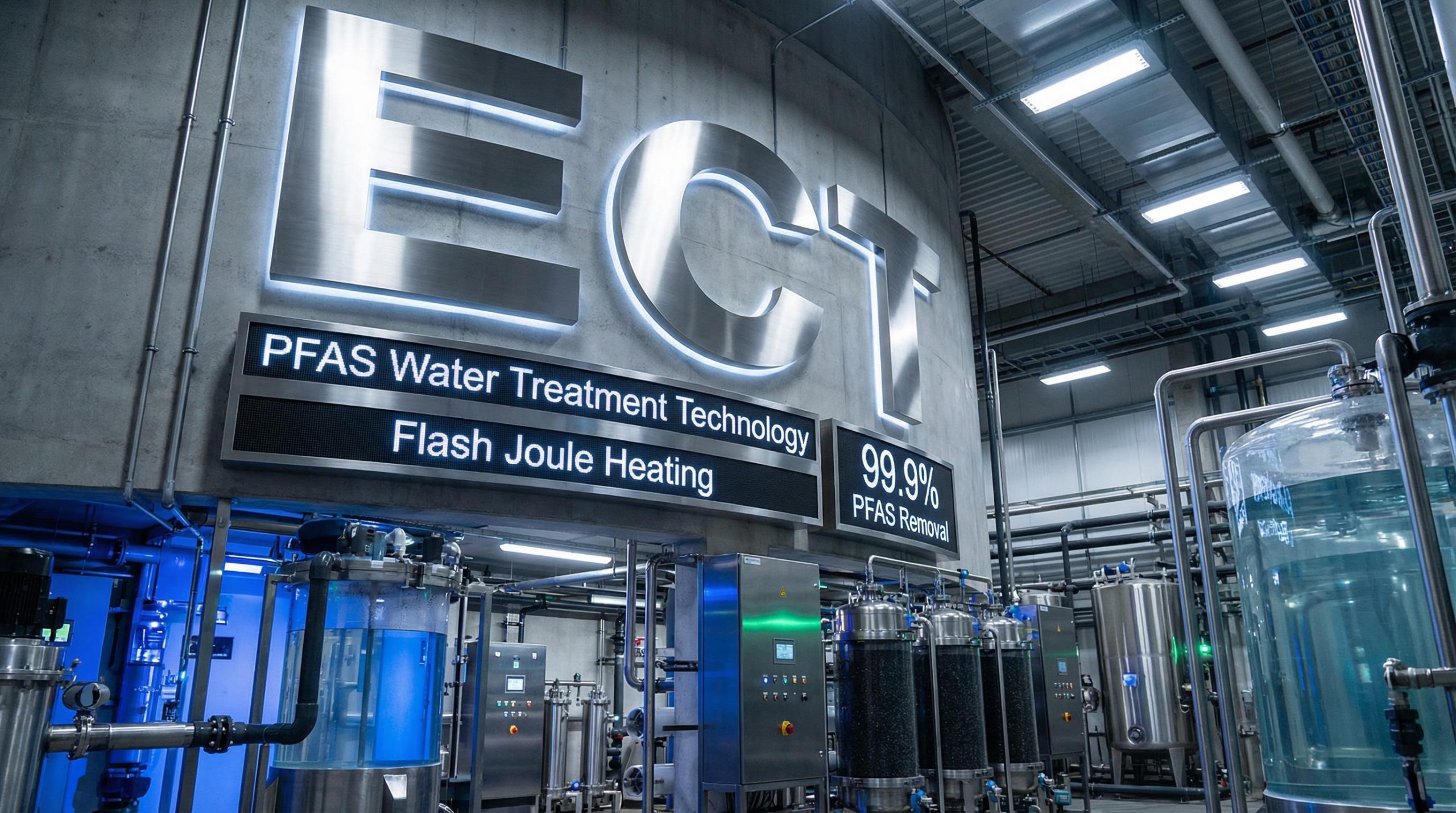
ECT expands Flash Joule Heating technology to destroy PFAS in water treatment systems
Environmental Clean Technologies (ASX: ECT) has expanded its licence agreement with William Marsh Rice University to include the right to apply Flash Joule Heating (FJH) technology to PFAS-contaminated adsorbents such as granular activated carbon (GAC). The expansion broadens ECT’s PFAS remediation strategy beyond soil remediation into water treatment applications, targeting GAC materials commonly used to filter PFAS from drinking water supplies.
The licence amendment builds on ECT’s existing Rapid Electrothermal Mineralisation (REM) technology platform for soil remediation. Both applications utilise the same core FJH intellectual property developed at Rice University under Professor James Tour. The expanded licence positions the company to develop an on-site PFAS destruction system for water treatment media, addressing growing industry demand for alternatives to conventional incineration pathways.
Under the amended agreement, ECT will pay a once-off licence amendment fee of $10,000. The annual maintenance fee increases from US$10,000 to US$12,500, whilst the milestone fee payable upon achieving US$50 million in gross sales rises from US$150,000 to US$200,000. The relatively modest upfront investment provides access to a significant expansion of ECT’s addressable market across both soil and water treatment sectors.
Justin Sharp, Chief Technology Officer
“This expansion is a strategic progression of our existing REM platform and reinforces our position in PFAS destruction technologies. The industry is increasingly looking for alternatives to incineration when it comes to treating spent treatment media such as GAC, as there are growing concerns about releasing PFAS into the atmosphere during combustion. We believe an on-site mineralisation solution that efficiently eliminates PFAS from spent treatment media and reduces secondary waste has the potential to address a critical gap in current GAC treatment pathways and in particular for those used in water treatment applications.”
When big ASX news breaks, our subscribers know first
Understanding PFAS contamination in water treatment and the GAC problem
Granular Activated Carbon serves as a highly porous filtration medium used across various industries, most commonly in water treatment systems to remove contaminants from drinking water. When deployed in PFAS-affected water sources, GAC effectively captures these persistent chemicals through adsorption. However, once saturated, the PFAS-laden GAC transforms into concentrated hazardous waste requiring specialist disposal.
Current industry practice typically involves transporting spent GAC off-site to high-temperature incineration facilities. This approach presents multiple operational and environmental challenges that ECT’s technical assessment has identified. The company’s evaluation of existing PFAS treatment pathways revealed three structural limitations inherent to incumbent destruction methods:
- Generation of secondary waste from incineration, including hazardous gases released into the atmosphere
- High energy consumption associated with thermal desorption and destruction processes
- Logistical and environmental risks linked to transporting contaminated materials for off-site disposal
These constraints create material cost burdens for water utilities and treatment operators whilst raising questions about the environmental sustainability of relying on incineration as the primary destruction pathway. The dependence on specialist destruction capacity also introduces supply chain vulnerabilities, particularly as regulatory pressure drives increased volumes of PFAS-contaminated media requiring treatment. ECT’s strategy seeks to address these limitations by enabling on-site destruction of PFAS captured on treatment media, minimising cost and risk associated with incumbent approaches.
How Flash Joule Heating destroys PFAS at the molecular level
Flash Joule Heating applies high-power electrical current through carbon-based materials to achieve rapid temperature increases within seconds. Under controlled laboratory conditions, the technology has demonstrated the ability to break carbon-fluorine bonds characteristic of PFAS compounds, which are among the strongest chemical bonds in organic chemistry. This rapid electrical heating rate destroys the carbon-fluorine bonds that define the PFAS molecular structure whilst simultaneously converting the GAC substrate into high-value carbon material products such as graphene, amorphous carbon, or graphite.
Peer-reviewed research validates the technology’s performance across multiple metrics critical to commercial viability. The process operates at temperatures approaching 3,000°C, enabling rapid molecular-level destruction of PFAS compounds within seconds. Independent studies indicate FJH applied to PFAS-contaminated carbon media can convert 90-96% of fluorine content to stable inorganic fluoride salts whilst producing minimal volatile fluorinated by-products.
| Performance Metric | FJH Result | Conditions | Significance |
|---|---|---|---|
| PFAS Removal Rate | >99.9% | Controlled laboratory conditions | Demonstrates near-complete elimination of target contaminants |
| Fluorine Conversion | 90-96% | Converted to stable inorganic fluoride salts | Transforms hazardous fluorine into stable, non-volatile compounds |
| Operating Temperature | Approaching 3,000°C | Achieved through electrical current | Enables rapid breaking of carbon-fluorine bonds |
| Processing Speed | Within seconds | Rapid electrothermal heating | Supports potential for high-throughput commercial systems |
Life cycle assessment and techno-economic analysis reported in peer-reviewed studies indicate competitive or favourable energy and emissions performance compared with incineration. The dual value proposition extends beyond PFAS destruction to include potential revenue streams from carbon co-products. Where silicon metal is introduced prior to treatment, the process may also produce silicon carbide nanomaterials, creating additional opportunities for value recovery from materials that would otherwise constitute hazardous waste.
Translatable technology across soil and water applications
The proposed water treatment application leverages the same core power systems and hardware architecture currently under development for ECT’s ex-situ REM soil remediation platform. This design approach supports scalability across multiple PFAS destruction applications without requiring parallel development of separate infrastructure. The ex-situ REM system targets PFAS-contaminated soil already moved to waste management sites, whilst the same core technology applies directly to remediating PFAS-laden GAC.
This platform architecture reduces capital requirements and accelerates commercialisation timelines by enabling a single technology system to serve both soil and water treatment markets. The ability to apply identical processing equipment to different contaminated media types represents a strategic advantage in addressing diverse customer needs across the broader PFAS remediation sector.
Global regulatory momentum driving PFAS remediation demand
Tightening international regulatory standards are accelerating demand for scalable, verifiable PFAS destruction technologies across water treatment and broader environmental remediation sectors. Growing concerns about atmospheric emissions from incineration are prompting water utilities and treatment operators to seek alternative destruction pathways that provide verifiable elimination of PFAS compounds rather than transferring contamination between environmental media.
ECT’s on-site mineralisation approach addresses this evolving regulatory landscape by enabling treatment of spent GAC at the point of generation. The ability to destroy PFAS-laden GAC on site has the potential to reduce reliance on transport and incineration pathways whilst minimising secondary waste streams that create ongoing environmental liability. As regulatory frameworks increasingly emphasise verifiable destruction outcomes and lifecycle environmental impacts, technologies that can demonstrate molecular-level elimination of PFAS compounds whilst reducing transport and atmospheric emission risks position to benefit from accelerating compliance requirements.
Development pathway and next steps for ECT
ECT will now progress development and validation of its on-site system for the mineralisation of PFAS from spent GAC using FJH technology. The company has stated its objective of advancing toward pilot-scale deployment, subject to technical and regulatory validation. This development pathway builds on the existing licence agreement dated 11 December 2025, which established ECT’s rights to apply FJH technology to PFAS and heavy metals contaminated soil.
The amended licence agreement incorporates the following commercial terms:
- Once-off licence amendment fee: $10,000
- Annual maintenance fee: US$12,500 (increased from US$10,000)
- Milestone fee at US$50 million in gross sales: US$200,000 (increased from US$150,000)
The modest upfront cost to access this market expansion reflects the complementary nature of the water treatment application to ECT’s existing soil remediation capabilities. Both applications utilise the same licensed FJH technology platform, enabling the company to leverage existing development work and intellectual property infrastructure. The clear development roadmap positions ECT to address both soil and water treatment sectors with a unified technology approach, potentially broadening the company’s addressable market whilst maintaining capital efficiency through shared platform architecture.
Looking to understand ECT’s expanded PFAS destruction capabilities?
Environmental Clean Technologies has secured licensing rights to apply Flash Joule Heating technology to water treatment systems, positioning the company to address PFAS contamination across both soil and water sectors. This strategic expansion leverages the same core technology platform already under development for soil remediation.
To explore ECT’s complete PFAS destruction strategy and track the company’s progress toward pilot-scale deployment, visit the Environmental Clean Technologies investor centre for comprehensive project updates and technical developments.