
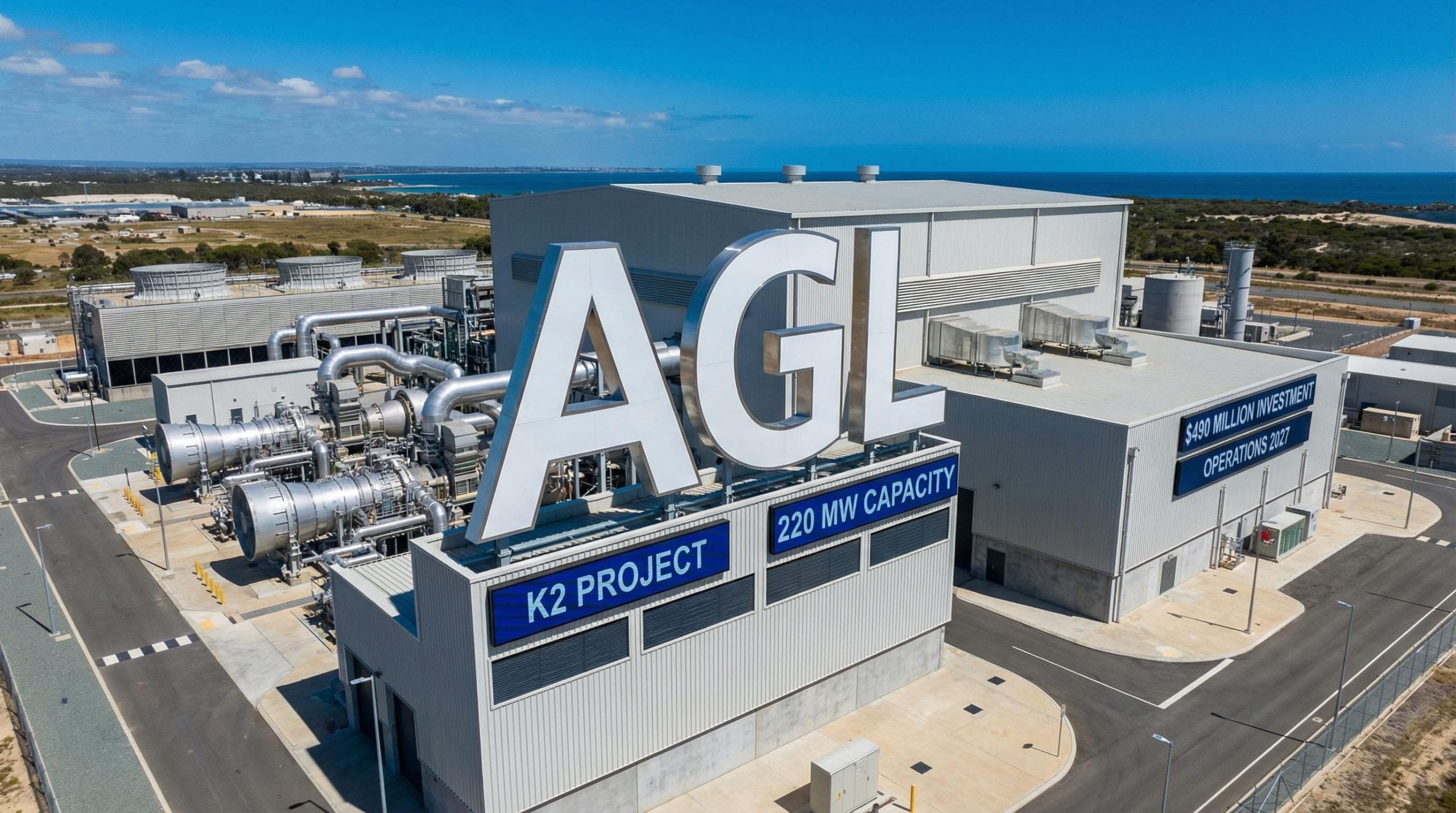
AGL Energy has reached a Final Investment Decision to proceed with the AGL Energy K2 Project Investment, committing $490 million to build a 220 MW open-cycle, dual-fuel gas turbine power station at its Kwinana site in Western Australia. The facility, co-located with the existing Kwinana Swift facility, targets commercial operations by Q4 2027 with a 25-year expected asset life.
AGL commits $490 million to Western Australian gas power expansion
The K2 Project represents a strategic portfolio expansion outside the National Electricity Market, providing dual benefits through firming capacity for renewable energy sources and earnings diversification across geographic markets. Construction is expected to commence in mid-2026, with the 220 MW dual-fuel turbine designed to operate on both natural gas and distillate fuel.
The project delivers firming capacity to support the build-out of intermittent renewable generation while expanding AGL’s presence in Western Australia’s energy market. The Kwinana location adjacent to the existing Swift facility enables operational synergies and leverages existing site infrastructure.
Damien Nicks, Managing Director and CEO
“The Final Investment Decision on the K2 Project, on the back of our recently signed 15-year PPA with Waddi Wind Farm for 105 MW, bolsters AGL’s portfolio in Western Australia and provides further opportunity to continue to scale our Perth Energy business and further diversify our earnings outside the NEM. It marks another important milestone in AGL’s strategy to develop new firming capacity to support the build out of renewables, and further expands the breadth and capacity of the company’s flexible asset portfolio.”
The Australian Energy Market Operator (AEMO) has assigned 176 MW of Peak Certified Reserve Capacity to the project, commencing from 1 October 2027. This certification provides the foundation for the project’s contracted revenue stream.
When big ASX news breaks, our subscribers know first
What is firming capacity and why does it matter?
Firming capacity refers to dispatchable generation that can be called upon rapidly to maintain grid stability when renewable energy sources like wind and solar are not generating. Unlike solar farms that only produce during daylight hours or wind farms dependent on weather conditions, gas-fired generation can ramp up quickly to meet demand spikes or fill gaps when renewable output drops.
This capability becomes increasingly valuable as the electricity system transitions towards higher penetrations of renewable energy. Grid operators require flexible generation assets that can respond within minutes to balance supply and demand, preventing blackouts and maintaining voltage stability.
For AGL, investing in firming capacity aligns with its Climate Transition Action Plan by enabling greater renewable energy deployment across the grid. The K2 Project specifically supports this transition by providing the flexible generation needed to complement the company’s renewable investments, including the recently signed Waddi Wind Farm power purchase agreement.
The dual-fuel design allows the facility to switch between natural gas and distillate fuel, providing additional operational flexibility and fuel security during supply constraints or price volatility.
Revenue visibility and project economics
The project has secured 10 years of contracted revenue through AEMO’s Reserve Capacity mechanism, with capacity credits priced at $360,700 per MW and escalating with the Consumer Price Index. This CPI-escalation mechanism provides built-in inflation protection across the contract duration.
The 176 MW of Peak Certified Reserve Capacity assigned by AEMO represents the certified output the facility can reliably deliver during peak demand periods. AEMO’s certification process involves rigorous technical assessment to verify that generation assets can meet their stated capacity when called upon.
AGL targets a post-tax, ungeared project return of above 8%, which sits within the company’s previously stated 7-11% return range for firming projects. This target return profile reflects the risk-adjusted economics of contracted firming capacity compared to merchant generation exposed to volatile spot market prices.
| Metric | Value | Duration | Notes |
|---|---|---|---|
| Total Project Cost | $490 million | — | Includes EPC, project management, contingency |
| Capacity | 220 MW | 25-year asset life | Open-cycle dual-fuel turbine |
| Certified Reserve Capacity | 176 MW | From 1 October 2027 | AEMO assigned |
| Capacity Price | $360,700 per MW | 10 years | CPI-escalating |
The contracted revenue structure reduces project risk by providing earnings visibility independent of volatile wholesale electricity prices. The capacity payment model rewards the facility for availability rather than actual generation, creating a stable revenue base that underpins the investment case.
Capital expenditure timeline
The $490 million total project cost will be deployed across three financial years:
- Approximately one-third of total costs in FY26
- Approximately half of total costs in FY27
- Remainder in FY28
AGL has updated its FY26 growth capital spend forecast to approximately $750 million, reflecting the K2 Project spend alongside other growth initiatives. The project will be funded using AGL’s existing balance sheet capacity, with no equity raising required.
This phased spending profile aligns capital deployment with construction milestones while demonstrating AGL’s financial capacity to execute growth initiatives without diluting existing shareholders. The balance sheet funding approach reflects the company’s investment-grade credit position and access to debt capital markets.
Strategic positioning in Western Australia
The K2 Project expands AGL’s Western Australian portfolio alongside the recently signed 15-year power purchase agreement with Waddi Wind Farm for 105 MW of renewable capacity. This integrated approach combines renewable generation with firming capacity to deliver reliable, lower-emissions energy supply.
AGL’s Perth Energy business serves Western Australian customers across the Wholesale Electricity Market, which operates independently from the National Electricity Market covering eastern and southern Australia. The WA expansion provides earnings diversification beyond the NEM, reducing concentration risk in AGL’s portfolio.
The company reports it is well positioned for gas supply in Western Australia with a flexible gas portfolio including short, medium and long-term gas and storage contracts. This established fuel supply position de-risks the K2 Project by ensuring access to competitively priced gas across various market conditions.
AGL supplies around 4.7 million customer services nationally across energy, telecommunications and Netflix offerings. The K2 Project strengthens the company’s ability to serve Western Australian customers through its Perth Energy business while contributing to the broader portfolio’s flexible generation capacity.
The Kwinana site co-location with the existing Swift facility enables operational efficiencies through shared infrastructure, maintenance resources, and grid connection assets.
Project delivery partners
AGL has entered into a contract with Clough as the engineering, procurement and construction provider for the K2 Project. This follows the company’s announcement on 31 October 2025 of an agreement to purchase four new gas turbines from Siemens AB for $185 million.
The pre-ordered Siemens equipment and established EPC contractor reduce execution risk by securing critical long-lead items and engaging experienced delivery partners with demonstrated capability in power generation projects.
Looking ahead
Investors can track the following near-term milestones as the K2 Project progresses:
- Construction commencement: mid-2026
- AEMO capacity credits commence: 1 October 2027
- Targeted commercial operations: Q4 2027
The Q4 2027 operational target provides visibility on when this $490 million capital deployment begins generating contracted returns. The project timeline spans approximately 18 months from construction start to commercial operations, with capacity payments commencing three months prior to full operations.
The K2 Project reinforces AGL’s strategic narrative of developing firming capacity to support renewable energy build-out while diversifying earnings across geographic markets. As the National Electricity Market and Western Australia’s Wholesale Electricity Market transition towards higher renewable penetrations, dispatchable generation assets capable of rapid response become increasingly valuable for grid stability and reliability.
Don’t Miss the Next Energy Infrastructure Play
Join 20,000+ investors getting FREE breaking ASX news delivered to your inbox within minutes, complete with in-depth analysis. Click the “Free Alerts” button at Big News Blast to start receiving alerts the moment market-moving announcements hit the wire.