TSMC Q1 Earnings Hit $18.2B Record, Yet Shares Fall 3%

Key Takeaways
- TSMC posted a record net profit of $18.2 billion in Q1 2026, a 58% year-over-year surge fuelled by explosive demand for advanced 3nm AI chips from Nvidia and Apple.
- TSM shares fell up to 3.1% after the earnings release despite record results, driven by profit-taking and investor concerns over supply chain vulnerabilities and capacity constraints.
- Middle East conflict between the U.S., Israel, and Iran has disrupted helium and bromine supplies critical to chip manufacturing, though TSMC has secured short-term alternative sources.
- TSMC plans to invest up to $30 billion in capital expenditure in 2026 as part of a $165 billion U.S. expansion programme, with analysts warning of near-term margin compression as overseas facilities ramp up.
- CEO C.C. Wei confirmed that replicating TSMC's advanced manufacturing capability would take competitors at least three years, reinforcing the company's structural moat in the AI chip supply chain.
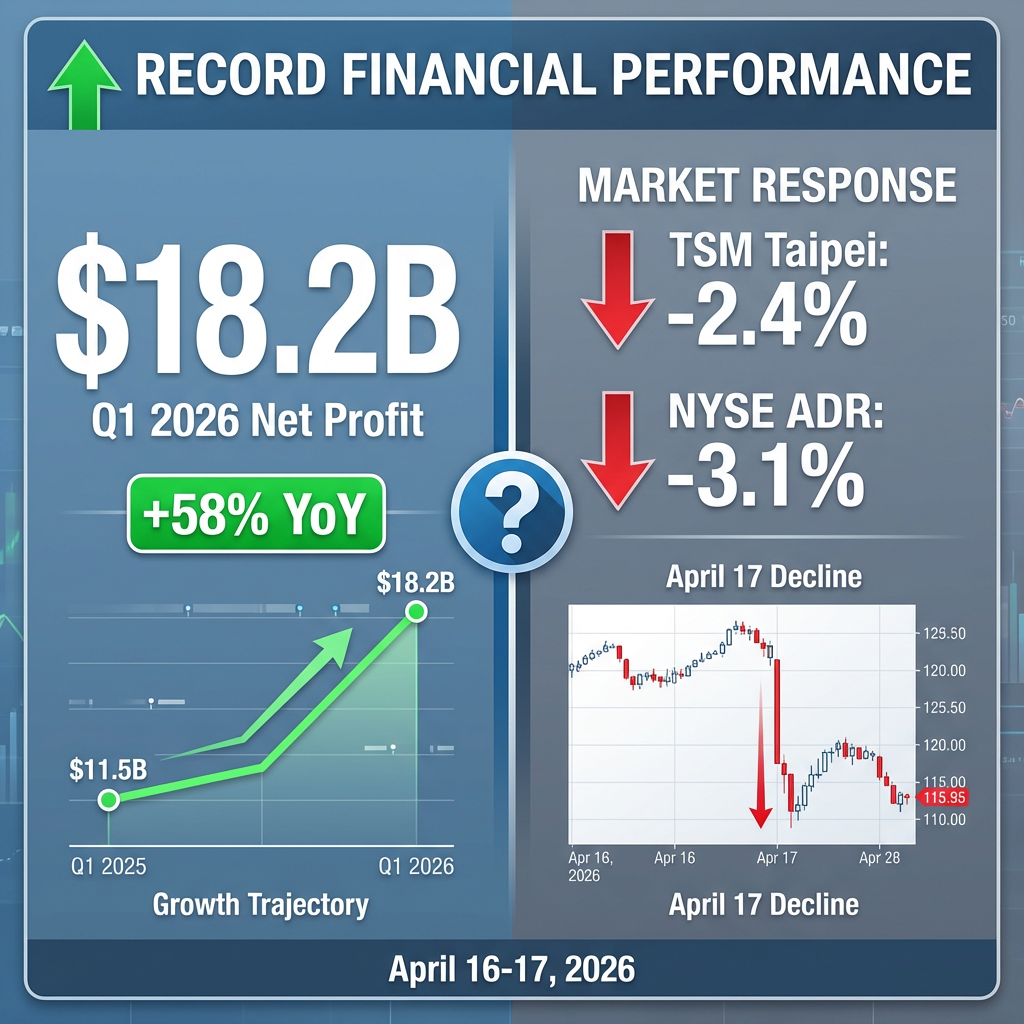
Taiwan Semiconductor Manufacturing Company (TSMC) delivered record-breaking financial results for Q1 2026, posting net profit of $18.2 billion on April 16. The 58% year-over-year surge reflects unprecedented demand for advanced 3nm chips powering artificial intelligence accelerators and flagship mobile processors for clients including Nvidia and Apple. Despite these exceptional results, TSM shares declined 2.4% in Taipei trading on April 17, while NYSE-listed ADRs fell 3.1% as investors weighed capacity constraints and supply chain risks against the company’s technological dominance.
The TSMC Q1 earnings report confirms the structural shift in semiconductor demand driven by AI infrastructure buildout. However, the market’s cautious response highlights growing concerns about whether the world’s largest contract chipmaker can sustain growth amid geopolitical supply chain vulnerabilities and the operational challenges of a $30 billion capacity expansion programme.
TSMC Posts Record Q1 Profit as AI Chip Demand Soars
TSMC achieved its highest-ever quarterly profit of $18.2 billion in Q1 2026, representing a 58% year-over-year increase driven by explosive demand for advanced 3nm chips from major AI and consumer technology clients. The results, announced April 16, underscore the company’s position as the critical enabler of the global AI revolution, with Nvidia and Apple leading orders for cutting-edge processors that no other manufacturer can produce at comparable scale.
Despite the stellar performance, TSM shares declined on April 17, with Taipei-listed stock falling 2.4% and NYSE ADRs dropping 3.1%. The decline came after shares reached record highs earlier in the week, signalling profit-taking combined with forward-looking concerns about operational constraints.
When big ASX news breaks, our subscribers know first
Why TSMC’s 3nm Chips Are Central to the AI Revolution
TSMC dominates advanced chip manufacturing with no comparable competition at scale. As the world’s largest contract semiconductor manufacturer, the company produces chips that technology giants cannot fabricate themselves, giving it unparalleled pricing power and customer dependency. Its 3nm process technology represents the cutting edge of chipmaking, powering Nvidia’s AI accelerators that drive data centre buildouts and Apple’s flagship iPhone and Mac processors.
This technological moat creates structural demand far exceeding current supply capacity. CEO C.C. Wei addressed capacity concerns during the April 16 earnings call, stating that building comparable manufacturing capability would require at least three years and substantial capital investment. This timeline makes near-term customer defection unlikely regardless of capacity constraints, as no alternative supplier can match TSMC’s advanced node capabilities or production volume.
According to the Semiconductor Industry Association’s 2024 State of the U.S. Semiconductor Industry report, firms with leading-edge 3nm capabilities command over 90% of the advanced logic market, validating TSMC’s position as the sole manufacturer capable of producing these chips at commercial scale.
> CEO Commentary
> “Building comparable chipmaking infrastructure would require at least three years and substantial capital investment,” said C.C. Wei, TSMC CEO, responding to analyst questions about whether capacity constraints might push customers to develop independent manufacturing capabilities.
What’s Driving the Stock Decline Despite Record Results
The post-earnings share price decline reflects a combination of technical profit-taking and substantive operational concerns. Taipei shares had reached record highs earlier in the week, creating natural selling pressure after consecutive gains. However, three fundamental factors explain why investors responded cautiously to otherwise exceptional results.
The post-earnings decline contrasts with the strong market anticipation ahead of TSMC’s earnings, when Chinese AI chip stocks reached record highs in expectation of positive results from the semiconductor leader.
- Profit-taking pressure: Shares approached historical peaks before the earnings release, prompting institutional investors to lock in gains after a sustained rally throughout early 2026.
- Middle East supply chain risks: Escalating tensions between the U.S., Israel, and Iran threaten supplies of helium and bromine, specialty chemicals critical to semiconductor manufacturing processes, with regional facility attacks causing production shutdowns.
- Capacity constraint concerns: Earlier 2026 reports suggested Nvidia may need to delay its Vera Rubin AI processors due to TSMC production limitations, raising questions about whether supply bottlenecks could impair growth or push major customers to diversify suppliers.
TSMC stated during the earnings call that it has secured alternative suppliers for critical chemicals in the near term, though longer-term supply security remains uncertain if regional instability persists. The company does not expect immediate financial impact from Middle East disruptions based on current contingency arrangements.
TSMC’s $30 Billion Capacity Expansion Plan
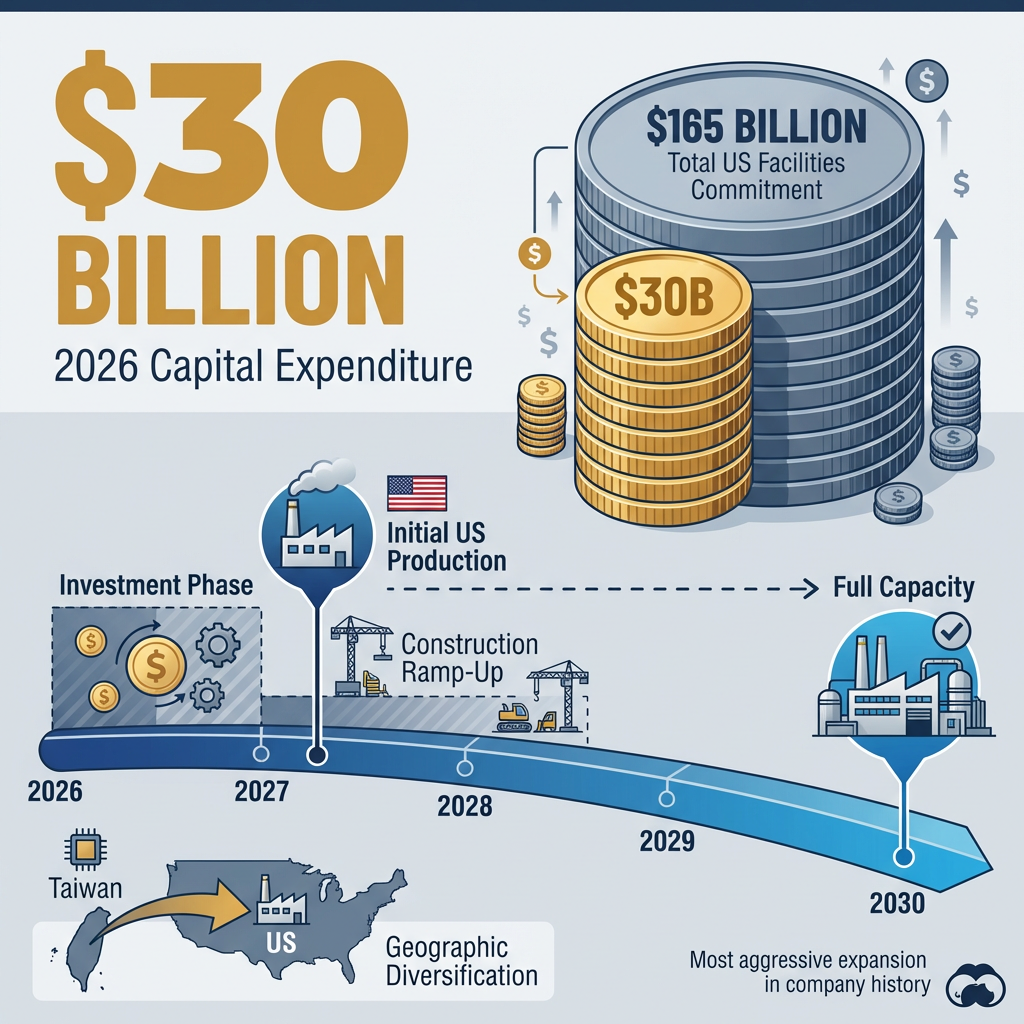
TSMC announced plans to allocate up to $30 billion in capital expenditure for 2026 to address surging AI chip demand and expand global manufacturing footprint. This investment forms part of a broader $165 billion commitment for chip production facilities in the United States, representing the most aggressive expansion programme in the company’s history.
> Strategic Investment Scale
> TSMC’s expansion addresses both immediate demand-supply imbalances for advanced AI chips and longer-term strategic diversification away from Taiwan’s geographic concentration. The $30 billion annual commitment demonstrates management’s confidence in sustained structural demand despite near-term margin pressures.
Analysts anticipate margin compression as overseas facilities ramp production, given significantly higher construction and operating costs outside Taiwan. This creates near-term tension between growth investment and profitability metrics, though management views geographic diversification as essential to maintaining customer relationships and mitigating geopolitical risks. The expansion timeline extends through the end of the decade, with initial U.S. production capacity expected online in late 2026 or early 2027.
Middle East Conflict Poses Supply Chain Uncertainty
The escalating military conflict involving the U.S., Israel, and Iran has disrupted shipments of helium and bromine from Middle East facilities, creating supply chain vulnerabilities for semiconductor manufacturing. These specialty chemicals are essential to chip fabrication processes, and attacks targeting regional production facilities have caused temporary shutdowns that ripple through global supply networks.
TSMC confirmed during the April 16 earnings call that it has secured alternative suppliers for immediate needs and expects no near-term financial impact from current disruptions. However, the company acknowledged that longer-term supply security remains a concern if regional instability persists or escalates further. The semiconductor industry’s reliance on geographically concentrated sources for critical materials represents a structural vulnerability that affects all manufacturers, not just TSMC.
The company’s response to supply chain disruptions affecting semiconductor production demonstrates management’s focus on contingency planning, though longer-term material security remains a strategic concern for the industry.
The next major ASX story will hit our subscribers first
What TSMC’s Results Mean for AI and Tech Stocks
TSMC’s 58% profit growth validates the investment thesis that AI infrastructure demand generates tangible, record-breaking financial results rather than speculative hype. The surge confirms that companies like Nvidia and cloud service providers are translating AI development into measurable chip orders, reinforcing the case for continued technology sector investment focused on AI enablement.
While TSMC’s results validate strong AI demand, investors should also consider broader AI investment risks that may affect the sustainability of semiconductor demand growth beyond 2026.
Gartner’s forecast of $71 billion AI chip market growth for 2024, with compound annual growth exceeding 40% through 2027, provides the demand foundation that makes TSMC’s $30 billion annual capital commitment financially viable despite near-term margin pressures.
However, investors should monitor three emerging constraints that may moderate growth pace despite strong fundamental demand. Capacity limitations that could delay next-generation products from Nvidia and other major customers, margin pressure from the aggressive $30 billion expansion programme, and geopolitical supply chain risks all warrant attention. These factors do not undermine the long-term AI growth narrative but suggest that execution risks and supply chain management will increasingly influence TSMC’s ability to capitalise on structural demand tailwinds.
Frequently Asked Questions About TSMC Q1 2026 Earnings
How much profit did TSMC make in Q1 2026?
TSMC reported record net profit of $18.2 billion in Q1 2026, representing 58% year-over-year growth. This represents the company’s highest quarterly profit ever, driven primarily by demand for advanced 3nm AI chips from clients including Nvidia and Apple.
Why did TSMC stock fall after strong Q1 earnings?
Shares declined due to a combination of profit-taking after reaching record highs earlier in the week, concerns about Middle East supply chain disruptions affecting helium and bromine supplies, and investor concerns about capacity constraints potentially limiting growth or straining customer relationships. The 2.4-3.1% decline reflects cautious forward-looking sentiment despite exceptional historical results.
What is TSMC spending on capacity expansion in 2026?
TSMC plans to allocate up to $30 billion in capital expenditure for 2026 global operations, part of a broader $165 billion commitment for chip production facilities in the United States. This expansion aims to address AI chip demand whilst diversifying geographic concentration away from Taiwan.
How are Middle East tensions affecting TSMC?
The U.S.-Israel-Iran conflict has disrupted supplies of helium and bromine, critical semiconductor manufacturing materials, from Middle East facilities. TSMC has secured alternative suppliers for near-term needs and expects no immediate financial impact, though longer-term supply security remains uncertain if regional instability persists.
—
This article is for informational purposes only and should not be considered financial advice. Investors should conduct their own research and consult with financial professionals before making investment decisions.
Frequently Asked Questions
What were TSMC's Q1 2026 earnings results?
TSMC reported a record net profit of $18.2 billion in Q1 2026, a 58% year-over-year increase driven by surging demand for advanced 3nm chips from AI and consumer technology clients including Nvidia and Apple.
Why did TSMC stock drop after record Q1 2026 earnings?
TSM shares fell 2.4% in Taipei and 3.1% on the NYSE following the earnings release due to profit-taking after the stock hit record highs, concerns about Middle East supply chain disruptions to helium and bromine supplies, and investor worries over capacity constraints potentially limiting future growth.
How much is TSMC investing in capacity expansion in 2026?
TSMC plans to allocate up to $30 billion in capital expenditure in 2026, forming part of a broader $165 billion commitment to build chip production facilities in the United States to address AI chip demand and reduce geographic concentration in Taiwan.
How are Middle East tensions affecting TSMC's supply chain?
Escalating U.S.-Israel-Iran conflict has disrupted supplies of helium and bromine — chemicals critical to semiconductor fabrication — from Middle East facilities; TSMC has secured alternative near-term suppliers and expects no immediate financial impact, but longer-term supply security remains uncertain.
What do TSMC's Q1 2026 results mean for AI chip stocks?
TSMC's 58% profit growth validates that AI infrastructure spending is generating real, measurable financial results, reinforcing the investment case for AI-focused semiconductor companies, though capacity constraints, margin pressure from expansion, and geopolitical risks remain key risks to monitor.