
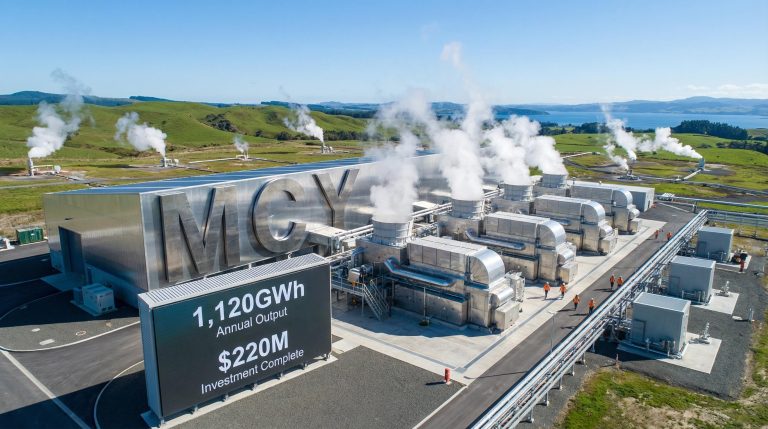
Mercury completes $220 million geothermal expansion, powering Christchurch-equivalent homes
Mercury NZ Limited (ASX: MCY) has officially opened the new fifth generation unit at its Ngā Tamariki Geothermal Station near Taupō, marking completion of the Mercury Ngā Tamariki Geothermal Expansion. The $220 million investment delivers 55MW of new capacity, lifting the station’s annual average generation output to approximately 1,120GWh, enough to power the equivalent of all residential homes in Christchurch.
Construction on the expansion began in 2024 following the initial announcement in 2023, with the project completed in just under two years. The new unit has more than twice the capacity of each of the four original generation units commissioned at Ngā Tamariki in 2013, reflecting advances in geothermal generation technology.
Chief Executive Stew Hamilton and Associate Minister of Energy Shane Jones opened the facility alongside mana whenua Ngāti Tahu Ngāti Whaoa, commercial partner Tauhara North #2 Trust, and approximately 300 contractors and staff who worked on the project.
Project Metrics:
- Total investment: $220 million
- New unit capacity: 55MW
- Annual station output: 1,120GWh
- Construction timeline: Under two years (2024-2026)
- Original commissioning: 2013 (four generation units)
When big ASX news breaks, our subscribers know first
How geothermal baseload generation supports grid stability
Geothermal energy provides baseload power, meaning it generates electricity continuously 24 hours a day, seven days a week, regardless of weather conditions or time of day. This differs from intermittent renewable sources such as wind and solar, which depend on environmental factors. For New Zealand’s national grid, baseload generation is critical for meeting winter demand peaks and maintaining system stability when variable renewable sources experience reduced output.
Mercury (ASX: MCY) operates a 100% renewable generation portfolio comprising hydro, geothermal, and wind assets. The company’s geothermal stations complement its hydro and wind facilities by providing consistent output during periods when water inflows are low or wind speeds are insufficient for optimal generation. This diversification across renewable technologies helps balance supply with demand fluctuations while maintaining grid resilience.
What is Baseload Power?
Baseload power refers to the minimum level of electricity demand that occurs continuously throughout the day and night. Baseload generation assets run constantly to meet this foundational demand, providing grid stability and reliability. Geothermal plants are well-suited to baseload supply because underground heat sources remain constant, enabling uninterrupted electricity generation.
Carbon reduction through gas reinjection technology
As part of the Mercury Ngā Tamariki Geothermal Expansion, the company drilled two new geothermal wells extending to depths exceeding 3,000 metres and reaching temperatures up to 290°C. One well provides additional steam supply for the new generation unit, while the second enables injection of geothermal fluid to support reservoir sustainability. The station now operates nine geothermal wells in total.
These new wells have enabled Mercury to reinject non-condensable gases, primarily carbon dioxide, back into the geothermal reservoir instead of releasing them into the atmosphere. The reinjection capability now applies across the entire Ngā Tamariki station. Mercury has stated this technology will help achieve a 70% reduction in the station’s carbon emissions by 2030, significantly lowering the facility’s environmental footprint compared to conventional geothermal operations.
For investors, the carbon reduction initiative positions Mercury favourably as regulatory scrutiny of emissions intensifies across energy markets. Lower emissions reduce potential exposure to future carbon pricing mechanisms and support the company’s appeal to ESG-focused capital allocators seeking exposure to clean energy infrastructure with demonstrable decarbonisation pathways.
Mercury targets 3.5 TWh of new generation by 2030
The Ngā Tamariki expansion forms part of Mercury’s broader growth trajectory targeting 3.5 TWh of new generation capacity by 2030, representing approximately 8% of New Zealand’s annual energy demand. The company has committed a combined $1 billion to renewable expansion, including the geothermal project and two wind farms currently under construction. The wind facilities are expected to begin generating electricity by the end of 2026.
This capital deployment programme provides medium-term growth visibility for shareholders. The 3.5 TWh target indicates sustained investment in long-life renewable assets that generate predictable cash flows once operational. Mercury’s Chief Executive Stew Hamilton noted that geothermal energy is central to the company’s long-term growth strategy, with the expansion at Ngā Tamariki supporting what he described as “the fastest rate of renewable generation development in New Zealand’s history.”
| Project | Investment | Capacity/Output | Status | Expected Completion |
|---|---|---|---|---|
| Ngā Tamariki Unit 5 | $220M | 55MW / 1,120GWh total station output | Completed | March 2026 |
| Wind Farm 1 | Part of $1B programme | Not disclosed | Under construction | End 2026 |
| Wind Farm 2 | Part of $1B programme | Not disclosed | Under construction | End 2026 |
| Total Programme | $1B | 3.5 TWh by 2030 (~8% of NZ demand) | In progress | 2030 |
Supercritical geothermal partnership with New Zealand Government
Mercury is partnering with the New Zealand Government on an investigation into supercritical geothermal energy. Supercritical systems access geothermal resources at higher temperatures and pressures than conventional wells, potentially delivering significantly greater power output per well. While this remains exploratory and is not yet material to Mercury’s near-term operations, the partnership signals potential optionality for next-generation geothermal technology beyond the company’s existing asset base.
Regional economic impact and project execution
The Mercury Ngā Tamariki Geothermal Expansion employed approximately 300 people during construction, drawing workers from Taupō, Rotorua, Hamilton, New Plymouth, Napier and beyond. The project accumulated more than 250,000 construction hours with no serious harm incidents recorded, demonstrating a strong safety culture and effective project execution capabilities.
Regional workforce locations:
- Taupō
- Rotorua
- Hamilton
- New Plymouth
- Napier
Mercury developed the expansion in collaboration with commercial partner Tauhara North #2 Trust and mana whenua Ngāti Tahu Ngāti Whaoa to ensure geothermal reservoir sustainability and environmental management. These community partnerships support the company’s social licence to operate and position it favourably for future development opportunities in the Taupō geothermal field.
For investors, the safety record reduces project execution risk and potential insurance cost escalations. Strong community relationships lower regulatory and reputational risks that could delay or complicate future expansion initiatives, particularly in geothermal development where resource consents and iwi engagement are critical path items.
The next major ASX story will hit our subscribers first
What Ngā Tamariki expansion means for Mercury shareholders
The Mercury Ngā Tamariki Geothermal Expansion demonstrates the company’s capacity to deploy significant capital into long-life baseload renewable infrastructure while maintaining project discipline. The station’s original design in 2013 included allowance for future expansion, indicating strategic foresight in asset planning. The $220 million investment adds low-carbon generation capacity with minimal ongoing fuel costs, a characteristic of geothermal assets that supports long-term margin stability.
Mercury operates exclusively renewable generation assets across hydro, geothermal, and wind technologies. This portfolio positioning aligns with decarbonisation mandates and avoids stranded asset risk associated with fossil fuel generation. The New Zealand Government holds a legislated minimum 51% shareholding in Mercury, providing sovereign backing that reduces policy and regulatory uncertainty for minority shareholders.
Stew Hamilton, Chief Executive
“Our investments support the fastest rate of renewable generation development in New Zealand’s history. This is the best way we can help deliver affordable renewable energy and help power economic growth over the coming decades.”
The 3.5 TWh capacity target by 2030, combined with the $1 billion investment programme, provides visibility on Mercury’s growth trajectory through the remainder of the decade. For shareholders, this represents sustained capital deployment into revenue-generating assets rather than speculative development pipelines, with geothermal and wind technologies offering different risk-return profiles that balance the overall portfolio. The completion of Ngā Tamariki under budget timelines and without safety incidents reinforces management’s execution credibility on major infrastructure projects.
Want the Next Utilities Breakthrough in Your Inbox?
Join 20,000+ investors receiving FREE ASX breaking news and in-depth analysis delivered within minutes of release. Get real-time alerts on utilities sector developments the moment they hit the market. Click the “Free Alerts” button at Big News Blast to stay ahead on energy infrastructure moves.