
Genesis Energy lifts FY26 guidance as hydro surge drives Q3 outperformance
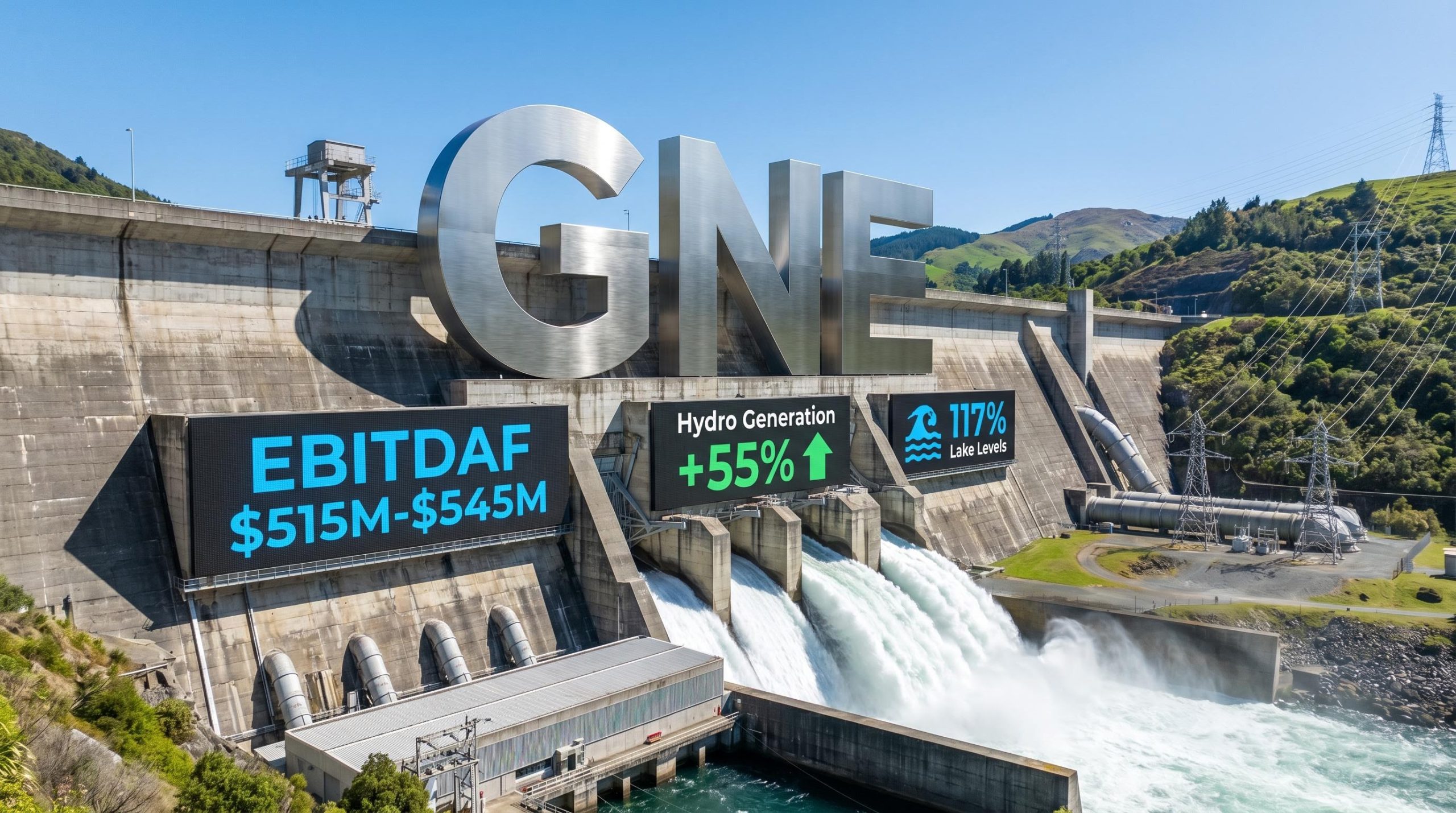
Genesis Energy has upgraded its FY26 normalised EBITDAF guidance to $515 million–$545 million, raised from the prior range of $490 million–$520 million. The upgrade follows a strong third quarter performance supported by improved hydrology, disciplined cost management, and favourable wholesale market conditions. National lake levels stood at 117% of average as at 21 April 2026, providing strong momentum heading into Q4. The revised guidance signals operational outperformance in an inflationary environment, demonstrating the company’s ability to leverage favourable renewable generation conditions while maintaining cost discipline across its thermal fleet.
When big ASX news breaks, our subscribers know first
What is EBITDAF and why does it matter for energy investors?
EBITDAF stands for Earnings Before Interest, Tax, Depreciation, Amortisation, and Fair value movements. Energy companies use this metric rather than net profit because it strips out non-cash accounting items and allows comparison across capital-intensive utilities. For Genesis, EBITDAF reflects underlying cash generation capacity before financing costs and accounting adjustments. The upgraded EBITDAF guidance indicates improved operational performance driven by higher-margin hydro generation, reduced thermal fuel costs, and strategic retail portfolio optimisation. This metric provides investors with a clearer view of the company’s core earnings power, independent of financing structure or accounting policy changes.
Hydro generation surges while thermal assets remain disciplined
Genesis delivered 745 GWh of hydro generation during Q3, up 264 GWh (+55%) on the prior corresponding period. Favourable hydrology and above-average storage levels throughout the quarter supported the surge, allowing the company to scale back expensive thermal generation. Thermal output fell to 236 GWh, down 716 GWh (-75%) on the prior year, with Unit 5 remaining largely offline due to market conditions and disciplined fuel management. Available gas was redirected to higher-value industrial customers rather than being burned for electricity generation. The coal stockpile remains high at over 1 million tonnes, providing security of supply while replacement coal remains unaffected by export restrictions.
The operational flexibility demonstrated by Genesis highlights a key advantage for investors: the company can pivot between generation sources based on market conditions, preserving margins when renewables perform strongly.
Generation emissions drop as renewable contribution rises
Generation emissions fell to 169 ktCO₂ during Q3, down from 666 ktCO₂ in the prior year—a 74.6% reduction. Generation carbon intensity dropped to 172 tCO₂/GWh from 465 tCO₂/GWh, reflecting the renewable-dominant generation mix. As thermal generation was scaled back, the renewable contribution to total generation increased significantly, reducing the company’s carbon cost exposure.
Lower emissions align with New Zealand’s long-term decarbonisation mandates and reduce Genesis’ exposure to volatile carbon pricing. This positions the company favourably as regulatory pressure on emissions intensifies across the energy sector.
| Metric | Q3 FY26 | Q3 FY25 | Change |
|---|---|---|---|
| Hydro Generation (GWh) | 745 | 481 | +264 GWh (+55%) |
| Thermal Generation (GWh) | 236 | 952 | -716 GWh (-75%) |
| Generation Emissions (ktCO₂) | 169 | 666 | -497 ktCO₂ (-74.6%) |
| Generation Carbon Intensity (tCO₂/GWh) | 172 | 465 | -293 tCO₂/GWh (-63.0%) |
Retail strategy prioritises margin quality over customer volume
Genesis reported total customers of 491,532, down 6.6% on the prior year. This decline reflects deliberate portfolio optimisation, with the company prioritising margin quality over volume growth. Electricity netback improved to $173/MWh, up 11.2% on the prior year, while total electricity sales fell to 1,380 GWh, down 94 GWh as the company shed low-margin accounts.
During the quarter, Genesis completed the integration of Frank into the Genesis brand, consolidating the retail offering under a single brand and simplifying the customer proposition. The decline in customer numbers paired with rising netback indicates successful value-over-volume execution—the company is improving unit economics while exiting unprofitable segments.
Key retail margin metrics:
- Electricity netback: $173/MWh (+11.2% on pcp)
- Gas netback: $30.5/GJ (+14.5% on pcp)
- LPG netback: $1,702.3/t (+19.5% on pcp)
Gen35 strategy advances across renewables and flexibility
Genesis continued to progress its Gen35 strategic roadmap, which aims to transition the company to a more flexible, lower-emissions generation portfolio. Key milestones during Q3 included development across battery energy storage systems, solar projects, and gas storage initiatives.
Battery energy storage systems (BESS)
Huntly Stage 1 (100 MW / 200 MWh): Equipment installation is complete, commissioning is approaching and on track, with commercial operation date expected in Q1 FY27. The project remains under budget.
Huntly Stage 2 (100 MW / 200 MWh): Reached final investment decision in April 2026, providing an additional layer of flexible capacity to support New Zealand’s firming requirements as intermittent renewable generation increases.
Solar development pipeline
- Tihori solar farm (136 MWₚ): Construction has commenced and remains on track and on budget.
- Leeston solar farm (67 MWₚ): Progressing toward target FID in Q4 FY26.
- Rangiriri solar farm (271 MWₚ): Pre-FID phase commenced, with FID expected in H2 FY27.
- Foxton solar farm (220 MWₚ): Fast Track consenting application accepted.
Gas storage and flexibility
Tariki Gas Storage: Preliminary economic evaluation completed, with technical studies and negotiations with Tariki JV partners advancing. Gas storage provides critical firming capacity as New Zealand’s electricity system becomes increasingly reliant on intermittent renewables.
Biomass project: Agreement with Natures Flame executed to validate project economics and support ongoing development.
Genesis is de-risking its portfolio by adding flexible storage and renewable generation capacity, reducing reliance on volatile thermal fuel costs while addressing New Zealand’s growing need for firming capacity. The company has $371 million of committed growth capex across BESS and Tihori solar, providing visibility on future capacity additions.
Kupe production impacted by outages but outlook stable
Genesis’ 46% interest in the Kupe Joint Venture delivered mixed results during Q3. Kupe gas sales fell to 1.1 PJ, down 0.6 PJ on the prior year, while Kupe LPG sales totalled 5.1 kt, down 2.2 kt. Oil production came in at 23 kbbl, down 36% on the prior year.
The decline was driven by two unplanned plant outages in January and February totalling 16 days. Excluding the outages, underlying performance was in line with operator expectations. Kupe remains a valuable diversified commodity asset, providing exposure to oil, gas, and LPG markets. The outages are temporary and do not reflect structural issues with the asset.
Outlook and investment considerations
Genesis has upgraded its FY26 normalised EBITDAF guidance to $515 million–$545 million, with all other FY26 guidance remaining unchanged. The upgrade is primarily driven by strong cost discipline, improved hydrology, more favourable wholesale market conditions, and reduced thermal generation with lower fuel and carbon costs. Guidance remains subject to hydrological conditions, gas availability and pricing, plant reliability, and no material changes to market conditions.
The investment thesis for Genesis Energy centres on five key pillars:
- Upgraded guidance signals operational outperformance in FY26, demonstrating the company’s ability to capitalise on favourable renewable generation conditions.
- Hydro-dominant generation mix reduces fuel cost exposure when storage levels are favourable, improving margins relative to thermal-heavy competitors.
- Margin-quality retail strategy is improving unit economics through deliberate portfolio rebalancing and value-over-volume execution.
- Gen35 growth pipeline provides visibility on future capacity additions, with $371 million of committed capex across BESS and Tihori solar.
- Strong balance sheet supports growth capex while maintaining exposure to diversified commodity markets through Kupe.
Want the Next Energy Breakout in Your Inbox?
Join 20,000+ investors receiving FREE ASX energy alerts within minutes of release, complete with in-depth analysis. Click the “Free Alerts” button at StockWire X to get breaking news and expert coverage delivered straight to your inbox the moment market-moving announcements drop.