
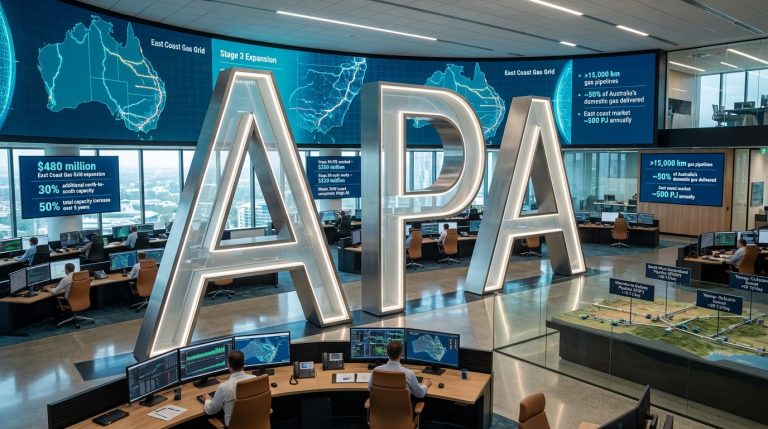
APA Group (ASX: APA) has announced a combined $480 million investment in the APA East Coast Gas Grid Expansion Stage 3, which is expected to add approximately 30% additional north-to-south transport capacity and address projected southern market gas shortfalls from 2028. Stage 3A has reached Final Investment Decision with $260 million committed, while Stage 3B involves $220 million for early works and long-lead procurement, pending final board approval.
APA commits $480 million to expand east coast gas grid capacity by 30%
The Stage 3 expansion comprises two components designed to increase gas transport capacity along Australia’s east coast corridor. Stage 3A, which has reached FID, will invest $260 million to deliver increased north-to-south capacity in time for winter 2028, when southern markets are projected to face supply shortfalls. Stage 3B involves $220 million for the Bulloo Interlink pipeline, including purchase of 342km of line pipe and pre-FID works, with final board approval subject to policy settings and progress with the Federal Government’s Gas Market Review.
This expansion follows earlier investments in Stages 1 and 2, which delivered approximately 25% capacity growth across the East Coast Gas Grid between 2023 and 2024 at a cost of approximately $300 million. When Stage 3 is completed, APA will have increased total capacity by more than 50% over a five-year period.
The staged expansion plan is designed to minimise customer costs by anticipating demand with fit-for-purpose solutions. APA’s modelling indicates that domestic gas delivered from northern supply markets can reach southern markets at a cost materially below imported LNG, based on Argus Northeast Asian spot prices and shipping costs as at 31 July 2025.
APA has confirmed the Stage 3 investments are expected to deliver financial returns above the company’s internal hurdles. The projects will be funded from existing balance sheet capacity and form part of APA’s approximately $3 billion organic growth pipeline.
Join thousands of readers who start here
Our best articles, sent straight to your inbox. You can unsubscribe anytime.
What does the east coast gas grid do and why does expansion matter?
APA Group operates Australia’s largest gas transmission network, delivering around half of the nation’s domestic gas through more than 15,000 kilometres of pipelines. The infrastructure connects gas production basins in Queensland and the Northern Territory with population centres and industrial users in southern states.
The structural challenge driving this expansion is declining supply from southern basins while abundant reserves remain in northern production regions. There are over 68,000 petajoules of 2P reserves and 2C resources in Eastern Australia, serving an east coast market that consumes approximately 500 petajoules annually. The expansion addresses this supply-demand geography mismatch by increasing pipeline capacity to transport northern gas southward.
For investors, this expansion represents growth in contracted pipeline capacity, which underpins predictable revenue streams. APA’s regulated infrastructure model provides long-duration contracted assets with earnings visibility. The Australian Energy Regulator has confirmed that the Bulloo Interlink pipeline will be subject to lighter regulation upon commissioning, exempt from heavy regulation for at least 10 years, providing pricing flexibility.
The Australian Energy Market Operator’s 2025 Gas Statement of Opportunities confirms that expansion of existing pipelines, combined with unlocking northern supply, would meet forecast gas needs into the 2030s without requiring an LNG import terminal.
Stage 3A delivers winter 2028 capacity via three new compressor stations
Stage 3A expands capacity through installation of three new gas compressor stations and debottlenecking works across the north-to-south transmission corridor. The enhanced scope aligns with identified market needs and supports increased gas-powered generation essential for energy transition. Target completion is winter 2028.
The physical infrastructure additions deliver capacity increases across three pipeline segments:
- South West Queensland Pipeline (SWQP): +58 TJ/day (11% increase in north-to-south capacity)
- Moomba to Sydney Pipeline (MSP) mainline: +10 TJ/day (2% increase north-to-south)
- Young-Culcairn lateral: +39 TJ/day (20% increase in northern gas to Victoria)
Together, these additions provide approximately 107 TJ/day of incremental capacity, with SWQP compression expected to be operational by winter 2028.
Stage 3B secures the Bulloo Interlink through long-lead procurement
Stage 3B involves $220 million investment to secure 342km of line pipe for the Bulloo Interlink pipeline and progress pre-FID works. This procurement strategy de-risks the delivery timeline by securing critical long-lead items while final investment decision remains subject to policy settings, progress with the Federal Government’s Gas Market Review, and board approval.
The Bulloo Interlink is designed to provide up to 800 TJ/day maximum capacity for north-to-south gas transport. Investment in long-lead items maintains a 2028 target delivery timeframe. The Australian Energy Regulator’s confirmation of lighter regulation for at least 10 years provides regulatory certainty and pricing flexibility for the asset.
The lighter regulation framework represents a strategic advantage, allowing commercial pricing arrangements rather than strict regulated returns during the critical early years of operation.
Domestic gas versus LNG imports: APA’s cost advantage thesis
APA’s modelling concludes that domestic gas delivered to southern markets costs materially less than imported LNG. The analysis compares Argus Northeast Asian spot pricing plus shipping costs against APA’s estimated tolling charges for long-term firm transport along the expanded East Coast Gas Grid.
The Australian Energy Market Operator’s 2025 Gas Statement of Opportunities supports this position, stating that expansion of existing pipelines would meet forecast needs into the 2030s without requiring an LNG import terminal. This positions APA’s infrastructure expansion as a cost-competitive alternative to import terminals, which would require significant capital investment and expose domestic users to international LNG market volatility.
Adam Watson, CEO and Managing Director
“The notion that Australia, as one of the three largest LNG exporters in the world, would need to resort to importing LNG when lower cost, lower emissions domestic gas is readily available, simply doesn’t make sense and would represent a massive failure of government policy.”
The CEO’s commentary emphasises that between Queensland and the Northern Territory, sufficient gas reserves exist to support both domestic markets and Asian LNG customers for decades. Management argues that incremental investment in existing pipeline infrastructure provides a logical, proven and timely solution to meet domestic needs while avoiding the cost and complexity of LNG imports.
For investors, this thesis supports the strategic value of APA’s infrastructure assets. If domestic pipeline transport remains the lowest-cost delivery method, contracted capacity on the East Coast Gas Grid positions APA as essential infrastructure in Australia’s long-term energy mix.
ECGG expansion stages at a glance
| Stage | Investment | Capacity Increase | Target Completion |
|---|---|---|---|
| Stages 1 & 2 (complete) | ~$300 million | 25% across ECGG | 2023-2024 |
| Stage 3A (FID reached) | $260 million | ~11% north to south | Winter 2028 |
| Stage 3B (pre-FID) | $220 million | 800 TJ/day max capacity | 2028 target |
| Future stages | ~$800 million (estimate) | ~450 TJ/day to Victoria + 500 TJ storage | 2029+ |
Funding and strategic fit within APA’s growth pipeline
APA will fund the Stage 3 investments from existing balance sheet capacity without requiring equity raising. The projects form part of the company’s approximately $3 billion organic growth pipeline, demonstrating significant additional expansion opportunities beyond the current commitments.
Management has confirmed that expected returns on the Stage 3 investments exceed APA’s internal hurdle rates, though specific return percentages have not been disclosed. Project returns are developed based on multiple factors, including the relative risk profile of each investment.
The funding structure supports distribution sustainability by avoiding equity dilution while deploying capital into regulated infrastructure assets with contracted revenue streams. This approach aligns with APA’s strategy of growing earnings through organic expansion of existing networks rather than acquisitions or new greenfield developments.
For investors assessing the capital allocation framework, the absence of equity raising indicates management confidence in balance sheet capacity to fund the pipeline of growth projects while maintaining financial flexibility. The regulated asset base expansion through these projects should support long-term distribution growth as new capacity enters service and generates contracted revenue.
Enjoyed this article?
We publish high-impact stories like this a few times a week. No spam.
What comes next for APA’s east coast expansion
Beyond Stage 3, APA is progressing investment to address projected shortfalls in the mid to late-2030s. Future expansion stages include additional compression capacity, the Riverina Storage Pipeline, and VTS upgrades. These projects are targeting approximately 450 TJ/day of additional capacity to Victoria plus 500 TJ of storage capacity, with indicative investment estimated at approximately $800 million, though this remains subject to board approval as projects progress.
Ongoing gas demand is expected to be underpinned by multiple drivers:
- Industrial demand and electrification requirements
- Gas-powered generation supporting renewables integration as coal retires
- Significant additional demand from AI and data centre development
The Australian Government’s Future Gas Strategy projects ongoing strong demand for gas to the 2050s and beyond, providing multi-decade visibility for infrastructure investment. APA’s phased expansion approach allows the company to scale capacity in response to demonstrated demand while minimising customer costs through fit-for-purpose solutions.
Management has emphasised that pipeline capacity will not constrain solutions to projected east coast gas supply shortfalls. The critical dependency identified by APA is implementation of a well-designed gas reservation policy that supports upstream investment and ensures adequate supply volumes reach the east coast market.
Adam Watson, CEO and Managing Director
“APA is addressing southern gas market transport bottlenecks and there’s plenty of domestic gas in the ground.”
For investors, this positions APA as critical infrastructure in Australia’s energy transition, with regulated assets providing essential connectivity between northern gas resources and southern demand centres. The multi-stage expansion programme demonstrates ongoing capital deployment opportunities within the existing network footprint, supporting long-term earnings growth without the execution risk associated with entirely new infrastructure corridors.
Want the Next Utilities Breakthrough in Your Inbox?
Join 20,000+ investors getting FREE breaking ASX news delivered within minutes of release, complete with in-depth analysis. Click the “Free Alerts” button at StockWire X to receive real-time alerts the moment market-moving announcements break across energy, infrastructure, and utilities sectors.