
Xero Maps AI Monetisation Plan and Melio Breakeven Path Through FY28
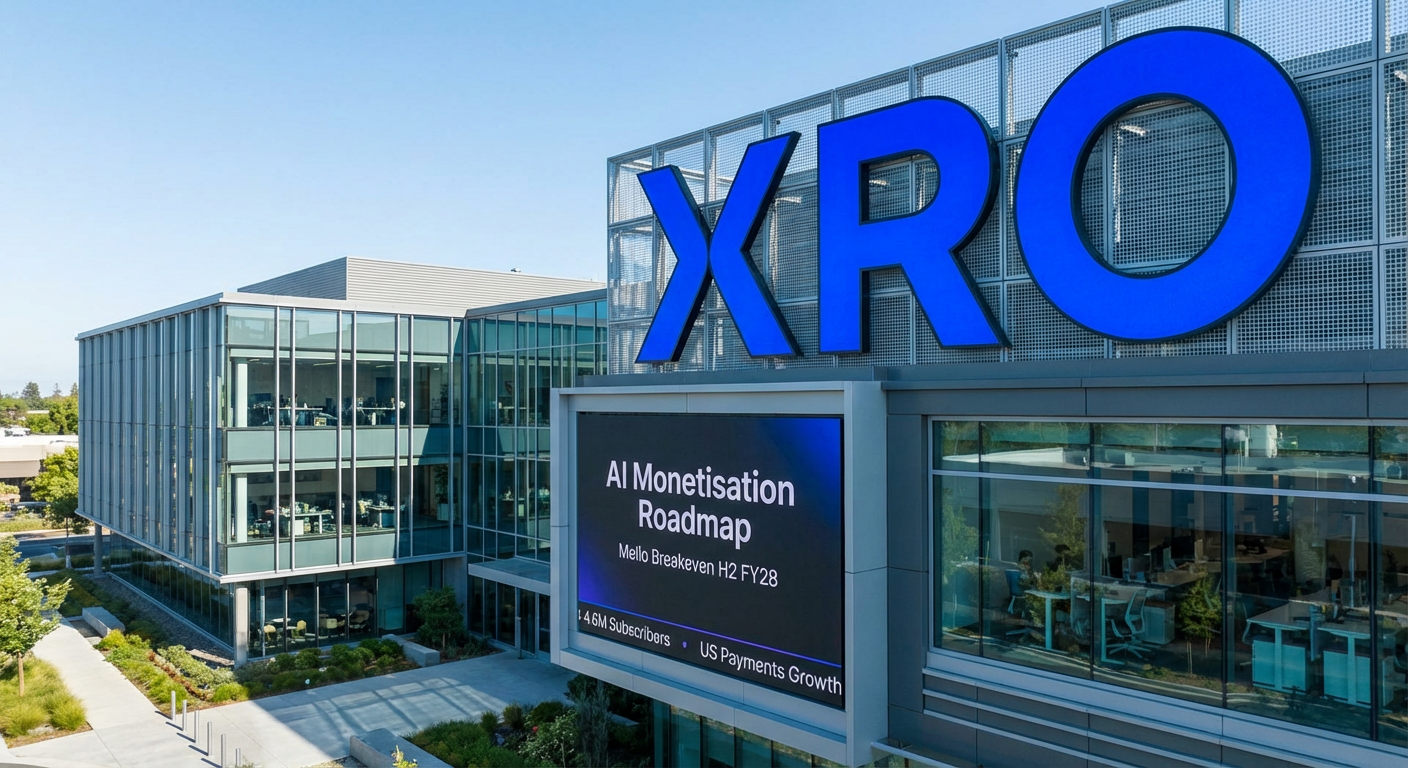
Xero Limited (ASX: XRO) has provided investors with a comprehensive update on its AI and US growth strategy, combining detailed product demonstrations with material financial guidance on its Melio payments acquisition. The global small business platform, which serves 4.6 million subscribers, outlined its dual strategic focus during an investor briefing on 3 February 2026, positioning artificial intelligence and US payments integration as key growth drivers through FY28.
The company announced that Melio is expected to reach Adjusted-EBITDA breakeven on a run-rate basis in H2 FY28, a significant milestone that de-risks the acquisition thesis. This guidance aligns with Xero’s existing FY28 aspirations communicated at the time of the June 2025 acquisition and underpins management’s confidence in pursuing the substantial US total addressable market opportunity.
Chief Executive Officer Sukhinder Singh Cassidy positioned Xero at the intersection of two high-growth opportunities. “We are deeply focused on capturing the global AI and US accounting plus payments TAM. Xero is well positioned to shepherd SMBs into the AI era and take advantage of this technology. We are already a trusted system of record and are now orchestrating multiple agents to evolve into the key system of action and decision making for our customers,” she stated.
The strategic update represents a material shift in Xero’s positioning, transitioning from a passive financial record-keeping system to an active decision-making platform powered by artificial intelligence. This evolution is supported by early adoption metrics showing more than two million subscribers currently using full AI features, with over 300,000 already engaging with newer generative AI capabilities announced at Xerocon Brisbane.
CEO Commentary on Integration Progress
“With Melio, we are executing well on our Win the 3×3 strategy by uniting accounting with payments on one platform to drive deeper value for SMBs, along with increasing scale and gross profit dollar growth. This will allow us to drive enhanced customer unit economics and stronger US growth.”
For FY26, Xero reiterated its operating expense guidance of approximately 70.5% of revenue, which includes the Melio business. This ratio is expected to be lower in H2 FY26 compared to H1 FY26, reflecting phasing of non-recurring remuneration impacts and typical seasonal revenue patterns. The company also confirmed it will transition to providing forward guidance on an Adjusted-EBITDA basis at its FY26 results announcement on 14 May 2026, replacing the existing OPEX ratio framework.
What is driving Xero’s AI competitive advantage?
Xero’s artificial intelligence strategy rests on four foundational advantages that competitors struggle to replicate. The company’s position as a trusted system of record, combined with its scale across 4.6 million subscribers, creates a defensible moat in the emerging AI-enabled small business software market.
The first advantage stems from Xero’s data infrastructure. The platform maintains a deep system of record containing both first-party and third-party data on key small business jobs to be done. This data foundation provides the raw material necessary for training AI models that understand the specific workflows, financial patterns, and operational challenges facing small and medium-sized businesses.
Xero’s second advantage lies in its comprehensive platform approach. Rather than offering point solutions, Xero supports the core jobs to be done for small businesses within a single integrated environment. This centralised architecture allows AI agents to operate across multiple business functions, from accounting and payroll to payments and reporting.
The company’s third advantage combines scale with deep domain expertise. Xero has developed vertical expertise across the breadth of small business operations, enabling it to deliver an AI-enabled platform experience that addresses genuine customer needs rather than generic automation. This expertise is amplified by Xero’s fourth advantage: a strong go-to-market engine built on established partnerships with accountants and bookkeepers who serve as trusted advisors to small business customers.
Management has outlined four strategic pillars through which these advantages translate into customer value:
-
Get help: More than 97% of help sessions are resolved without creating a support ticket, using self-serve content that is partly AI-enabled across all help surfaces including in-product assistance, the dedicated help hub Xero Central, and chat bots.
-
Get time back: Customers save approximately 22 hours each month through automated bank feeds and AI-powered actions that eliminate manual data entry and reconciliation tasks.
-
Manage their business smarter: JAX messages per user have increased by approximately 61% over the last three months, indicating growing engagement with Xero’s AI assistant for business insights and decision support.
-
Unlock new business growth: More than 12% of eligible subscribers have already used AI-powered insights to identify growth opportunities within their operations.
These adoption metrics validate the customer value proposition and provide management with confidence to progress towards monetisation. In FY27, Xero plans to focus on driving usage and adoption of AI features, deepening AI value within its products, and monetising new AI capabilities. The company has established three principles for AI monetisation: simplicity, encouraging adoption, and considering future usage evolution.
When big ASX news breaks, our subscribers know first
Melio integration accelerates US market capture
Xero’s “Win the 3×3” strategy centres on uniting accounting software with payments infrastructure to capture a greater share of the US small and medium-sized business market. The approach targets winning more US SMB customers, expanding average revenue per user, accelerating US growth, and delivering stronger unit economics through the combined value proposition.
Since completing the Melio acquisition in October 2025, Xero has moved quickly on integration priorities. The company has successfully embedded Melio’s basic bill payments functionality directly into the Xero platform, allowing existing accounting software users to access payments capabilities without leaving their primary workflow environment. Management has unified the go-to-market teams across both businesses and consolidated US office locations, with shared services migration now underway to realise operational synergies.
The united Xero-Melio proposition diversifies Xero’s US revenue model by capturing a greater share of small business bill payment revenue. This diversification is particularly valuable given the size of the addressable market and the transaction-based revenue potential from payment processing volumes.
New US business metrics revealed
To improve investor visibility into the previously opaque US segment performance, Xero has introduced three new disclosure categories that will be reported going forward. These metrics provide tools for tracking the execution of the company’s US expansion strategy and assessing the financial returns from the Melio integration.
| Metric Category | What It Measures | Investment Significance |
|---|---|---|
| Total Payment Volume & Gross Take Rate | Adoption and usage of payments across Xero and Melio’s direct customers, measured through TPV processed and the percentage captured as gross revenue | Indicates market share gains and pricing power in the competitive US payments market |
| US Direct Customer ARPU Growth | Growth in average revenue per user among direct US customers, reflecting upsell success and feature adoption | Demonstrates ability to expand revenue from existing customer base through payments integration |
| US Gross Dollar Profit per Customer Growth | Absolute growth in gross profit generated per customer, supporting reinvestment capacity | Validates improving unit economics that fund continued US market expansion |
The new disclosure framework addresses a longstanding investor request for greater transparency into Xero’s US operations, which have historically been consolidated within broader regional reporting. By breaking out payments-specific metrics and customer profitability data, management is signalling confidence in the trajectory of the combined business while providing accountability mechanisms for tracking progress against the Win the 3×3 strategy.
The emphasis on gross dollar profit per customer growth is particularly relevant for investors assessing Xero’s reinvestment capacity. Higher gross profit dollars generated from each customer relationship provide management with greater financial resources to fund sales and marketing programmes, product development initiatives, and geographic expansion efforts within the US market without compromising group-level profitability targets.
The next major ASX story will hit our subscribers first
FY28 aspirations reaffirmed with clear pathway
Xero has reiterated the FY28 financial targets originally outlined at the time of the Melio acquisition in June 2025. The company maintains its aspiration to more than double its FY25 group revenue of NZ$2,103 million by FY28, excluding anticipated revenue synergies of approximately US$70 million. This revenue doubling aspiration implies sustained high growth rates across both the core accounting software business and the newly integrated payments operations.
In addition to the revenue target, Xero continues to aspire towards delivering greater than Rule of 40 outcomes for the group in FY28. The Rule of 40 framework, which combines revenue growth rate and EBITDA margin to assess the balance between expansion and profitability, provides a disciplined target for capital allocation and operational efficiency. Management has noted that in the interim period prior to FY28, the company expects to deliver below Rule of 40 outcomes on a pro forma basis as it digests the Melio acquisition and invests in integration and growth initiatives.
The FY28 aspirations are assessed including both expected revenue synergies and expected cost synergies from the Melio combination. Revenue synergies are anticipated to reach approximately US$70 million by FY28, driven by cross-selling opportunities, enhanced product capabilities, and improved customer retention through the integrated accounting-plus-payments value proposition.
To bridge investors from the current FY26 guidance framework to the FY28 aspirations, Xero will provide a one-off FY27 revenue growth range guide when it announces FY26 results on 14 May 2026. This additional disclosure will help market participants model the growth trajectory and assess the plausibility of achieving the FY28 doubling target.
Key upcoming milestones for investors tracking Xero’s progress include:
- 14 May 2026: FY26 results announcement, including transition to Adjusted-EBITDA guidance framework and one-off FY27 revenue growth range guide
- FY27 focus: Driving AI usage and adoption, deepening AI product value, and monetising new AI features
- H2 FY28: Expected Melio breakeven on an Adjusted-EBITDA run-rate basis
- FY28: Target period for more than doubling FY25 revenue and achieving greater than Rule of 40 outcomes
The reaffirmation of these targets, combined with the new Melio breakeven guidance and enhanced US business disclosures, provides investors with a clearer roadmap for assessing execution against the company’s dual strategic priorities of AI leadership and US market expansion.
Want the Next Software Stock Before It Moves?
Join 20,000+ investors getting FREE breaking ASX news delivered within minutes of release, complete with in-depth analysis. Click the “Free Alerts” button at StockWire X to receive alerts the moment market-moving announcements hit the ASX.