
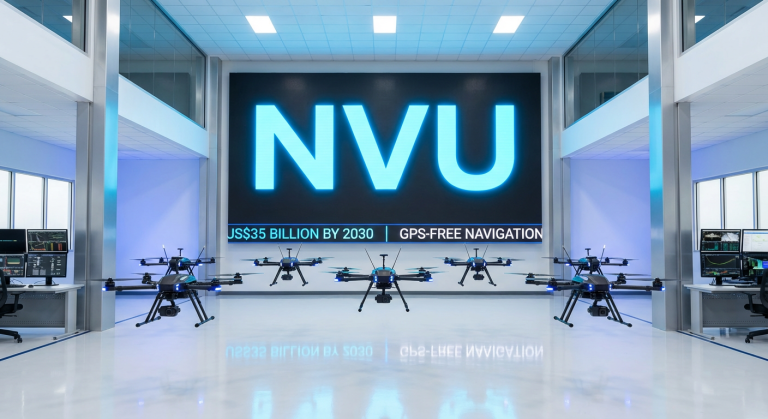
Nanoveu secures exclusive global licence to GPS-free drone swarm navigation technologies
Nanoveu (ASX: NVU) has entered an exclusive evaluation licence agreement with Nanyang Technological University Singapore (NTU Singapore) for four advanced autonomous navigation inventions. The Nanoveu Autonomous Drone Swarm License positions the company to compete in a global drone autonomy and swarm robotics market projected to exceed US$35 billion by 2030.
The announcement, dated 17 February 2026, grants Nanoveu exclusive global licensing rights to four complementary inventions that enable multi-drone swarm functions in GPS-absent or GPS-constrained environments. Unlike traditional approaches that rely on satellite positioning or costly LiDAR systems, the NTU portfolio combines onboard vision and ultra-wideband (UWB) radio technologies to deliver high-precision localisation and formation control without external infrastructure.
What the four NTU inventions deliver
The NTU Singapore portfolio provides four complementary methods for autonomous localisation and swarm coordination. Each invention addresses different operational constraints, from minimal hardware weight to GPS-jammed environments. Together, they offer an infrastructure-light alternative to conventional multi-anchor beacon networks.
| Invention | Technology | Key Advantage | Use Case | NVU Integration |
|---|---|---|---|---|
| Monocular vision localisation | Single onboard camera | Lowest hardware cost/weight | Large swarm formations | Pairs with ECS-DoT low-power control |
| Rotating UWB tag ranging | Radio signal modulation | Works in dust, smoke, GPS-jammed spaces | Indoor/underground sites | Complements vision systems |
| RGB-D leader-follower control | Colour + depth camera | Direct distance cues for smooth spacing | Convoy and inspection workflows | Hybrid fleet compatibility |
| Single-anchor UWB 3D localisation | One fixed anchor + rotating tag | Faster setup, lower cost than multi-anchor | Pop-up logistics hubs, temporary worksites | Rapid deployment focus |
The monocular vision method uses a single camera per robot to estimate relative position and orientation within a group, scaling efficiently to large swarms. The rotating UWB tag approach modulates radio signals to improve range and bearing over time, maintaining functionality in cluttered, low-light, or smoke-filled environments where optical systems degrade.
RGB-D leader-follower control employs colour and depth cameras to maintain formation spacing and path-keeping with minimal external infrastructure. The single-anchor UWB method achieves 3D positioning using one fixed anchor point, reducing site setup time and cost compared to multi-anchor layouts that require extensive calibration.
Why GPS-free navigation matters for autonomous drones
GPS-based navigation faces fundamental limitations in high-value commercial environments. Satellite signals are unavailable indoors and underground, unreliable in urban canyons where buildings block line-of-sight, and vulnerable to jamming or spoofing in contested spaces. These constraints exclude drones from warehouse automation, underground mining inspection, and dense urban logistics applications where commercial demand is strongest.
LiDAR systems offer an alternative but introduce trade-offs that limit deployability. LiDAR sensors add cost, power consumption, calibration complexity, and weight to each platform, reducing flight endurance and payload capacity. Traditional UWB solutions require extensive fixed beacon infrastructure across deployment sites, creating setup delays and recurring costs.
The NTU inventions address these barriers by combining onboard cameras, precise UWB radio ranging, and single-anchor positioning methods. This approach delivers high-precision, GPS-free localisation without the power draw of LiDAR or the infrastructure burden of multi-anchor UWB grids. The result is a system that can deploy faster, operate longer, and function in environments where competitors cannot.
Building a complete drone autonomy stack with ECS-DoT integration
Integration with Nanoveu’s existing ECS-DoT ultra-low-power control engine creates a combined value proposition addressing both efficiency and autonomy. ECS-DoT delivers sub-milliwatt, 50 Hz closed-loop control that extends flight time without hardware changes. Phase 2 hardware-in-the-loop testing achieved average flight endurance gains of 60% for quadcopters, 58% for hexacopters, and 57% for octocopters across more than 300 campaigns, with no modifications to batteries, propulsion systems, or airframes.
Layering the NTU navigation technologies onto ECS-DoT’s deterministic control framework translates saved energy into additional mission capability rather than idle hover time. The combined stack addresses four critical integration points:
- Deterministic control with robust pose estimation via complementary vision and UWB signals that ECS-DoT can fuse or arbitrate against, preserving tight control even in low-light, dust, or texture-poor scenes
- Infrastructure-light deployment with single-anchor UWB cutting site setup time versus multi-anchor grids, aligning with ECS-DoT’s drop-in philosophy for faster bring-up and lower cost
- Formation behaviours executed within milliwatt-class compute budgets, with RGB-D leader-follower supplying direct distance cues for spacing and path-keeping
- Scalability via multi-chip partitioning across multiple ECS-DoT processors as workloads grow, preserving timing determinism and endurance gains
A practical example illustrates the integration logic. In a warehouse cycle-count sweep, optical features may degrade in dimly lit aisles. The follower drone briefly prioritises UWB range and bearing from the rotating tag to maintain spacing through the turn, then hands back to vision when texture returns. ECS-DoT maintains 50 Hz control throughout the transition, keeping formation stable.
Live drone trials progressing toward completion this quarter
Nanoveu’s EMASS division is conducting live, on-air validation of ECS-DoT technology using an open-source, modular platform suited to controlled and repeatable trials. The testing programme, building on 300+ hardware-in-the-loop campaigns in Phase 2, is on track for completion this quarter.
The trials focus on confirming that sub-milliwatt, 50 Hz closed-loop control demonstrated in simulation can be achieved in real operating conditions and on assessing endurance uplift under natural variability. In parallel, EMASS is exploring GPS-free indoor autonomy with a minimal sensor suite, including a monocular camera and inertial measurement unit (IMU), evaluating how ECS-DoT can support on-device visual-inertial odometry, lightweight obstacle avoidance, and real-time path planning within a tight power budget.
To broaden the test envelope, Nanoveu has engaged a US-based specialist drone technology group to support validation on additional platforms and configurations. This work is intended to inform subsequent phases of the ECS-DoT programme, including further OEM and partner evaluations as milestones are met.
Commercial roadmap and target markets
Nanoveu has outlined a four-step development plan to advance from IP acquisition to commercialisation. The roadmap targets logistics, industrial inspection, and surveillance applications within the US$35 billion drone autonomy and swarm robotics market projected by 2030.
- Integration with ECS-DoT – Developing a bespoke daughterboard combining energy-efficient AI control with GPS-free navigation into a unified drone flight platform
- OEM Engagement – Expanding discussions with global drone manufacturers and avionics suppliers, positioning Nanoveu (ASX: NVU) as a turnkey autonomy partner
- Live Field Trials – Incorporating NTU technologies into Phase 3 real-world flight programmes to validate combined navigation and endurance gains
- IP Expansion – Filing additional patents around integrated swarm autonomy frameworks, building long-term defensibility and global licensing potential
The progression from evaluation to commercialisation follows a staged approach that de-risks capital deployment while expanding partner engagement. Successful Phase 3 trials could accelerate OEM licensing discussions and open multiple revenue channels, including technology licensing to manufacturers, turnkey autonomy partnerships with avionics suppliers, and direct deployment in vertical applications.
Key licence terms
Nanoveu has secured an exclusive evaluation licence with NTUitive, NTU Singapore’s innovation and enterprise company, granting exclusive evaluation rights and, subject to exercise, a worldwide licence to the portfolio of advanced autonomous navigation and formation control technologies. The licence, introduced and assigned through corporate advisor 62 Capital Pty Ltd, initially provides for an evaluation-only period until September 2026.
The agreement requires the provision of data to NTUitive, with NTUitive retaining ownership of the licensed innovation during the evaluation period. If Nanoveu exercises its option to an exclusive worldwide licence, the parties have agreed to negotiate a definitive licence on commercially reasonable terms.
Financial terms include S$50,000 at signing of a licence agreement, S$85,000 on or before 18 September 2026, and S$50,000 annual payments during the licence period thereafter for up to 7 years. Nanoveu will reimburse reasonable patent prosecution and maintenance costs at signing of the licence agreement. The licence scope covers exclusive, worldwide rights for drone swarms in indoor and outdoor surveillance applications.
The company has agreed to issue 5 million performance rights to 62 Capital Pty Ltd. One-third of the performance rights will vest on Nanoveu achieving a 20-day volume-weighted average price of $0.10, $0.15, and $0.20 respectively, with a 5-year expiry from the date of issue.
Management commentary
Alfred Chong, Managing Director and CEO
“This option significantly advances Nanoveu’s vision of becoming a platform leader in Edge-AI enabled autonomous systems. By combining NTU’s world-class localisation technologies with our AIoT and ECS-DoT edge AI control engine, we will aim to enable drone and robotic swarms to operate with precision in environments where GPS cannot, representing a major step in addressing emerging markets for autonomous mobility and next-generation drone ecosystems.”
Management is positioning Nanoveu as a platform leader rather than a single-product company. This ambition, if executed successfully, supports multiple growth vectors across drone autonomy, swarm robotics, and adjacent autonomous mobility markets. The tiered payment structure and evaluation period allows the company to validate commercial potential before committing to full licence fees, representing a capital-efficient approach to IP acquisition.
Nanoveu’s broader technology portfolio includes EMASS’s ultra-low-power systems-on-chip solutions, EyeFly3D glasses-free visualisation platforms, and Nanoshield antimicrobial and anti-fouling films. The NTU licence expands the company’s capabilities in Edge-AI enabled autonomous systems, with applicability to emerging autonomous ecosystems beyond traditional drone applications.
Want the Next Drone Tech Breakthrough in Your Inbox?
Join 20,000+ investors receiving FREE ASX tech news delivered within minutes of release, complete with in-depth analysis. Click the “Free Alerts” button at StockWire X to get breaking announcements the moment they hit the market, with expert coverage already done for you.