
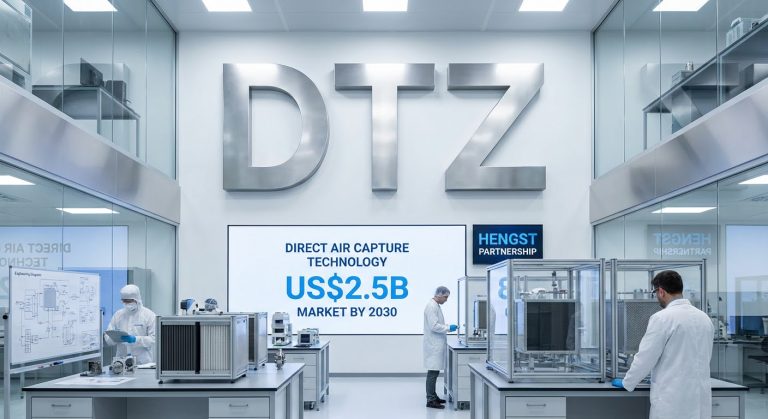
Dotz partners with global filtration leader Hengst to develop plug-and-play carbon capture systems
Dotz Nano Limited (ASX: DTZ) has signed a Memorandum of Understanding with Hengst SE, a Germany-based global leader in filtration technology, to jointly develop structured Direct Air Capture adsorbers. The Dotz Hengst Carbon Capture Partnership represents a strategic shift for the materials science company, moving from sorbent supplier to integrated system provider targeting the rapidly expanding carbon removal market.
Under the MOU, Dotz will supply its proprietary AMP-family sorbent materials for prototype development. Hengst will contribute advanced filtration design, pressure casting, and injection moulding capabilities to structure these materials into DAC adsorber formats. The partnership includes performance benchmarking against commercial sorbents, with both parties agreeing to enter good-faith commercial supply discussions if the prototype achieves predefined performance targets.
The collaboration validates Dotz’s sorbent technology with a major industrial partner. By combining its materials innovation with Hengst’s manufacturing expertise, Dotz is positioning itself to deliver turnkey solutions rather than raw materials, potentially improving margins and market positioning as DAC technology scales commercially.
CEO Sharon Malka stated: “This MOU represents a major step forward as we bring our solution closer to DAC players, moving from sorbent material innovation to structured DAC system solutions, paving the way for broader commercial deployment. We are proud that Hengst, a global leader in filtration technology, recognises the potential of our high-performance sorbent materials.”
What is Direct Air Capture and why does sorbent design matter?
Direct Air Capture refers to technology that removes carbon dioxide directly from ambient air, rather than capturing emissions from industrial exhaust streams. DAC systems use specialised materials called sorbents that chemically or physically bind CO₂ molecules from the atmosphere, then release them when heated or depressurised for storage or utilisation.
Sorbent performance determines the economic viability of DAC operations. Materials must capture CO₂ efficiently at low atmospheric concentrations, require minimal energy to regenerate, and maintain performance over thousands of capture cycles. Sorbent cost and efficiency remain the primary bottlenecks limiting commercial-scale deployment.
Structured adsorbers address a critical engineering challenge. Sorbent powder alone is difficult to deploy at industrial scale due to airflow constraints and system integration complexity. By structuring sorbents into engineered filter formats, manufacturers can optimise air contact, reduce pressure drop, and create modular units that DAC operators can integrate into existing infrastructure.
The Dotz Hengst Carbon Capture Partnership specifically targets this “plug-and-play” solution, combining materials science with filtration engineering to simplify logistics and reduce capture costs.
DAC market projected to exceed US$2.5 billion by 2030
The global DAC market is experiencing accelerated growth driven by climate commitments, technological advancement, and corporate net-zero targets. Industry research forecasts market expansion from the low-hundreds of millions currently to approximately US$2.5 billion by 2030, representing an annual growth rate exceeding 60% through the latter half of this decade.
Solid sorbent-based DAC is positioned to capture meaningful market share due to its modularity and performance potential compared to alternative approaches. The technology’s ability to operate in distributed locations and scale incrementally makes it attractive for both industrial and project-based carbon removal applications.
| Metric | Figure |
|---|---|
| Current DAC market size | Low-hundreds of millions (USD) |
| 2030 forecast | ~US$2.5 billion |
| Growth rate (CAGR) | >60% |
Dotz is positioning its sorbent technology to address this expanding addressable market through partnerships that accelerate commercialisation pathways. The company’s focus on structured adsorber solutions targets the technical and logistical barriers currently limiting DAC adoption at scale.
Management perspective on commercial pathway
Dr. Laura Marie Henning, Development Engineer at Hengst SE, acknowledged the technical challenges inherent in DAC deployment and the strategic value of combining expertise: “Direct Air Capture presents unique technical challenges that require both advanced sorbent materials and optimised structured adsorber design. We look forward to combining Hengst’s expertise in filtration engineering and industrial manufacturing with Dotz’s innovative sorbent technology to evaluate high-performance DAC adsorber concepts.”
Sharon Malka, CEO, Dotz Nano
“Together, our goal is to develop a plug-and-play adsorber with superior performance, helping DAC players reduce capture costs while simplifying logistics and system integration.”
Management commentary signals confidence in technology validation and commercial intent. The MOU structure establishes clear milestones and performance criteria before transitioning to commercial supply agreements, providing a staged risk framework for both parties.
Next steps and what investors should watch
The development pathway outlined in the MOU follows a structured validation process:
- Dotz supplies AMP-family sorbents for prototype development.
- Hengst structures materials into DAC adsorber formats using advanced filtration design and manufacturing capabilities.
- Performance benchmarking against commercial sorbents under defined test conditions.
- If prototype achieves predefined performance targets, parties enter good-faith discussions regarding potential commercial supply agreements.
The key catalyst for investors to monitor is prototype performance results and any announcement of progression to commercial supply negotiations. Successful validation would de-risk Dotz’s technology pathway and potentially establish a template for similar partnerships with other DAC system integrators.
The partnership’s emphasis on “plug-and-play” solutions addresses a recognised market need, potentially accelerating adoption if performance targets are met.
The Dotz Hengst Carbon Capture Partnership represents a strategic inflection point, moving the company from materials innovation to integrated system solutions within a high-growth carbon removal market. Performance validation in the coming months will determine whether this partnership structure can be replicated across the broader DAC ecosystem.
Want the Next CleanTech Breakthrough in Your Inbox?
Join 20,000+ investors getting FREE breaking ASX news delivered within minutes of release, complete with in-depth analysis. Click the “Free Alerts” button at StockWire X to start receiving alerts the moment market-moving announcements hit the ASX.