
BrainChip Commits US$2.5M to Develop Akida 2.0 Neuromorphic Chip on TSMC 12nm
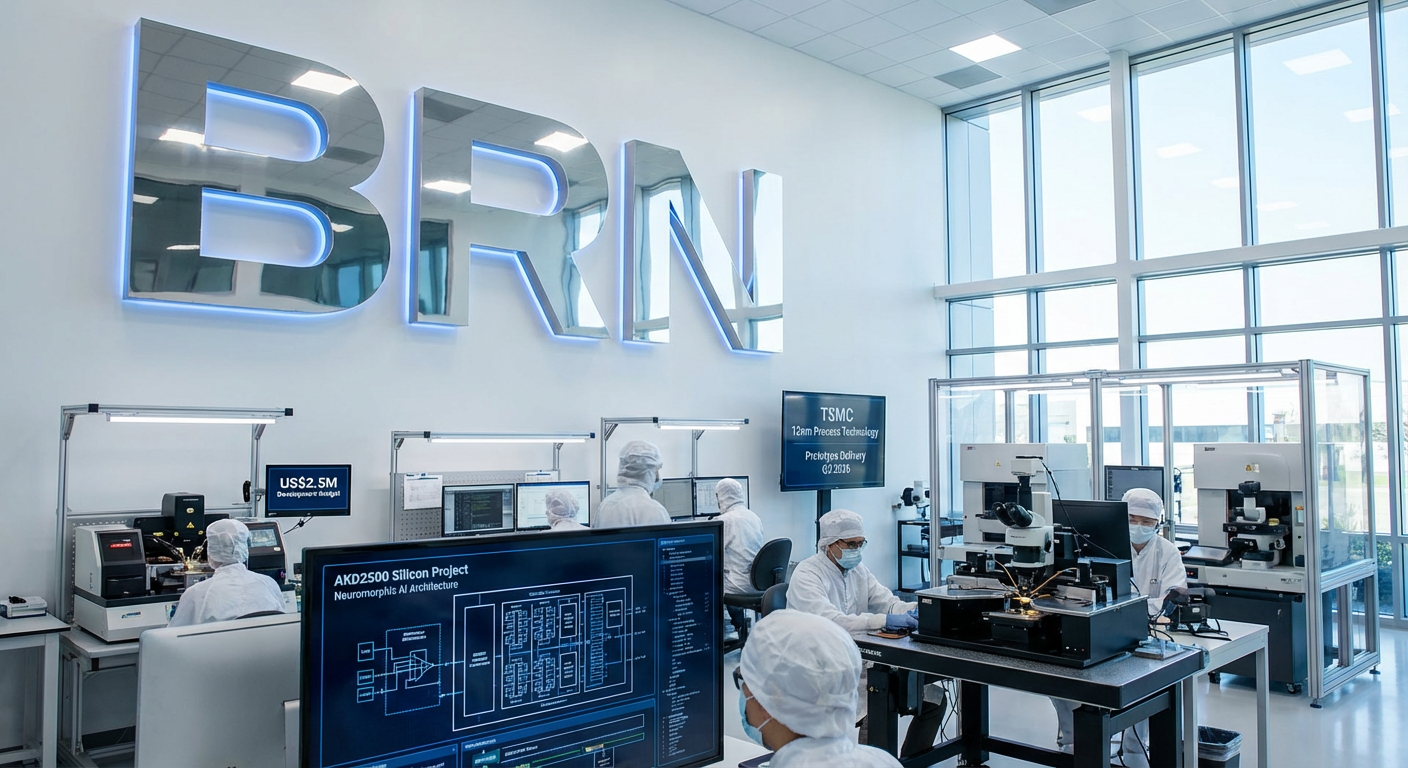
BrainChip Holdings (ASX: BRN) has formally initiated the BrainChip AKD2500 Silicon Project, committing US$2.5 million to develop custom silicon incorporating its next-generation Akida 2.0 neuromorphic architecture. The chip will be fabricated using TSMC’s 12nm process technology, with prototype silicon expected in Q3 2026.
BrainChip commits US$2.5 million to next-generation Akida 2.0 silicon development
The AKD2500 project represents a strategic financial commitment to advancing BrainChip’s neuromorphic IP roadmap into tangible silicon. By partnering with TSMC, the company is positioning its technology on an industry-proven, widely adopted process node that enables potential customers to evaluate performance under conditions relevant to modern edge AI deployments.
The initial development phase will proceed through a multi-project wafer (MPW) pilot, allowing functional validation and manufacturability assessment before any consideration of volume production. Development activities are scheduled across staged milestones over the coming year.
Key project parameters:
- Total budget: US$2.5 million
- Process technology: TSMC 12nm
- Development partner: ASICLAND Co. Ltd (KOSDAQ: 445090)
- Prototype delivery: Q3 2026
- Development approach: Multi-project wafer (MPW) pilot
The project commenced following execution of binding third-party agreements, including engagement with ASICLAND for custom application-specific integrated circuit (ASIC) development services covering design support, TSMC fabrication coordination, packaging and testing.
When big ASX news breaks, our subscribers know first
What is neuromorphic computing and why does it matter for edge AI?
Neuromorphic computing refers to chips designed to mimic how the human brain processes information. Unlike traditional processors that continuously process data, neuromorphic chips operate on an event-based model, analysing only relevant data changes as they occur. This architectural difference dramatically reduces power consumption whilst maintaining processing capability.
For edge AI applications, where processing must occur directly on devices rather than in cloud data centres, this power efficiency becomes critical. Industries deploying edge AI solutions, including autonomous vehicles, industrial IoT sensors, and consumer electronics, require chips capable of sophisticated processing without draining battery life or generating excessive heat. BrainChip’s Akida technology addresses this constraint by enabling real-time AI inference at the point of data acquisition.
Project structure and development milestones
BrainChip expects the total budget of approximately US$2.5 million to cover development services, fabrication activities, packaging and testing, and licensing of required third-party technology. A material portion of this budget will be allocated to IP licence fees, reflecting the use of advanced design elements and supporting intellectual property required for next-generation silicon development.
Expenditures under the project will be incurred on a staged basis, aligned with defined technical milestones across the pilot development program. The MPW pilot approach allows BrainChip to validate functionality before committing to larger production volumes, reducing financial risk whilst maintaining technical rigour.
| Phase | Activity | Status | Expected Timing |
|---|---|---|---|
| Phase 1 | Third-party agreements executed | Complete | February 2026 |
| Phase 2 | MPW pilot development | Underway | H1 2026 |
| Phase 3 | Prototype silicon delivery | Pending | Q3 2026 |
The project does not include guaranteed production volumes. Any transition beyond MPW pilot development, including risk production or volume manufacturing, would be subject to separate approvals, agreements and disclosures as required under ASX Listing Rules.
Strategic positioning in edge AI markets
The AKD2500 serves as a customer validation tool, allowing potential IP licensees to evaluate Akida 2.0 performance in real-world conditions. This capability is essential for converting pipeline interest into licensing revenue, as customers can measure and confirm the advantages of event-based, low-power processing within their own application environments.
BrainChip has identified four target verticals for the AKD2500 platform:
- Defence applications
- Industrial processing and automation
- Consumer electronics
- Intelligent sensing systems
TSMC’s 12nm process node adds customer confidence, being a proven technology widely adopted across the semiconductor industry. This manufacturing credibility supports BrainChip’s IP licensing business model by demonstrating that the Akida architecture can be implemented on established fabrication processes.
CEO outlines commercial opportunity
Management has framed the AKD2500 project as a strategic enabler for commercial engagement rather than a direct revenue generator. The chip provides tangible demonstration capability that supports the pathway from customer evaluation to IP licensing agreements.
CEO Sean Hehir
“This chip gives customers a tangible way to evaluate the capabilities of our Akida 2.0 architecture, which is essential for expanding commercial engagement and driving future IP licensing opportunities. By progressing AKD2500 on TSMC’s 12-nanometre process, we are building the capability required for future customer and partner opportunities. This program strengthens our position in edge AI and represents a disciplined, strategic use of capital to accelerate our technology roadmap.”
The emphasis on “disciplined, strategic use of capital” signals management’s intent to deploy resources toward technology validation rather than speculative development.
Partnership with ASICLAND adds manufacturing credibility
ASICLAND, listed on KOSDAQ under ticker 445090, is a TSMC Value Chain Alliance (VCA) partner specialising in low-power edge AI and turnkey design services. The company provides design support, fabrication coordination, packaging and testing services for the AKD2500 project. Jong-min Lee, CEO of ASICLAND, described the partnership as “a powerful convergence of our proven design expertise and BrainChip’s industry-leading Akida IP.”
The next major ASX story will hit our subscribers first
What investors should watch for next
The AKD2500 program represents a technology development initiative rather than a commercial supply commitment. No customer orders or guaranteed production volumes are attached to this project at present.
Key milestones ahead:
- Q3 2026: Prototype silicon delivery following MPW cycle completion
- Post-Q3 2026: Customer evaluation feedback and potential licensing discussions
- Future catalyst: Any transition beyond pilot development would require separate approvals and ASX disclosures
Investment considerations:
- This is R&D investment, not revenue-generating activity in the near term
- Successful prototype completion will be essential for validating commercial viability
- Customer evaluation outcomes will determine whether the technology converts pipeline interest into licensing agreements
- Any move toward risk production or volume manufacturing requires separate board approval
BrainChip retains ownership of its pre-existing and newly developed proprietary IP associated with the Akida platform. The project includes licensing of selected third-party IP necessary to support implementation of Akida 2.0 in silicon, in accordance with applicable licence terms.
Want the Next Tech AI Breakout in Your Inbox?
Join 20,000+ investors receiving FREE breaking ASX news within minutes of release, complete with in-depth analysis. Click the “Free Alerts” button at StockWire X to get real-time alerts the moment market-moving announcements drop across Tech, Healthcare, Finance, and beyond.