
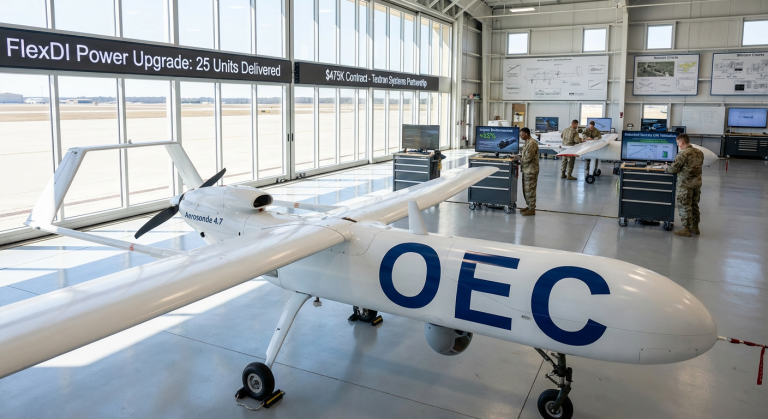
Orbital UAV (ASX: OEC) has secured a contract valued at approximately A$475,000 from Textron Systems for the supply of 25 power upgrade kits for the Aerosonde 4.7 unmanned aerial vehicle currently in service with the US military. Revenue from the Orbital UAV Aerosonde engine upgrade order is expected to be recognised across the remainder of 2026, subject to delivery milestones.
Orbital UAV secures A$475,000 Aerosonde engine upgrade contract with Textron Systems
The contract represents Orbital’s first commercial validation of its engine upgrade kit offering, establishing a new revenue channel beyond original equipment supply. The 25 power upgrade kits will be fitted to Textron’s Aerosonde 4.7 platform, a proven Group 3 UAV operated by the US military for reconnaissance and surveillance missions.
The Aerosonde 4.7 is powered by an Orbital-designed 75HFE engine manufactured by Lycoming Engines, a wholly owned subsidiary of Textron Inc. The upgrade kits utilise Orbital’s patented FlexDI technology, designed to enhance performance, reliability and operational efficiency whilst providing a cost-effective pathway to extend engine life and improve operational capability.
Textron Systems operates the Aerosonde 4.7 as part of its tactical unmanned aerial systems portfolio supporting US defence operations. The platform’s role in persistent surveillance and intelligence gathering makes engine reliability and operational endurance critical performance factors.
What are Group 3 UAVs and why do militaries rely on them?
Group 3 UAVs represent a specific weight and capability classification in military unmanned aerial systems. These platforms typically weigh between 25kg and 600kg and operate at altitudes up to 18,000 feet, filling the operational gap between smaller tactical drones and larger high-altitude reconnaissance aircraft.
The Aerosonde 4.7 operates within this classification as a medium-endurance reconnaissance platform. Its primary missions include persistent surveillance, intelligence gathering, and battlefield monitoring, with flight endurance measured in hours rather than minutes.
Engine performance directly impacts mission capability in Group 3 UAVs. Higher power output enables extended flight times, increased payload capacity, and improved operational ceiling. For defence customers, upgrading existing engines offers a cost-effective alternative to full fleet replacement whilst maintaining operational readiness.
Military procurement cycles favour incremental upgrades over wholesale platform replacement. Existing platforms with proven reliability and established logistics chains represent known quantities for defence planners, making engine upgrades an attractive option for capability enhancement without the risk and cost of new system integration.
FlexDI technology powers the upgrade opportunity
Orbital’s patented FlexDI direct injection technology forms the core of the upgrade kit offering. The technology replaces conventional carburettor systems with electronic fuel injection, providing precise fuel delivery across varying operating conditions and altitudes.
The upgrade delivers three material benefits for military operators. Enhanced performance comes through improved power output and fuel efficiency, critical factors in extending mission duration. Improved reliability stems from fewer mechanical components and reduced maintenance requirements. Extended engine life results from optimised combustion and reduced wear on internal components.
For defence customers managing multi-year fleet budgets, the cost-effectiveness proposition centres on extending the operational life of existing assets rather than funding complete platform replacement. The retrofit solution integrates with engines already in operational service, minimising downtime and avoiding the lengthy certification processes required for entirely new systems.
Operational Efficiency Benefits
The FlexDI upgrade provides defence operators with a cost-effective pathway to extend engine life and improve operational capability without requiring platform replacement or extensive recertification.
The 1,350-engine installed base represents significant revenue runway
Orbital has delivered an estimated 1,350 of these engines into operational service globally, establishing a substantial installed base for potential upgrade adoption. The initial order of 25 units represents approximately 1.9% of this addressable market, positioning the contract as proof-of-concept within a much larger revenue opportunity.
Based on the initial order value, each upgrade kit implies a per-unit value of approximately A$19,000. If upgrade adoption scaled across the full installed base, the potential revenue opportunity would exceed A$25 million at current pricing, though actual adoption rates will depend on customer budget cycles and operational priorities.
| Metric | Value |
|---|---|
| Initial order value | A$475,000 |
| Units ordered | 25 |
| Implied per-unit value | ~A$19,000 |
| Total installed base | 1,350 engines |
| Indicative full-fleet value | ~A$25.7 million |
The company continues to engage with Textron Systems regarding the broader upgrade programme across the existing fleet. These ongoing discussions suggest the initial order may serve as a pilot programme ahead of larger-scale deployment decisions.
Deepening the Textron Systems relationship across multiple platforms
The upgrade contract expands Orbital’s existing relationship with Textron Systems across multiple UAV platforms. The partnership now encompasses three distinct commercial opportunities:
-
150HFE engine supply for the Aerosonde 4.8 platform, an existing contract under which Orbital currently supplies engines for Textron’s newer UAV variant
-
Upgrade kit supply for the Aerosonde 4.7 platform, representing the newly secured contract for retrofit solutions on existing operational aircraft
-
New production engine opportunity for the Aerosonde 4.7, with discussions underway regarding the potential integration of an Orbital-manufactured 75cc engine into future new production orders
The three-pillar relationship provides Orbital with both recurring revenue from upgrade programmes and potential original equipment manufacturer (OEM) opportunities on new production runs. For Textron Systems, consolidating engine supply across multiple platforms with a single proven supplier reduces supply chain complexity and supports parts commonality across its UAV portfolio.
Strategic partnerships with major US defence contractors carry long-term revenue visibility due to multi-year procurement cycles and the preference for proven suppliers in defence programmes.
What this contract signals for Orbital UAV’s growth trajectory
The initial upgrade order validates Orbital’s aftermarket business model beyond its core OEM engine supply operations. Aftermarket upgrades typically carry higher margins than original equipment and create recurring touchpoints with defence customers as fleets age and operators seek performance improvements.
The installed base of 1,350 engines provides a defined addressable market for the upgrade offering. Unlike new platform sales that depend on winning competitive tenders, the upgrade opportunity targets existing Orbital-designed engines already proven in operational service, reducing customer risk and shortening sales cycles.
Defence procurement operates on multi-year budget cycles, with upgrade programmes often funded through sustainment budgets rather than capital acquisition accounts. This characteristic provides revenue visibility once initial orders prove successful and customers commit to broader fleet upgrades.
The 2026 delivery timeline establishes near-term revenue milestones, whilst ongoing discussions with Textron Systems regarding both the broader upgrade programme and new production integration suggest additional contract announcements may follow as these opportunities mature.
Don’t Miss the Next Defence Technology Winner
Join 20,000+ investors getting FREE breaking ASX news delivered to your inbox within minutes, complete with in-depth analysis. Click the “Free Alerts” button at StockWire X to start receiving alerts the moment market-moving announcements break across Defence, Technology, Healthcare, and all non-resource sectors.