
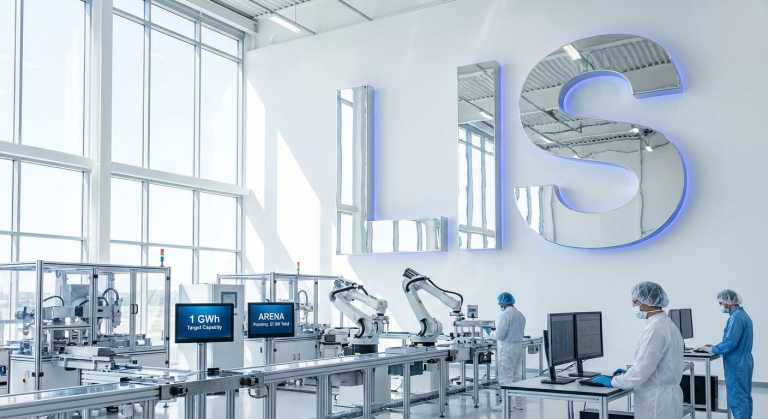
Li-S Energy secures first $1.9 million ARENA funding and appoints Hatch for gigawatt-scale battery facility study
Li-S Energy (ASX: LIS) has received $1.9 million in Li-S Energy ARENA funding and appointed global engineering consultancy Hatch to lead a feasibility study for a large-scale lithium-sulfur battery manufacturing facility. The dual announcement marks a critical step in the company’s pathway toward commercial-scale production, with the proposed facility targeting up to 1 GWh per annum of production capacity.
The $1.9 million represents the first tranche of a $7.8 million grant awarded under the Australian Renewable Energy Agency’s (ARENA) Advancing Renewables Program (ARP). The funding supports the Phase 4 Front-End Loading (FEL-1) feasibility study, which will define the technical, infrastructure and commercial framework required to scale beyond Li-S Energy’s existing automated production line in Geelong, Victoria. Government-backed funding of this scale provides material validation of the company’s technology pathway whilst reducing development capital requirements through non-dilutive financing.
Hatch’s appointment brings demonstrated expertise across gigafactory-scale battery projects and lithium-sulfur chemistry. The engineering consultancy will deliver the FEL-1 study, which the company expects will enable customer adoption and future offtake agreements, particularly across defence, drone and aerospace markets where secure supply chains and scalable manufacturing capability are critical. Independent engineering validation is typically prerequisite for procurement discussions with defence and aerospace customers, who require demonstrated manufacturing readiness before committing to supply agreements.
Dr Lee Finniear, CEO and Managing Director
“The appointment of Hatch is an important step, bringing demonstrated global battery manufacturing expertise and relevant FEL study execution experience, including work across gigafactory-scale battery projects and lithium-sulfur chemistry.”
Understanding lithium-sulfur batteries and why energy density matters
Lithium-sulfur battery technology represents a significant departure from traditional lithium-ion chemistry. Li-S Energy is commercialising lithium-sulfur and lithium-metal battery cells with more than double the energy density of conventional lithium-ion batteries, a technical advantage with substantial implications for weight-sensitive applications.
Energy density refers to the amount of energy stored per unit of weight. Higher energy density translates directly to lighter batteries for equivalent energy storage, or extended range and performance when weight constraints are fixed. For sectors such as drones, electric aviation and defence, where every kilogramme affects payload capacity, flight time or operational range, this performance differential becomes commercially material.
Li-S Energy’s proprietary technology incorporates Boron Nitride Nanotubes (BNNTs) and Li-Nanomesh™, designed specifically for high-performance applications where premium pricing can be supported by superior technical specifications. This positions the company in market segments where energy density advantages justify the technology’s current cost premium over mass-market lithium-ion alternatives.
Lithium-sulfur advantages compared to lithium-ion:
- Energy density more than double that of traditional lithium-ion chemistry
- Lighter weight for equivalent energy storage capacity
- Extended operational range in weight-sensitive applications
- Potential for reduced material costs at scale due to sulfur abundance
- Alignment with defence and aerospace performance requirements
Hatch appointment brings global battery manufacturing expertise
Hatch is an established global engineering consultancy with demonstrated experience across gigafactory-scale battery projects and lithium-sulfur chemistry. The appointment positions Li-S Energy to leverage external expertise in defining a credible manufacturing scale-up pathway beyond its current Phase 3 automated production line in Geelong, Victoria.
The Phase 4 FEL-1 feasibility study will define the early-stage technical, infrastructure and commercial framework required to support large-scale manufacturing. This study phase represents the foundation for progressing from pilot production to commercial-scale operations, with the proposed facility intended to be developed in stages targeting up to 1 GWh per annum of production capacity.
Front-End Loading (FEL) methodologies are standard in large capital projects, providing structured risk assessment and project definition before significant capital commitments are made. For Li-S Energy, independent engineering-led project definition is expected to be a key enabler for customer adoption and future offtake agreements, particularly across sectors where procurement processes require demonstrated manufacturing readiness and supply chain security.
Target markets and customer adoption pathway
Li-S Energy is targeting three priority sectors where lithium-sulfur technology’s energy density advantages align with customer requirements:
-
Defence applications: Military customers prioritise secure supply chains and superior performance metrics. Battery weight directly impacts operational capabilities across drone systems, portable power and next-generation platforms.
-
Drone and unmanned systems: Commercial and defence drone operators require extended flight times and payload capacity. Higher energy density batteries enable longer missions or heavier sensor packages without airframe redesign.
-
Electric aviation: Early-stage electric aviation programmes face severe weight constraints. Energy density improvements represent one of the critical pathways to viable commercial electric flight.
The company expects that independent engineering-led project definition will enable credible discussions with customers across these sectors. Defence and aerospace procurement typically requires demonstrated manufacturing capability and supply chain resilience before committing to long-term offtake agreements. The Hatch-led feasibility study positions Li-S Energy to meet these requirements, providing potential revenue visibility and supporting future financing discussions.
ARENA funding breakdown and next steps
The funding structure provides milestone-based support for Li-S Energy’s manufacturing scale-up pathway. Receipt of the first $1.9 million tranche confirms that grant terms have been satisfied to date, with the remaining funding expected to be released against defined project milestones.
| Funding Component | Amount |
|---|---|
| First tranche received | $1.9 million |
| Total ARENA grant | $7.8 million |
| Program | Advancing Renewables Program |
Milestone-based government funding reduces dilution risk compared to equity financing, a material consideration for shareholders as the company progresses toward commercial-scale operations. The $7.8 million total grant represents substantial validation of Li-S Energy’s technology pathway and manufacturing readiness, with ARENA funding typically reserved for projects demonstrating technical and commercial credibility.
The Phase 4 FEL-1 study now represents the critical path item for Li-S Energy’s scale-up strategy. Completion of the feasibility study is expected to provide the technical and commercial foundation required to progress from pilot production at the Geelong facility to large-scale manufacturing capability targeting up to 1 GWh per annum. This production scale would position the company to credibly address defence, drone and aerospace customer requirements whilst supporting future offtake negotiations and financing discussions.
Want the Next Clean Energy Breakout in Your Inbox?
Join 20,000+ investors getting FREE breaking ASX news delivered within minutes of release, complete with in-depth analysis. Click the “Free Alerts” button at StockWire X to start receiving alerts the moment market-moving announcements hit the ASX across technology, healthcare, finance and manufacturing sectors.