
ECT Advances In-Situ PFAS Destruction Tech Toward Pilot-Scale Deployment
ECT advances in-situ PFAS destruction technology toward pilot-scale deployment
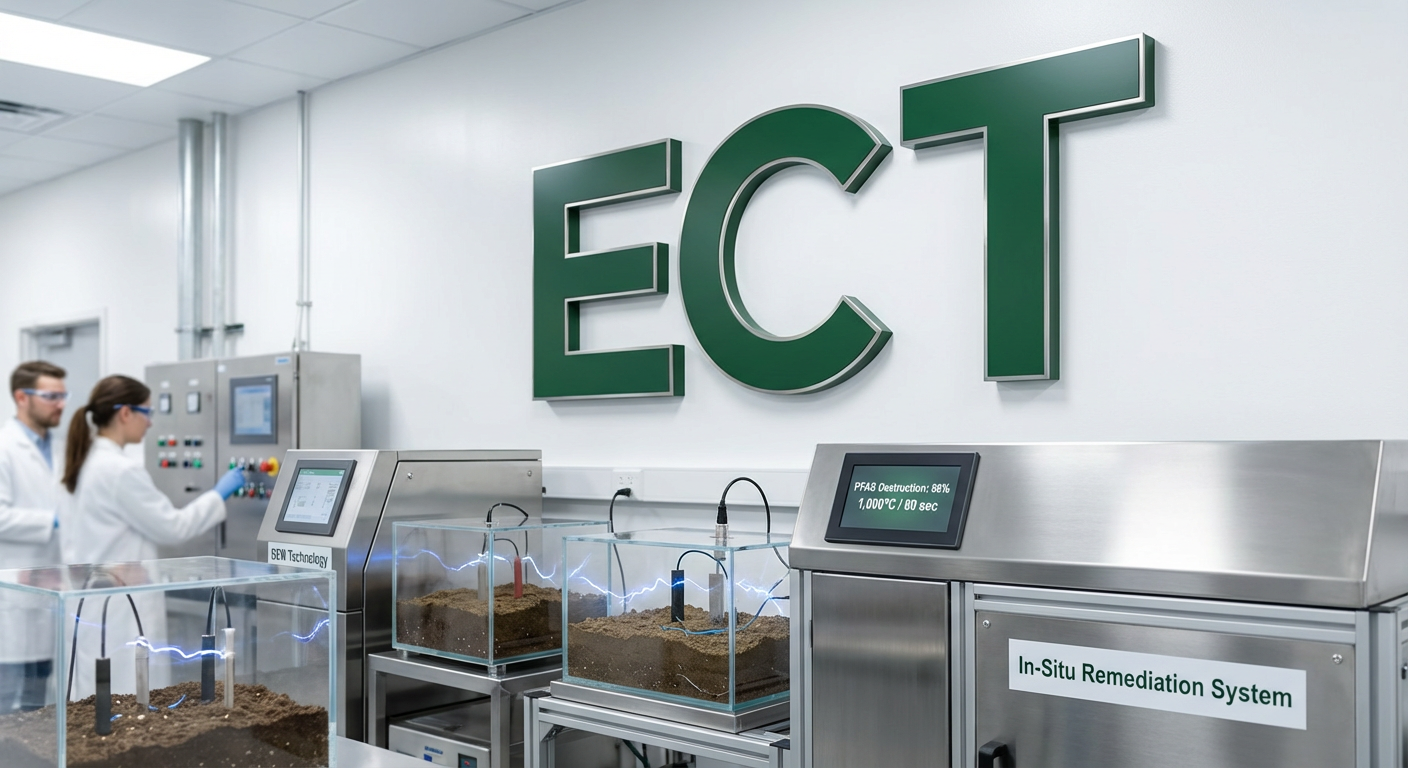
Environmental Clean Technologies (ASX: ECT) is progressing its Rapid Electrothermal Mineralisation (REM) technology toward pilot-scale development, targeting a structural gap in the global PFAS remediation market. The technology is designed to permanently destroy per- and polyfluoroalkyl substances (PFAS) directly within contaminated soil, addressing a limitation in current remediation practices where no scalable, commercially deployed in-situ solution exists. Laboratory testing under controlled conditions has demonstrated defluorination efficiencies exceeding 96% and perfluorooctanoic acid (PFOA) removal of up to 99.98%, with the REM process generating temperatures exceeding approximately 1,000°C within around 60 seconds.
The Environmental Clean Technologies REM PFAS Solution update follows a 12-month transformation period during which ECT refreshed its Board of Directors, acquired an exclusive licence from Rice University for REM technology use, and established an Advisory Board to support commercialisation efforts. The company is now progressing toward pilot-scale validation, with safety testing and hardware validation of a next-generation system in their final stages.
ECT’s positioning reflects investor interest in the PFAS remediation sector, where regulatory tightening and inadequate disposal infrastructure have created demand for permanent destruction technologies rather than containment-based approaches. Current methods rely on excavation, transport, and long-term storage, effectively relocating contamination rather than eliminating it. The limited availability of specialist high-temperature furnaces for off-site PFAS destruction compounds this challenge, positioning in-situ solutions as a priority area for both government and commercial stakeholders.
When big ASX news breaks, our subscribers know first
What is PFAS and why does it matter to investors?
PFAS are synthetic chemicals commonly referred to as “forever chemicals” due to their resistance to environmental degradation. Historically used across industrial and consumer applications, these substances are now widely recognised as hazardous to human health and ecosystems. Their strong carbon-fluorine bonds make them exceptionally persistent, accumulating in soil, water, and biological organisms over time.
The scale of PFAS contamination represents a structural liability with significant economic implications. The European Commission estimates cumulative PFAS-related costs of approximately €440 billion by 2050, with scenarios exceeding €1 trillion under higher contamination assumptions. Separately, the European Environment Agency has estimated annual PFAS-related health costs in Europe of €52-84 billion, reflecting the burden of exposure-related diseases and healthcare system impacts.
Regulatory frameworks governing PFAS are tightening globally, with multiple jurisdictions introducing stricter soil and water contamination thresholds. This regulatory momentum is forcing action across industrial, defence, and municipal sectors, where historical PFAS use has left widespread contamination. However, existing remediation solutions remain constrained by their reliance on containment rather than permanent destruction, creating a structural demand driver for alternative technologies.
The limitations of current remediation methods
Existing PFAS remediation approaches face several operational and economic constraints:
- Excavation and transport: Contaminated soil must be dug up, transported to storage facilities, and held indefinitely, relocating rather than resolving the contamination.
- Limited destruction capacity: High-temperature incineration capable of destroying PFAS is available only through specialist furnaces with constrained capacity and high operational costs.
- Storage availability decline: The availability of approved storage locations for PFAS-contaminated materials is diminishing as disposal volumes increase and regulatory scrutiny intensifies.
- No in-situ destruction pathway: Current practices do not offer scalable technologies capable of destroying PFAS directly within contaminated soil on-site.
REM is being developed to address these limitations by enabling electricity-based PFAS destruction directly within soil, without excavation or secondary waste stream generation.
Technical breakthrough removes key scalability barrier
ECT has developed a high-voltage, high-frequency REM system designed to operate without conductive additives such as biochar, addressing a critical barrier to scalability and commercial viability. Early REM configurations required these additives to facilitate current flow through soil, which introduced additional cost and complexity that limited suitability for large-scale deployment.
The new system has been tested at laboratory scale, demonstrating the ability to uniformly heat contaminated soil to approximately 1,000°C without biochar additives. This advancement represents a material step toward field deployment, as the removal of additive requirements simplifies logistics, reduces operational costs, and improves the feasibility of treating soil in-situ.
| Metric | Previous Configuration | High-Voltage System |
|---|---|---|
| Voltage Input | 160V | 500V |
| Power Output | 500W | Over 1,600W |
| Temperature Achieved | ~1,000°C | ~1,000°C |
| Scale Tested | Laboratory | Kilogram scale |
| Conductive Additives Required | Yes (biochar) | No |
Testing has demonstrated scaling of voltage input from 160V to 500V and power output from 500W to over 1,600W, illustrating hardware scalability and design flexibility. The system’s ability to achieve uniform heating at kilogram scale without additives marks a transition from proof-of-concept to potential field readiness, subject to further validation.
For investors, this technical progression transforms the economics of potential deployment. Eliminating additive requirements removes a material cost component and operational complexity barrier, improving the commercial viability of both in-situ and ex-situ applications. The distinction between laboratory demonstration and commercially scalable technology often hinges on such engineering refinements.
Dual deployment capability
The REM system is being developed to operate in two distinct modes:
- In-situ deployment: Electrodes are inserted directly into contaminated soil on-site, with electrical current applied to generate temperatures sufficient to destroy PFAS without excavation.
- Ex-situ deployment: The system treats PFAS-contaminated soil already stored in containers or barrels, addressing existing stockpiles where disposal capacity is constrained or unavailable.
The ex-situ application addresses an immediate market need. As storage locations for PFAS-contaminated soil become scarcer and regulatory scrutiny increases, existing stockpiles represent a near-term addressable market for destruction technologies. The ability to deploy modular units to these storage sites without requiring permanent infrastructure offers operational flexibility.
Development roadmap and near-term milestones
ECT is currently in Phase 1 of its development pathway, focused on capacity building and technical team expansion. The roadmap reflects a staged progression from laboratory validation to pilot-scale demonstration, with timelines indicative and subject to regulatory, safety, and engineering outcomes.
- Phase 1: Capacity Build (0-3 months)
- Hire specialist electrical engineer in collaboration with Rice University
- Assess complementary PFAS water remediation technology from Rice University
- Expand technical capabilities to support prototype development
- Phase 2: Prototype Validation and Regulatory Readiness (3-6 months)
- Finalise REM prototype design and complete hardware validation
- Initiate permitting processes required for on-site soil remediation
- Complete safety testing of high-voltage, high-frequency system
- Phase 3: Deployment and Pilot Readiness (6-9 months)
- Build pilot modular REM system suitable for field deployment
- Demonstrate on-site PFAS destruction capability
- Scale voltage input approximately 5x to raise total power approximately 25x, reducing remediation times to minutes per cubic metre
- Phase 4: Commercial Market Entry (6-12 months)
- Establish partnerships in the US, Australia, EU, and Japan
- Target non-dilutive government grants and environmental remediation subsidies
- Deploy standardised modular hardware platform for both in-situ and ex-situ applications
The pilot system will utilise the same hardware architecture as the prototype but will be configured as a mobile unit rated for higher power output, enabling on-site deployment at contaminated locations. This modular approach is designed to streamline engineering and commercial rollout while maintaining technical consistency across deployment scenarios.
Standardised modular platform approach
ECT is developing a single, standardised hardware platform capable of operating in both in-situ and ex-situ modes. This design strategy aims to reduce engineering complexity, accelerate commercialisation timelines, and improve cost efficiency by leveraging common components across multiple deployment scenarios.
The company intends to subsidise commercialisation costs through government grants and environmental remediation subsidies, reflecting the strategic importance of PFAS remediation within public policy frameworks. The pilot system’s design as a modular unit enables staged deployment, with revenue potential emerging as validation milestones are achieved.
Executive Chairman outlines strategic positioning
Faldi Ismail, Executive Chairman
“There is currently no scalable, in-situ solution for permanently destroying PFAS in soil. REM is being developed to address that precise challenge, and our progress over the past 12 months reflects a deliberate focus on solving a problem the market already recognises as critical.”
Executive Chairman Faldi Ismail emphasised that existing PFAS remediation pathways remain constrained by excavation, transport, long-term storage, and limited availability of specialist high-temperature furnaces. These structural limitations reinforce demand for on-site destruction technologies capable of addressing contamination directly rather than relocating it.
CTO Justin Sharp has been collaborating with Rice University to develop the high-voltage, high-frequency REM system capable of both in-situ and ex-situ PFAS remediation without the cost and complexity of conductive additives. Management commentary positions ECT’s development efforts as targeting a validated market problem with structural demand drivers already in place, rather than pursuing speculative research and development.
The next major ASX story will hit our subscribers first
What to watch next
Investors should monitor the following near-term catalysts as indicators of ECT’s progress toward pilot-scale validation:
- Completion of safety testing and hardware validation for the high-voltage, high-frequency system
- Hiring of specialist electrical engineer in collaboration with Rice University
- Outcome of complementary PFAS water remediation technology assessment
- Commencement of permitting processes for on-site soil remediation
- Prototype completion and initiation of pilot system development
- Establishment of commercial or government partnerships in target markets (US, Australia, EU, Japan)
The Environmental Clean Technologies REM PFAS Solution represents an early-stage technology development program with clear validation milestones ahead. While laboratory results demonstrate proof-of-concept, progression to pilot-scale and commercial deployment remains subject to technical, regulatory, and operational validation. The company’s focus on addressing a structural market gap with no existing scalable solution positions it within a sector where regulatory momentum and inadequate infrastructure are driving demand for permanent destruction technologies.
Want the Next Industrial Breakthrough in Your Inbox?
Join 20,000+ investors getting FREE breaking ASX news delivered within minutes of release, complete with in-depth analysis. Click the “Free Alerts” button at StockWire X to stay ahead on industrial sector developments the moment market-moving announcements hit the ASX.