
Bhagwan Marine Acquires Riverside Marine for $120M in Transformational Deal
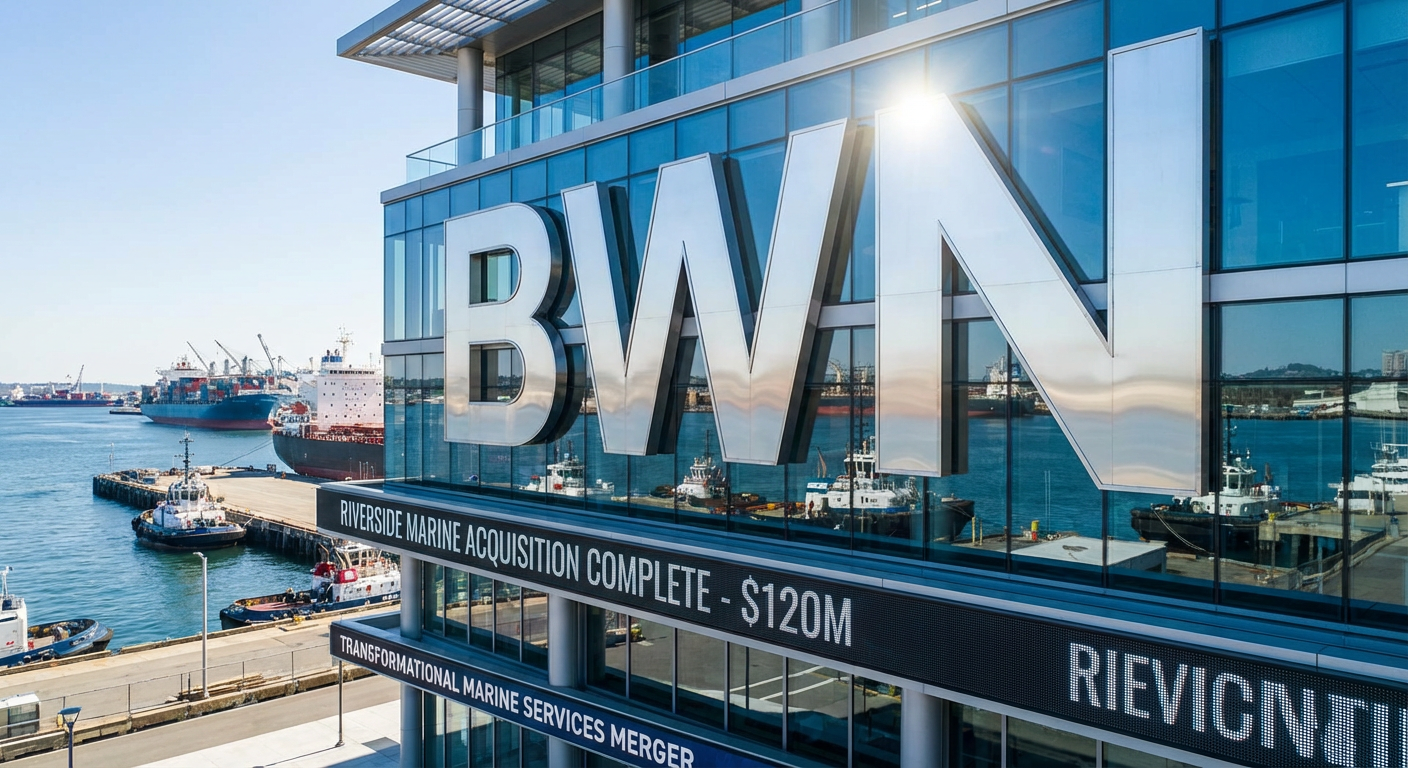
Bhagwan Marine acquires Riverside Marine for $120 million in transformational deal
Bhagwan Marine (ASX: BWN) has announced the acquisition of 100% of Riverside Marine Holdings for $120 million in upfront consideration, marking the company’s largest acquisition to date. Completion is expected on or about 31 March 2026, with funding structured through a $70 million debt facility, $20 million in vendor shares, and a $30 million equity placement at $0.41 per share.
The transaction includes a performance-linked earnout component, with up to $10 million in additional consideration payable if Riverside achieves FY26 EBITDA between $25.2 million and $27.2 million. The earnout structure operates on a linear basis, aligning vendor incentives with operational performance while protecting Bhagwan if Riverside underperforms forecasts.
This acquisition represents a step-change transaction for Bhagwan, immediately scaling the combined group’s earnings base and diversifying revenue streams across service offerings, geographical markets, and commodity exposure. The deal creates a diversified marine services group with enhanced capability in vessel management, harbour operations, and specialised maritime services.
| Funding Source | Amount |
|---|---|
| Debt Facility | $70m |
| Vendor Shares | $20m |
| Equity Placement | $30m |
| Total Upfront | $120m |
When big ASX news breaks, our subscribers know first
What does Riverside Marine bring to the combined group?
Riverside Marine is a 99-year-old Brisbane-founded marine services business, established in 1926 by the Campbell Family. The company operates approximately 30 vessels across five distinct brands, with a capital-light business model focused on vessel management rather than ownership. This operational structure prioritises management contracts over asset accumulation, generating high-quality revenue with minimal capital expenditure requirements.
The business owns 9 vessels valued at approximately $35.7 million, alongside managing a fleet of third-party vessels for tier-one customers. Riverside employs over 200 crew members and operates with an industry-leading EBITDA margin of approximately 40%. For FY26, the company is forecast to deliver revenue of $63.3 million and EBITDA of $26.2 million, representing a 41.3% EBITDA margin.
A defining characteristic of Riverside’s business model is its 88% repeatable revenue base, derived from multi-year contracts with tier-one customers across resources, government, and essential services sectors. Sustaining capital expenditure represents 30% to 35% of EBITDA, significantly lower than asset-heavy maritime operators, which translates to strong free cash flow generation.
Riverside’s five operating brands explained
-
Rivtow Marine (approximately 28% of EBITDA) manages 21 tugs for tier-one mining customers in the Pilbara and Mackay regions, supporting an 11+ year relationship with a major global miner conducting over 20,000 annual tug movements.
-
AIMS Vessel Management (approximately 3% of EBITDA) operates research vessels for the Australian Institute of Marine Science under government contracts spanning 27+ years, conducting approximately 26 expeditions and 220 sea days per vessel annually.
-
Riverside Industrial Sands (approximately 22% of EBITDA) is Brisbane’s largest construction sand supplier, with 1.6 million tonnes of sand available for dredging and exclusive supply agreements with Brisbane’s largest concrete producers.
-
Magnetic Island Ferries (approximately 39% of EBITDA) operates as the sole vehicle ferry service to Magnetic Island under exclusive 20-year lease arrangements, transporting approximately 7,000 vehicles and 4,500 walk-on passengers monthly.
-
Riverside Oceanic (approximately 7% of EBITDA) provides quality charter vessels for hydrography, marine research, and defence support across Northern Australia, with three vessels acquired between 2021 and 2024.
Understanding capital-light maritime business models
A capital-light business model in the maritime sector refers to operations focused on managing and operating vessels rather than owning them. Traditional maritime operators purchase and maintain large fleets, requiring substantial upfront capital expenditure and ongoing maintenance costs. In contrast, capital-light operators like Riverside specialise in vessel management contracts, crew provision, and operational expertise without bearing full asset ownership costs.
This model generates several financial advantages. Maintenance capital expenditure remains proportionally lower, typically 30% to 35% of EBITDA compared to 50% to 70% for asset-heavy operators. Free cash flow conversion improves significantly, as the business generates revenue from management fees and operational margins rather than asset utilisation alone. Balance sheet risk reduces because the company avoids carrying substantial vessel financing debt.
For maritime services operators, capital-light models allow earnings growth without proportionally scaling asset bases, improving return on equity and reducing financial leverage risk. This becomes particularly relevant in cyclical industries where vessel values fluctuate with market conditions, as management-focused businesses remain insulated from asset impairment risks.
Pro forma financials show immediate earnings accretion
The Bhagwan Marine Riverside acquisition delivers immediate financial benefits to the combined group. Pro forma FY26 revenue reaches $346.3 million, while EBITDA increases by 54% to $77.2 million. EBIT grows 75% to $40.0 million, demonstrating operational leverage from combining complementary service offerings.
Margin expansion represents a key financial benefit. EBITDA margin increases from 18% to 24%, while EBIT margin rises from 8% to 12%. These improvements reflect Riverside’s high-margin business model integrating with Bhagwan’s existing operations, creating a more profitable combined entity.
The transaction delivers approximately 14% EPS accretion and return on equity accretion exceeding 20%, indicating efficient capital deployment. Pro forma gearing remains conservative at 1.0x net debt to EBITDA, providing balance sheet flexibility for future growth initiatives while maintaining financial stability.
| Metric | Bhagwan Standalone | Pro Forma Combined |
|---|---|---|
| EBITDA | $50.9m | $77.2m |
| EBITDA Margin | 18% | 24% |
| EBIT | $22.8m | $40.0m |
| Net Debt/EBITDA | 0.1x | 1.0x |
Transaction valuation and earnout structure
At the base case scenario, the acquisition values Riverside at 4.8x FY26 forecast EBITDA of $26.2 million and 7.3x forecast EBIT of $17.2 million. These multiples represent reasonable pricing for a high-margin, contract-backed maritime services business with 88% repeatable revenue.
The earnout mechanism operates on a linear basis, triggered once Riverside achieves EBITDA of $25.2 million and capped at $27.2 million. If Riverside delivers base case EBITDA of $26.2 million, the earnout payment would be $5 million, bringing total consideration to $125 million. At the maximum earnout threshold of $27.2 million EBITDA, total consideration reaches $130 million.
This structure creates downside protection for Bhagwan while incentivising the Campbell family to deliver strong operational performance post-completion. Higher Riverside earnings reduce the effective multiple paid, making the transaction more attractive if the business outperforms forecasts. The earnout also aligns vendor interests with shareholder value creation during the integration period.
Strategic rationale and growth outlook
The acquisition delivers multiple strategic benefits. Service diversification expands Bhagwan’s offering to include third-party vessel operations, harbour tugs, sand dredging, and commercial ferry services. Geographical expansion adds exposure to North Queensland, Mackay, and Port Hedland, complementing Bhagwan’s existing footprint. Commodity diversification introduces iron ore, metallurgical coal, and industrial sand exposure, reducing oil and gas concentration from 66% to 53% of combined revenues.
Repeatable revenue increases from approximately 40% to 50% of total revenue, providing improved earnings visibility. The acquisition creates cross-selling opportunities, combining Bhagwan’s offshore energy and subsea expertise with Riverside’s ports and inshore capabilities. Both companies share a safety-first, quality-focused culture, supporting smooth integration.
Growth opportunities exist across each Riverside brand. Rivtow Marine can leverage combined vessel management expertise to win additional contracts and manage increased commodity volumes. AIMS Vessel Management benefits from growing marine research funding. Riverside Industrial Sands can transition to 24-hour dredging operations and capture volume growth from the 2032 Brisbane Olympics construction cycle. Magnetic Island Ferries stands to benefit from tourism expansion and infrastructure development. Riverside Oceanic can increase vessel utilisation in a tight charter market and potentially support Bhagwan operations.
Loui Kannikoski, Managing Director
“The transaction is a strong strategic and cultural fit. It reinforces our commitment to long-term shareholder value through higher returns on assets and strong free cash flow. We’re excited by the Company’s future growth opportunities and warmly welcome the Campbell Family and the Riverside team to Bhagwan.”
The next major ASX story will hit our subscribers first
Post-completion capital structure and shareholding
Following completion, Bhagwan will have 397.2 million shares on issue, representing a pro forma market capitalisation of $162.8 million at the placement price of $0.41 per share. Pro forma enterprise value reaches $233.8 million after accounting for net debt of $71.0 million.
The Kannikoski family’s shareholding reduces from 40.8% to 30.1%, while the Campbell family becomes a substantial shareholder with 13.2%. Vendor escrow arrangements apply to the Campbell family’s shareholding, with 50% escrowed for one year and 50% for two years, demonstrating confidence in the combined group’s outlook.
Bhagwan Directors intend to participate in the placement for approximately $3.7 million, subject to shareholder approval at an extraordinary general meeting scheduled for late March 2026. Director participation aligns management incentives with shareholder interests and demonstrates board confidence in the acquisition’s strategic merit.
The two-tranche placement structure includes $16.4 million raised in Tranche 1 under existing placement capacity and $13.6 million in Tranche 2 subject to shareholder approval. Tranche 1 is expected to settle on 16 February 2026, with Tranche 2 settling two days after the EGM. All new shares will rank equally with existing shares on issue.
Stay Ahead on Industrial Sector Deals
Join 20,000+ investors receiving FREE breaking ASX news within minutes of release, complete with in-depth analysis. StockWire X delivers market-moving announcements straight to your inbox. Click the “Free Alerts” button to get real-time coverage of mergers, acquisitions, and capital raisings before the market reacts.