
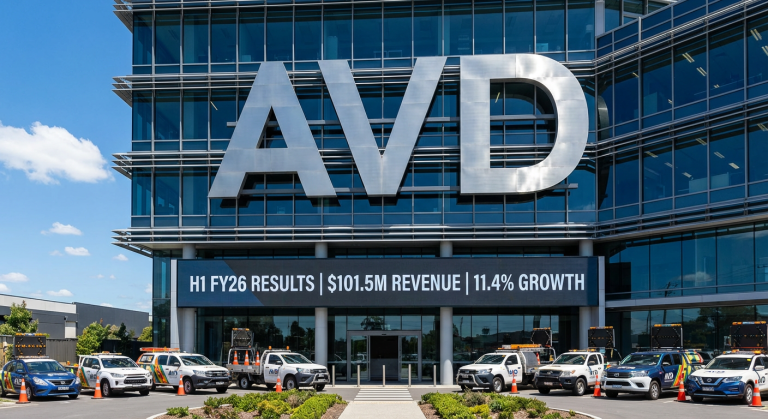
Avada Group delivers 11% revenue growth as Queensland and New South Wales drive momentum
Avada Group reported $101.5 million in revenue for H1 FY26, representing 11.4% growth from the prior corresponding period’s $91.1 million. The Avada Group 1H FY26 Results showed adjusted EBITDA improving to $7.1 million (up from $6.2 million in H1 FY25), despite the statutory result recording a loss driven by a $15.0 million non-cash impairment relating to the Victorian business.
The impairment reflects historical acquisition goodwill and ongoing constraints from union labour mandates on Victorian State Government contracts, rather than operational weakness. Underlying business performance improved across key metrics, with revenue per vehicle rising to $111,000 (from $96,000) and revenue per traffic controller hour increasing to $87 (from $77).
Queensland operations restored revenue momentum following business development activity that offset the non-renewal of the Brisbane City Council contract in FY25. New South Wales delivered strong revenue growth supported by industry-leading governance standards, though margins were temporarily impacted by mobilisation costs on new contracts.
Join thousands of readers who start here
Our best articles, sent straight to your inbox. You can unsubscribe anytime.
What is adjusted EBITDA and why it matters for Avada’s results
Adjusted EBITDA refers to earnings before interest, tax, depreciation and amortisation, excluding one-off items that do not reflect the ongoing operational performance of the business.
Companies report adjusted figures alongside statutory results to give investors a clearer view of underlying cash-generating ability. This is particularly important when non-recurring events distort the headline financial outcome.
In Avada’s case, the $15.0 million impairment is a non-cash accounting adjustment that reduces the carrying value of Victorian intangible assets on the balance sheet. It does not represent a cash outflow or a deterioration in the company’s ability to generate operating cash flow. The adjusted EBITDA of $7.1 million (representing a 7.0% margin) reflects the actual earnings capacity of the business before accounting adjustments, compared to the statutory loss after tax of $16.5 million.
This distinction is critical for assessing whether the business is improving operationally. The Avada Group 1H FY26 Results demonstrate that despite the balance sheet clean-up, the underlying operations are generating positive returns and improving margin performance year-on-year.
Regional performance and operational improvements position Avada for stronger H2
Queensland and New South Wales leading growth
Queensland delivered revenue momentum across all regions, with business development activity successfully restoring revenues following the non-renewal of the Brisbane City Council contract in FY25.
New South Wales achieved strong revenue growth supported by the company’s industry-leading governance and transparency standards. However, margins were temporarily impacted by mobilisation costs associated with new contract wins. These upfront costs represent an investment in future growth rather than a structural margin issue.
Victoria and New Zealand addressing challenges
Victoria remains constrained by union labour mandates on State Government contracts, limiting operational flexibility. The company is pursuing growth opportunities in regional areas where these constraints are less restrictive.
New Zealand operations are benefiting from a new management team and increased business development activity. The company is optimising its depot network and improving fleet utilisation as the New Zealand economy enters the early stages of recovery following a prolonged downturn.
| Metric | H1 FY26 | H1 FY25 |
|---|---|---|
| Revenue | $101.5m | $91.1m |
| Vehicles (period end) | 917 | 953 |
| Revenue per vehicle | $111k | $96k |
| Traffic controller hours (000) | 1,166 | 1,179 |
| Revenue per TC hour | $87 | $77 |
The operating metrics reveal improved efficiency despite a slightly smaller fleet. Revenue per vehicle increased 15.6%, while revenue per traffic controller hour rose 13.0%, indicating better asset utilisation and pricing power. The company operated with 36 fewer vehicles at period end while generating significantly higher revenue, demonstrating improved operational leverage.
Leadership strengthening and refinancing on track
Avada appointed an Executive General Manager of Strategic Execution and Operations and a Head of Commercial to strengthen leadership capabilities during the half. A new Queensland State Manager was promoted from within the organisation, demonstrating the company’s internal talent development.
Business development resources were expanded in Queensland and Victoria to capitalise on pipeline opportunities. Fleet utilisation improved in Q2 FY26, with further gains expected in Q3 as optimisation initiatives take effect.
The company confirmed that refinancing remains on track for completion in Q3 FY26, with multiple offers currently under consideration. Completing this process will remove a near-term uncertainty for investors and provide greater balance sheet flexibility.
Enjoyed this article?
We publish high-impact stories like this a few times a week. No spam.
Outlook and investment case
Management stated that improving business momentum and a strong pipeline of work position the company for enhanced performance in the second half of FY26.
The business transformation programme is expected to deliver operational and financial benefits in H2 FY26, with a focus on margin improvement and resource optimisation initiatives. Avada’s best practice standards for safety, governance and public accountability continue to differentiate the company in competitive tender processes.
Management Outlook
“First-half actions position the Group for improved FY26 outcomes.”
The investment case centres on several inflection points converging. Revenue growth has resumed with 11.4% year-on-year improvement, driven by Queensland’s recovery and New South Wales expansion. Adjusted EBITDA margins improved to 7.0% despite temporary mobilisation costs in New South Wales, suggesting further upside as these investments deliver returns.
The $15.0 million impairment represents a balance sheet clean-up of historical acquisition costs rather than an operational concern. With gross margins holding at 20.4% and refinancing nearing completion, the company appears well-positioned for a stronger second half. The combination of leadership investment, improved fleet utilisation, and expanding business development capabilities suggests the business is inflecting positively following a period of restructuring and operational refinement.
Want the Next Industrials Breakout in Your Inbox?
Join 20,000+ investors receiving FREE breaking ASX news within minutes of release, complete with expert analysis. Click the “Free Alerts” button at Big News Blast to get real-time alerts on industrials and every non-resource sector the moment market-moving announcements drop.