Austin Engineering Half Year Results
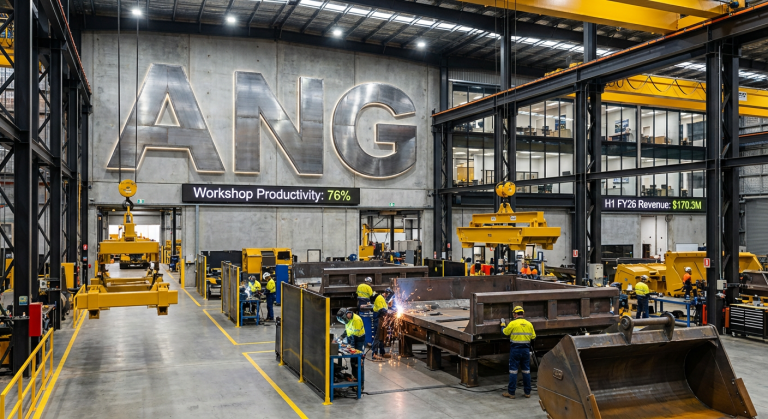
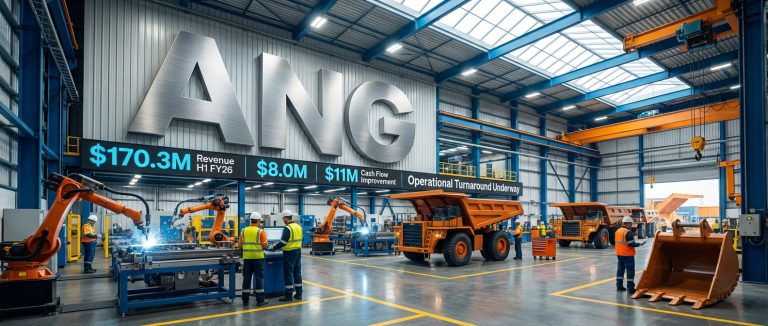
Austin Engineering has reported its Half Year Results for the six months ended 31 December 2025, posting revenue of $170.3 million, EBITDA of $8.0 million, and net profit after tax of $2.0 million. The results reflect operational challenges across three regions, offset by a significant improvement in cash generation, with operating cash flow of $6.6 million representing an $11 million turnaround from the prior corresponding period’s $4.4 million outflow.
The board declared a fully franked interim dividend of 0.3 cents per share, with a record date of 17 March 2026 and payment on 10 April 2026. Management highlighted post-period momentum, with $51 million in new orders secured since 1 January 2026.
Join thousands of readers who start here
Our best articles, sent straight to your inbox. You can unsubscribe anytime.
What drove the earnings decline?
Earnings compression in H1 FY26 stemmed from three specific operational issues, each now subject to targeted remediation programmes.
The Chilean operation reported an EBITDA loss of $4.1 million for the half, including a $1.6 million onerous contract provision related to a legacy OEM programme. Austin Engineering (ASX: ANG) suspended accepting new orders under this contract, with existing orders scheduled for completion this quarter. Negotiations are underway to extend the programme only under significantly improved pricing and commercial terms.
North American profitability was impacted by production inefficiencies, facility bottlenecks, and higher reliance on contract labour to meet demand. The business temporarily outsourced some manufacturing to fulfil customer orders, which compressed margins despite revenue growth of 12% to $71.5 million.
Indonesian operations faced efficiency challenges, including a major customer deferring product deliveries into the second half and the Batam facility diverting resources to support Chilean OEM contract requirements. The business has since been right-sized to align with current demand levels.
| Factor | Impact | Status |
|---|---|---|
| Chile OEM contract | $4.1m EBITDA loss (incl. $1.6m provision) | Completing Q3 FY26 |
| North America | Margin compression from contractor reliance | Productivity improvements underway |
| Indonesia | Deferred orders, Batam supporting Chile | Right-sized to current demand |
The issues are operational rather than demand-related. Customer engagement remains supportive across all regions, with underlying market conditions described as robust.
Regional performance breakdown
Three distinct regional dynamics shaped the half-year result:
- Asia Pacific: Revenue declined 12% to $70.6 million (approximately 41% of group revenue). Tray sales decreased $20.3 million due to timing of a major Australian customer order and a softer East Coast market. Bucket demand delivered a $14 million uplift, with production increasing through the period. Post-period, the division secured $21 million in additional tray orders, providing second-half momentum.
- North America: Revenue grew 12% to $71.5 million (42% of group revenue), continuing a multi-year growth trajectory. The business expanded with a leased facility and upgrades to its main Casper facility to meet demand. Profitability was impacted by rapid growth outpacing operational infrastructure. Management is investing in welding automation, an expanded welding school programme, and lean manufacturing training to restore operating leverage and reduce external contractor dependency.
- South America: Chilean revenue fell 11% to $28.3 million (approximately 17% of group revenue). Production for the major OEM was limited to five trays per month while restructuring operations. A new General Manager and leadership team implemented a single-shift operating model, exited underperforming contractors, and introduced tighter governance controls. The region expects to return to profitability in H2 FY26.
Understanding mining equipment services stocks
Austin Engineering designs and manufactures dump truck bodies, buckets, and attachments for mining operations. These companies serve both open-cut and underground mining across multiple commodity types, providing equipment that directly impacts mine site productivity.
The business model relies on operational leverage. When revenue grows faster than fixed costs, margins expand. Conversely, when inefficiencies emerge (through contractor reliance or outsourced manufacturing), margins compress even as revenue increases. This explains how North American revenue grew 12% whilst profitability declined.
Large equipment orders can create lumpy revenue patterns. Tray orders, which represent significant contracts for dump truck bodies, often arrive in concentrated periods rather than evenly through the year. This timing dynamic affected both the Asia Pacific order book and North American revenue recognition in H1.
Order book visibility matters significantly for these businesses. Austin’s order book stood at $111 million at period end, down from $147 million in the prior year, primarily due to timing delays in major tray orders. The $51 million secured post-period provides clearer near-term revenue visibility.
Management’s turnaround actions and updated guidance
CEO Sy van Dyk framed the challenges as operational issues within management’s control.
Sy van Dyk, CEO and Managing Director
“These are operational issues under our control, unrelated to customer demand or market strength, and we are already seeing positive changes from our actions.”
Specific remediation actions implemented across regions include:
- Chile: New General Manager and refreshed leadership team, single-shift operating model, exit or replacement of underperforming contractors, strengthened production processes, tighter governance and controls
- North America: Welding automation investment, expanded welding school programme, lean manufacturing training, reduced reliance on contractors and outsourced manufacturing
- Indonesia: Right-sized operations to current demand levels, focus on manufacturing efficiency and stability improvements
Management updated FY26 guidance to reflect first-half performance and second-half recovery expectations. Revenue guidance revised to $350+ million (from $370-380 million). EBIT guidance adjusted to $14-16 million excluding foreign exchange movements (from $30-34 million).
The updated guidance implies H2 EBIT of $11-13 million, compared to H1’s $3.0 million. This represents a substantial step-up dependent on operational improvements taking effect. Operating cash flow of $6.6 million in H1 (versus $4.4 million outflow in the prior corresponding period) demonstrates working capital discipline returning.
Enjoyed this article?
We publish high-impact stories like this a few times a week. No spam.
What to watch in the second half
Five metrics will indicate whether operational fixes translate to earnings recovery:
- Order book trajectory and conversion timing (currently $111 million, with $51 million secured post-period providing near-term visibility)
- Chilean return to profitability under new leadership following single-shift implementation and contractor rationalisation
- North American margin recovery as in-house production increases and contractor dependency reduces
- OEM contract resolution (existing orders complete this quarter; renegotiation outcome for programme extension)
- Cash generation continuation after H1’s $11 million working capital improvement
Austin’s strategic fundamentals (global footprint, diversified commodity exposure, design-led solutions) remain intact. The company serves major mining operations across Australia, the United States, Chile, and Indonesia. With over 50 years operating history, the business has navigated previous operational cycles.
The second-half earnings requirement of $11-13 million EBIT represents execution risk, but also potential upside if remediation actions deliver as management expects. Customer engagement described as supportive, with broader market conditions remaining robust across the company’s operating regions.
Don’t Miss the Next Manufacturing Turnaround
Join 20,000+ investors getting FREE breaking ASX news delivered to your inbox within minutes of release, complete with in-depth analysis. Click the “Free Alerts” button at StockWire X to receive real-time alerts the moment market-moving announcements hit the ASX across manufacturing, industrials, and every non-resource sector.