
1414 Degrees Silicon Anode Holds Capacity at 530 mAh/g Through Extended Cycling
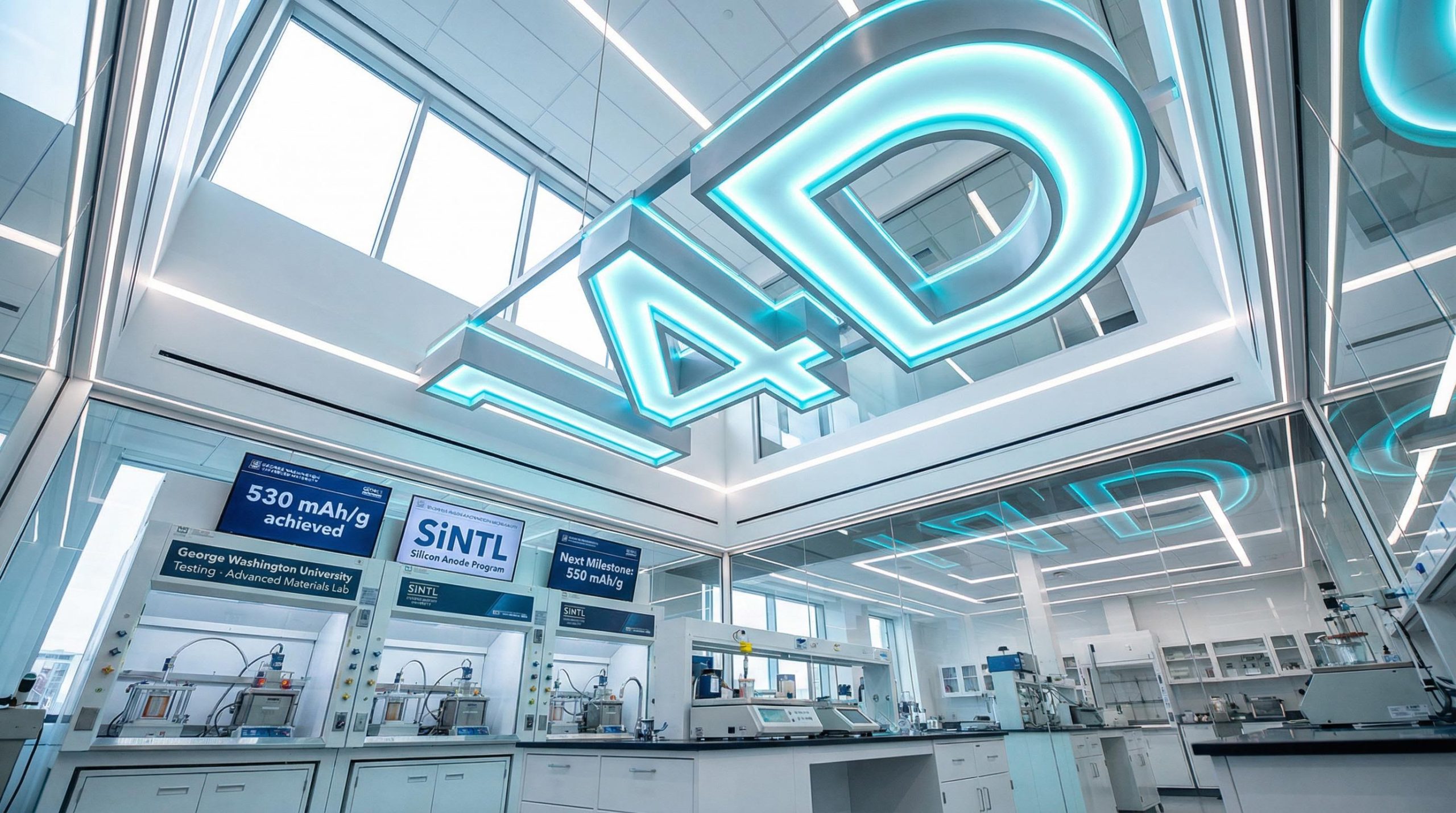
1414 Degrees advances SiNTL silicon anode toward commercial qualification
1414 Degrees (ASX: 14D) has reported continued capacity retention across extended cycling in its SiNTL Silicon Anode program, with laboratory testing at George Washington University demonstrating sustained performance under repeated charge/discharge cycles. The results mark progress through the cycle life validation phase, the critical bridge between laboratory performance and original equipment manufacturer (OEM) qualification for commercial battery systems.
The SiNTL program has achieved 530 mAh/g specific capacity and is progressing toward 550 mAh/g, with an ultimate target of 600 mAh/g. By comparison, graphite anodes currently used in lithium-ion batteries deliver approximately 372 mAh/g, while silicon offers a theoretical capacity of approximately 3,600 mAh/g. The latest testing confirms that capacity retention remains stable as cycling progresses, indicating the material is maintaining structural integrity under repeated lithium insertion and extraction.
Cycle life validation is the gatekeeper to commercial adoption. Without sustained retention data, high capacity figures remain laboratory achievements rather than commercially viable solutions. OEMs require this dataset to evaluate integration into production battery systems, making this phase essential for SiNTL’s progression from performance demonstration to commercial pathway.
When big ASX news breaks, our subscribers know first
What is a silicon anode and why does it matter for batteries?
Silicon anodes represent a significant advancement in lithium-ion battery technology. Current battery systems rely on graphite anodes, which offer limited energy density at approximately 372 mAh/g. Silicon, by contrast, provides a theoretical capacity of approximately 3,600 mAh/g, nearly 10 times higher than graphite.
The challenge that has historically constrained widespread silicon adoption is volume expansion. Silicon expands significantly during charging, causing structural degradation and shortened battery life. SiNTL addresses this through aluminium-coated silicon nanoparticles with an in-situ protective coating designed to manage volume expansion while maintaining air- and water-stable material properties.
For investors, silicon anode technology represents a step-change in battery performance. Success in this area opens doors to electric vehicle applications, drones, and defence systems where energy density translates directly into competitive advantage through extended range and reduced weight.
SiNTL’s drop-in advantage and integrated materials pathway
SiNTL’s key commercial differentiator is compatibility with existing battery manufacturing infrastructure. Unlike competing approaches that rely on chemical vapour deposition and specialised equipment, SiNTL is designed as a drop-in solution. The production process operates at low temperatures (125–180°C) through a single-step synthesis, with demonstrated yield of approximately 97%.
SiNTL technical advantages:
- Low-temperature synthesis (125–180°C)
- Single-step process
- Aluminium-coated nanoparticles with in-situ protective coating
- Approximately 97% demonstrated yield
- Air- and water-stable material properties
- Compatible with standard slurry-based anode manufacturing
Drop-in compatibility removes the biggest adoption barrier. Battery manufacturers can integrate SiNTL without costly production line changes, reducing capital expenditure requirements and accelerating time-to-market.
A further point of differentiation is the potential integration of SiNTL with the company’s SiPHyR methane pyrolysis technology. SiPHyR produces solid carbon as a co-product, which may be combined with SiNTL silicon nanoparticles to form silicon-carbon composite anodes widely used in commercial battery systems. This creates a pathway for 1414 Degrees to control both key material inputs, with potential to reduce production costs and strengthen its position in the battery materials value chain.
The SiPHyR integration creates potential vertical integration advantages. Controlling both silicon and carbon inputs could deliver cost advantages and supply chain resilience as the market scales toward commercial deployment.
The next major ASX story will hit our subscribers first
A USD 25.8 billion market opportunity by 2035
The silicon anode battery market is projected to grow from USD 0.4 billion in 2025 to USD 25.8 billion by 2035, reflecting a compound annual growth rate (CAGR) of 51.7%. Global investment in silicon anode technologies continues to accelerate, with more than USD 4.5 billion deployed in 2024.
| Metric | 2024/2025 | 2035 Projection |
|---|---|---|
| Silicon anode battery market | USD 0.4 billion | USD 25.8 billion |
| CAGR | — | 51.7% |
| Global silicon anode investment (2024) | USD 4.5 billion | — |
Beyond electric vehicles, the company sees additional applications in high-growth sectors such as drones, where energy density and rapid recharge capability are critical performance requirements across both commercial and defence applications. The market timing aligns with SiNTL’s development trajectory, with the shift from research-driven development to commercial deployment creating tailwinds for validated technologies reaching commercialisation.
A 51.7% CAGR signals strong market momentum for technologies that can bridge the gap between laboratory performance and commercial integration requirements.
Next steps and OEM pathway
Testing at George Washington University is ongoing, with three key priorities guiding the program’s advancement:
- Extending cycle life dataset
- Progressing toward 550 mAh/g capacity milestone
- Supporting OEM engagement and evaluation pathways
Peter Yaron, Chief Technology and Operations Officer
“The SiNTL program has consistently delivered ahead of schedule on capacity. We are now focused on building the cycle life dataset that underpins commercial credibility. The retention we are observing as cycling progresses is encouraging, and we will continue to report results as they become available.”
The company stated that further updates will be provided as results are confirmed, including progression toward the 550 mAh/g milestone. The emphasis on cycle life data reflects the program’s pivot from performance demonstration to the commercial validation phase that OEMs require before evaluating integration into production battery systems.
For investors, the progression toward OEM engagement pathways represents a critical inflection point. While capacity milestones demonstrate technical capability, sustained cycle life data is what enables commercial conversations with battery manufacturers evaluating next-generation anode materials.
Want the Next Battery Tech Breakthrough in Your Inbox?
Join 20,000+ investors receiving FREE breaking ASX news within minutes of release, complete with in-depth analysis. Get real-time alerts on emerging tech opportunities before the market moves. Click the “Free Alerts” button at Big News Blast to start receiving expert coverage the moment announcements break.