
1414 Degrees Hits 500 mAh/g Silicon Anode Target Months Ahead of Schedule
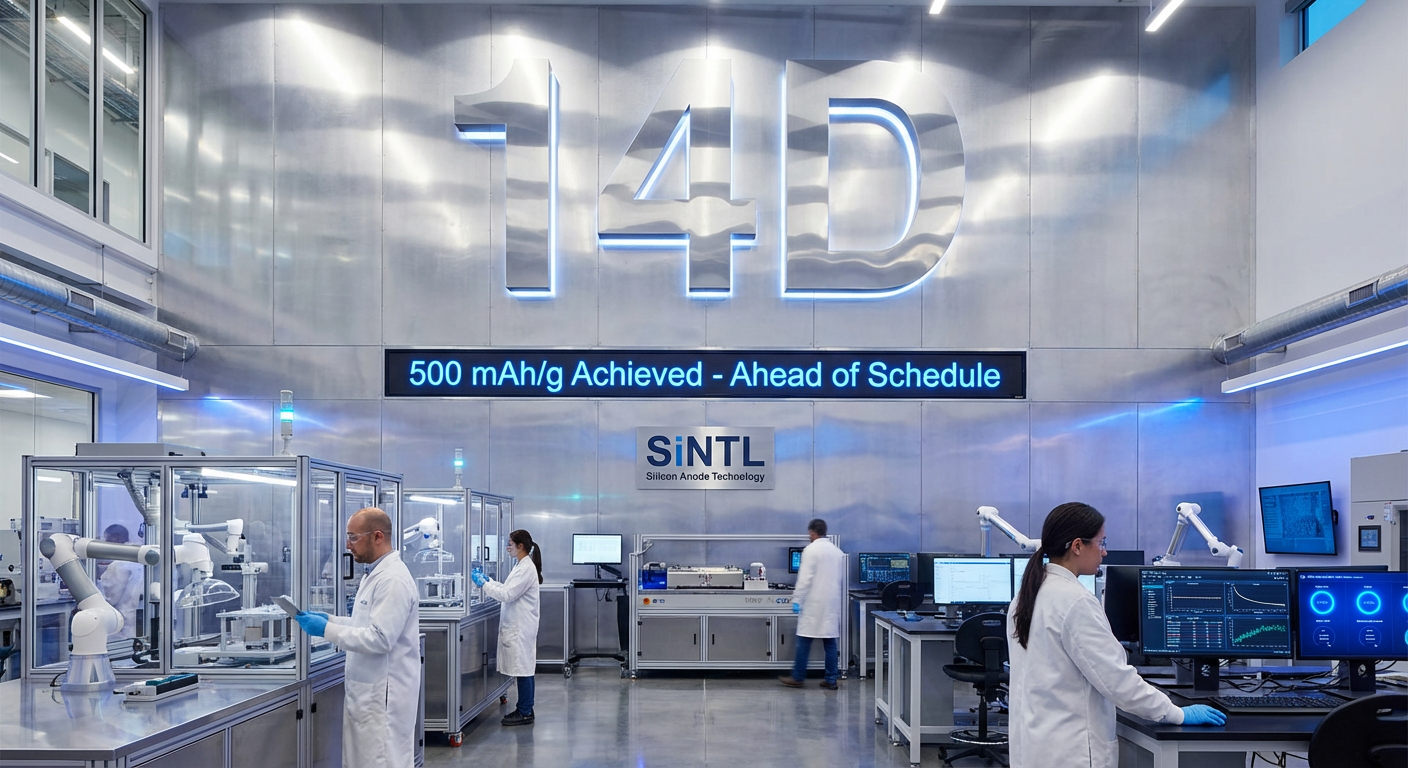
1414 Degrees (ASX: 14D) has achieved a significant technical milestone with its 1414 Degrees SiNTL Silicon Anode program, reaching 500 mAh/g specific capacity months ahead of its commercialisation schedule. This performance aligns with current best-in-class commercial silicon-enhanced anode materials and validates the underlying material design approach, establishing a platform for further advancement toward the 600 mAh/g target within 12 months.
1414 Degrees hits silicon anode milestone months ahead of schedule
The initial composite samples produced under the SiNTL program have met the first targeted performance threshold of 500 mAh/g, confirming parity with existing commercial benchmarks for silicon-enhanced graphite anodes used in lithium-ion batteries. This early achievement de-risks the commercialisation timeline and demonstrates the technical capability of the Company’s silicon nanotechnology platform.
The program is progressing ahead of schedule toward 600 mAh/g, which represents approximately 20% higher capacity than typical current commercial benchmarks. Achieving this target whilst maintaining acceptable stability and manufacturability would significantly enhance the energy contribution from the anode in standard lithium-ion cell designs, positioning 1414 Degrees SiNTL Silicon Anode to exceed industry performance standards.
The result validates a repeatable and technically proven development framework that directly links battery performance to material properties across multiple sample formulations. This systematic approach supports predictable scaling and ongoing improvement, critical factors for commercial deployment in the battery materials sector.
When big ASX news breaks, our subscribers know first
Why silicon anodes matter for battery performance
Silicon-enhanced anodes offer higher energy storage capacity compared to traditional graphite anodes, which typically deliver around 350-400 mAh/g in commercial applications. Silicon’s theoretical capacity is substantially higher, but integrating it into stable, commercially viable anode materials has presented significant technical challenges, including volume expansion during charging cycles and structural degradation over time.
The 600 mAh/g threshold represents a meaningful performance level where silicon-enhanced anodes can provide notable improvements in cell-level energy density without requiring disruptive changes to existing manufacturing processes. This compatibility with current production infrastructure lowers adoption barriers for battery manufacturers, as they can integrate higher-performance anode materials into existing lithium-ion cell designs without major capital expenditure on new facilities.
For investors, this translates to reduced commercialisation risk. Battery manufacturers can adopt silicon-enhanced anodes more readily when the technology fits within proven manufacturing frameworks rather than requiring bespoke production lines.
| Anode Type | Specific Capacity (mAh/g) | Status |
|---|---|---|
| Traditional Graphite | 350-400 | Current industry standard |
| Commercial Silicon-Enhanced | 500 | Best-in-class benchmark (SiNTL achieved) |
| SiNTL Target | 600 | 20% above current commercial benchmarks |
A USD $20 billion market opportunity
The global silicon-anode battery market is forecast to grow from USD $536.5 million in 2025 to more than USD $20.8 billion by 2034, representing nearly 40-fold expansion over nine years. This accelerating demand trajectory reflects the broader transition toward higher energy density battery technologies across electric vehicle, consumer electronics, and energy storage applications.
1414 Degrees’ timing positions the Company to capture value as this market scales. Achieving technical milestones ahead of schedule whilst the market undergoes rapid growth creates a potential convergence between validated technology readiness and commercial demand, a critical factor for investors assessing revenue generation pathways in emerging battery materials sectors.
Scalable production pathway without new infrastructure
The SiNTL commercialisation program is underpinned by a low-temperature, scalable synthesis process compatible with existing anode manufacturing infrastructure. This approach supports a clear pathway to production-scale manufacturing without the need for fundamentally new operations, reducing capital expenditure risk and accelerating potential time-to-market compared to competitors requiring bespoke facilities.
The development framework offers three key scalability advantages:
- Low-temperature synthesis process that reduces energy requirements and simplifies production scaling compared to high-temperature alternatives
- Compatibility with existing manufacturing infrastructure, enabling battery manufacturers to integrate SiNTL materials into current production lines without major facility modifications
- Validated development framework that systematically links material structure to battery performance, enabling predictable scaling and ongoing improvement
These characteristics reduce the infrastructure investment burden typically associated with novel battery materials, positioning the technology for more rapid adoption once commercialisation milestones are achieved.
SiPHyR integration creates potential downstream value
Parallel anode testing is underway incorporating pristine graphitic carbon from the Company’s SiPHyR methane pyrolysis process into the SiNTL synthesis process. This test program aims to validate the quality of SiPHyR carbon output for battery anode applications and may support additional downstream value opportunities for the SiPHyR hydrogen program over time.
The vertical integration opportunity could enhance margins by utilising carbon byproducts from hydrogen production in higher-value battery materials applications. If validated, this creates a dual-purpose revenue stream from the SiPHyR technology platform, addressing both the low-emission hydrogen market and the high-quality graphitic carbon market for battery anodes and other industrial applications.
The next major ASX story will hit our subscribers first
Management and inventor perspective
“This milestone demonstrates that SiNTL is not just a research program; it is a commercial platform in development. As performance improves and scalability is validated, the strategic relevance of this technology to battery manufacturers and OEM supply chains becomes increasingly clear.”
Dr Peter Yaron, Chief Technology & Operations Officer
“The performance data confirms that the silicon composite architecture and synthesis approach are delivering the electrochemical characteristics required for next-generation anode materials. The ability to systematically link material structure to battery performance is what enables predictable scaling and ongoing improvement, which is critical for commercial deployment.”
Professor Michael Wagner, SiNTL inventor
What comes next for SiNTL
Investors now have clear milestones to track over the coming 12 months as the program advances toward 600 mAh/g capacity targets. The Company has outlined several upcoming catalysts and timeline markers:
- 12-month development timeline toward 600 mAh/g specific capacity target
- Ongoing anode testing incorporating SiPHyR graphitic carbon into SiNTL synthesis
- Performance validation whilst maintaining stability and manufacturability at commercial scale
- Supply chain positioning as strategic relevance to battery manufacturers and OEM supply chains increases
The defined development pathway provides measurable checkpoints for progress assessment, allowing investors to evaluate technical advancement against commercial market growth trajectories in the rapidly expanding silicon-anode battery sector.
Want the Next Battery Tech Breakthrough in Your Inbox?
Join 20,000+ investors receiving FREE breaking ASX news within minutes of release, complete with expert analysis. Click the “Free Alerts” button at Big News Blast to get alerts the moment market-moving announcements drop across Tech, Healthcare, Industrials and more.