
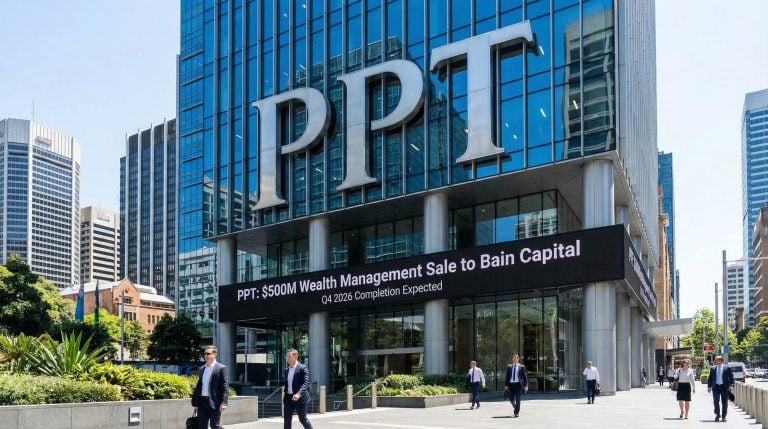
Perpetual Limited (ASX: PPT) has entered into a binding agreement to sell its Wealth Management business to Bain Capital Private Equity for $500 million upfront cash, with potential additional payments of up to $100 million linked to business performance. The transaction transforms Perpetual into a focused two-business operation centred on Asset Management and Corporate Trust, with completion expected towards the end of calendar year 2026.
Perpetual finalises $500 million Wealth Management sale to Bain Capital
The Perpetual Wealth Management sale comprises three distinct consideration elements. The upfront cash payment of $500 million is subject to customary adjustments for regulatory capital, working capital and other items relating to the Wealth Management business at completion.
An additional upfront payment of up to $50 million, with a mid-point of $25 million, may be payable at completion based on the performance of the advice business in the period leading up to the transaction’s finalisation. A further earn out payment of up to $50 million will be tested and potentially paid two years following completion, contingent on the performance of the Accounting and Wealth operations.
The transaction represents the culmination of what CEO and Managing Director Bernard Reilly described as “a thorough sale process” that delivers the right outcome for shareholders, clients and employees.
Bernard Reilly, CEO and Managing Director
“This is a pivotal step in our strategy to simplify and transform Perpetual. Following completion, Perpetual will have a stronger balance sheet and more simplified business, focused on two core businesses, asset management and corporate trustee services, while also enhancing its ability to invest for future growth and deliver improved shareholder returns over the longer term.”
As part of the agreement, Perpetual will licence the brands “Perpetual Wealth” and “Perpetual Private” to the Perpetual Wealth Management Group for 15 years, whilst retaining full ownership of all rights in the “Perpetual” brand.
When big ASX news breaks, our subscribers know first
What is a corporate divestiture and why do companies sell business units?
Corporate divestitures involve the strategic sale of business divisions or subsidiaries to external buyers. Companies pursue these transactions to streamline operations, unlock value trapped in diversified structures, and reallocate capital towards higher-return opportunities.
The proceeds from selling non-core assets typically strengthen balance sheets by reducing debt levels, providing financial flexibility for organic growth investment in remaining businesses. Brand licensing arrangements, such as the 15-year agreement Perpetual has structured, allow sellers to retain valuable intellectual property whilst generating ongoing revenue from licensed use.
For conglomerates operating across multiple business lines, focused operations can sometimes generate superior shareholder returns compared to maintaining diversified portfolios, particularly when market valuations fail to reflect the sum-of-the-parts value.
Transaction structure and financial impact
The sale agreement structures consideration across three payment milestones, reflecting both immediate value and future performance potential.
| Consideration Element | Amount | Timing |
|---|---|---|
| Upfront cash payment | $500 million | At completion |
| Additional upfront (advice performance) | Up to $50 million | At completion |
| Earn out payment | Up to $50 million | Two years post-completion |
The transaction delivers substantial balance sheet transformation. Following completion, Perpetual expects to achieve a pro-forma net debt to EBITDA ratio of approximately 0.2x, accounting for transaction costs, tax and other adjustments. This represents a significant deleveraging from the company’s current position.
Net cash proceeds will be used to repay the $400 million Facility D – Bridge, with final repayment amounts determined at completion through the purchase price adjustment process and following resolution of any earn out payment two years after transaction close.
The financial impact includes several cost elements that will affect net proceeds:
- Transaction and separation costs of approximately $30 million post-tax, to be incurred over 12-18 months
- Estimated tax on proceeds of $45-50 million (based on assumed net proceeds of $500 million at completion)
- Tax payments will add franking credits to Perpetual’s balance sheet for utilisation in future dividend payments, expected by 2H27
- Stranded costs following completion are not expected to be material, given the existing Simplification Programme already underway
The transaction is structured as a cash and debt free sale of all shares in Perpetual PWM Services Pty Ltd, the head company of the Perpetual Wealth Management Group. This structure cleanly separates the divested business from Perpetual’s remaining operations.
Strategic rationale and future focus
The divestiture enables Perpetual to operate as a simplified organisation concentrated on two core businesses: Asset Management and Corporate Trust. This focused structure positions management to allocate capital more efficiently and pursue organic growth opportunities within these remaining divisions.
The strengthened balance sheet provides Perpetual with enhanced financial flexibility following transaction completion. With net debt to EBITDA falling to approximately 0.2x, the company gains significant capacity for both operational investment and potential capital returns to shareholders over the longer term.
Reilly emphasised the strategic alignment between Bain Capital’s capabilities and the Wealth Management business’s future trajectory, stating: “We believe we have found the right owner for the Wealth Management business to help it continue to grow and deliver high quality products and services to its clients.”
The strategic priorities following completion are:
- Debt reduction through deployment of net sale proceeds
- Investment in organic growth across Asset Management and Corporate Trust
- Simplified operating structure reducing complexity
- Enhanced capacity for improved shareholder returns over time
The announcement provides operational clarity for Perpetual’s workforce. Reilly noted that teams “have continued to show an exceptionally high level of professionalism, commitment and focus throughout this process”, with the binding agreement delivering certainty about the business’s future ownership structure.
Conditions and expected timeline
The transaction’s completion is contingent on several regulatory and corporate restructuring requirements. Bain Capital must obtain approvals from the Foreign Investment Review Board (FIRB) and the Australian Competition and Consumer Commission (ACCC) before the sale can proceed.
Perpetual faces a complex corporate restructure to separate the Wealth Management business from its Asset Management and Corporate Trust operations. This restructure requires:
- Regulatory relief and approvals from the Australian Securities and Investments Commission (ASIC)
- Court orders to facilitate the transfer of certain assets, liabilities and undertakings relating to the Wealth Management business
- Schemes of arrangement under Part 5.1 of the Corporations Act
- Ministerial consent to the change in control of the Wealth Management traditional trustee business
Notably, no shareholder vote is required to implement the corporate restructure, including the schemes of arrangement, which will be implemented by certain Perpetual subsidiaries rather than at the parent company level.
The sale agreement includes termination rights for both parties if conditions are not satisfied, or if events occur that would, or would be reasonably expected to, materially adversely impact FY26 or FY27 earnings of the Perpetual Wealth Management Group. Significantly, the transaction is not subject to a financing condition, reducing execution risk compared to leveraged buyout structures where buyer financing can become a deal obstacle.
Perpetual will provide transitional services to the Perpetual Wealth Management Group for up to 18 months following completion, covering technology, operational services and incidental matters. The agreement includes an option for the buyer to extend these services for up to a further six months, ensuring business continuity during the separation period.
The current intention is to complete the transaction towards the end of calendar year 2026.
The next major ASX story will hit our subscribers first
What this means for Perpetual shareholders
The transaction reshapes Perpetual’s investment proposition, delivering both immediate balance sheet benefits and future dividend capacity enhancement. The transformation to a net debt to EBITDA position of approximately 0.2x provides substantial financial headroom for management to pursue growth initiatives without balance sheet constraints.
Shareholders will benefit from franking credits accumulated through the estimated $45-50 million tax payment on sale proceeds. These franking credits become available for utilisation in dividend payments expected by 2H27, potentially enhancing the after-tax return profile for Australian resident shareholders receiving fully franked distributions.
The focused two-business model concentrates operations in Asset Management and Corporate Trust, both sectors where Perpetual maintains established market positions and operational expertise. This strategic narrowing eliminates the complexity and overhead associated with managing disparate business lines across wealth management and asset management.
Key shareholder benefits include:
- Balance sheet transformed to approximately 0.2x net debt to EBITDA, creating financial flexibility
- Franking credits from tax payment available for dividends by 2H27, enhancing future distribution capacity
- Focused operational model in Asset Management and Corporate Trust, reducing business complexity
- Retained ownership of the “Perpetual” brand with licensing income for 15 years from the divested business
The 15-year brand licensing arrangement generates ongoing revenue whilst preserving Perpetual’s most valuable intellectual property asset. This structure allows the company to monetise its brand equity within the wealth management sector without permanently relinquishing trademark rights.
Under the sale agreement, Perpetual retains responsibility for certain pre-completion matters and will provide indemnity protection to Bain Capital and the Perpetual Wealth Management Group for these issues. This structure is standard in transactions of this nature, quarantining legacy liabilities from the buyer’s operational risk profile.
Don’t Miss the Next Financial Services Breakout
Join 20,000+ investors receiving FREE breaking ASX news delivered within minutes of release, complete with expert analysis. Get real-time alerts on major transactions, strategic pivots and market-moving announcements across Financial Services and beyond. Click the “Free Alerts” button at Big News Blast to start receiving alerts the moment news breaks.