
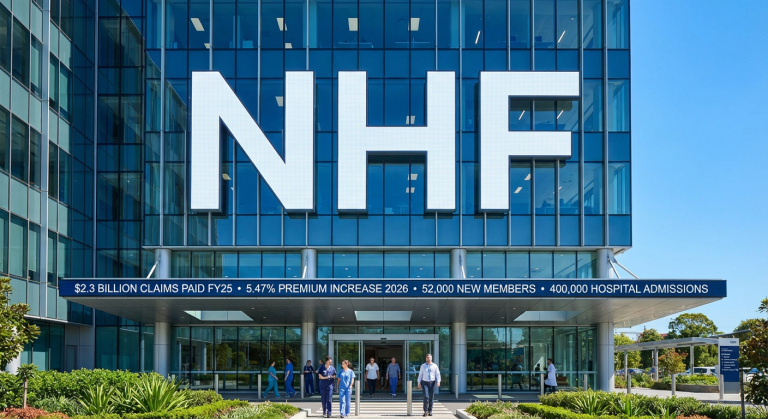
nib announces 5.47% average premium increase for 2026
nib Holdings (ASX: NHF) has announced its health insurance premiums will rise an average of 5.47% following approval by Minister for Health and Ageing, Disability and the NDIS, The Hon. Mark Butler. The nib Holdings 2026 premium increase will result in a rise of $3.80 per week or less for more than half of the company’s policyholders, with the adjustment taking effect from April 2026.
The premium increase reflects three key drivers: larger payments to private and public hospitals, higher healthcare costs across the sector continuing to outpace general inflation, and a rise in the number of customers claiming on their health insurance. For investors, premium increases represent a key revenue driver for health insurers, with the approved rate balancing regulatory requirements against margin sustainability in a cost-constrained environment.
Record claims payments reflect growing member engagement
nib paid more than $2.3 billion in claims during FY25, representing an increase of almost 9% on the prior year. This claims growth translated into tangible healthcare outcomes for members, including almost 400,000 hospital admissions and 4.3 million visits to dentists, optometrists and other healthcare providers.
| Metric | FY25 Figure |
|---|---|
| Total claims paid | $2.3 billion |
| YoY claims growth | ~9% |
| Hospital admissions | ~400,000 |
| Allied health visits | 4.3 million |
The claims growth indicates strong member utilisation, which supports retention by demonstrating policy value. However, the almost 9% claims increase versus the 5.47% premium rise highlights the ongoing challenge health insurers face in balancing value delivery to members with margin management.
High claims volume reflects an engaged membership base actively using their cover rather than treating it as regulatory compliance alone.
What drives private health insurance premium increases?
Understanding the regulatory framework governing the nib Holdings 2026 premium increase helps investors assess pricing power constraints within Australia’s private health insurance sector.
- Ministerial approval required: All health insurers must submit premium applications to the Minister for Health annually, with increases assessed against cost justification and affordability considerations.
- Healthcare inflation premium: Healthcare cost inflation historically outpaces general CPI due to medical technology advances, specialist wage growth, and increasing treatment utilisation.
- Hospital costs dominate: Payments to public and private hospitals represent the largest component of claims expense, making hospital cost inflation a primary driver of premium adjustments.
- Claims experience dictates pricing: Insurers’ actual claims data directly influences pricing submissions, with higher utilisation requiring corresponding revenue adjustments to maintain solvency.
This regulatory structure constrains pricing power compared to other insurance sectors, making operational efficiency and cost management critical to profitability.
Cost containment and gap reduction initiatives
nib has expanded its gap networks with medical providers, with almost 80% of customers now benefiting from no-gap or known-gap payments when treated by a medical specialist. Gap networks function as both a competitive differentiator in attracting members and a retention tool by reducing out-of-pocket costs at the point of care.
From an investment perspective, gap reduction programs improve customer satisfaction while providing the insurer with negotiation leverage over provider pricing. This dual benefit supports policyholder lifetime value by reducing churn whilst containing the average cost per claim through negotiated fee schedules.
Prevention and health management programs
nib supported approximately 22,000 customers with chronic illness through health management programs during FY25, with these initiatives saving over 24,000 hospital bed days through prevention and in-home care alternatives.
Prevention programs deliver measurable investment benefits:
- Chronic disease management reduces acute hospital admissions, which carry higher average claim costs than preventative interventions.
- In-home care alternatives lower average claim expenses compared to inpatient hospital stays.
- Prevention focus aligns with the broader industry shift toward value-based care models that reward outcomes over service volume.
These programs represent a structural cost management lever. Each avoided hospital bed day directly reduces claims expense whilst maintaining member satisfaction through proactive health support.
Hospital partnerships and system sustainability
nib paid more than $1 billion to private and public hospitals during FY25, representing the company’s largest claims category. The health fund has developed partnership agreements with several major hospital groups designed to drive more sustainable outcomes for customers.
Hospital costs represent the most significant claims component for private health insurers, making supplier relationship management critical to financial performance. Strategic partnerships signal a collaborative approach to cost containment rather than purely adversarial negotiations, potentially supporting more predictable cost trajectories than arm’s length relationships.
Member growth signals continued market relevance
Around 52,000 people chose nib for private health cover during FY25 who were new to the private health insurance market entirely, rather than switching from competitor funds. This new-to-market acquisition demonstrates organic growth potential beyond the zero-sum game of competitor switching.
Ed Close, nib Group CEO and Managing Director
“In FY25, around 52,000 people chose nib for private health cover who were new to market, highlighting the continued relevance of private health insurance for Australians.”
New member acquisition from outside the existing private health insurance market indicates the sector maintains its value proposition despite cost-of-living pressures. For nib specifically, it suggests brand strength and product competitiveness in attracting first-time buyers rather than solely relying on churn from established insurers.
Looking ahead
The nib Holdings 2026 premium increase takes effect from April 2026, following standard industry timing for annual adjustments. The approved 5.47% increase provides revenue visibility for FY27, whilst ongoing cost management initiatives through gap networks, prevention programs and hospital partnerships support margin protection in an environment where claims growth continues to outpace premium increases.
Group CEO Ed Close emphasised nib’s ongoing commitment to delivering strong value for customers whilst working to drive healthcare affordability and accessibility. The balance between maintaining member value through high claims payments and gap coverage, whilst managing cost inflation and growing the member base, remains central to the company’s investment proposition in Australia’s regulated private health insurance market.
Don’t Miss the Next Financial Sector Mover
Join 20,000+ investors getting FREE breaking ASX news delivered to your inbox within minutes of release, complete with in-depth analysis. Click the “Free Alerts” button at StockWire X to start receiving alerts the moment market-moving announcements hit the ASX across financials, healthcare, tech and more.