
Macquarie Group Q3 Profit Rises on Asset Management Divestment and AUM Growth
Macquarie Group delivers “satisfactory” third quarter as asset sales drive profit gains
Macquarie Group (ASX: MQG) has reported satisfactory trading conditions in its third quarter trading update for Q3 FY26, with CEO Shemara Wikramanayake confirming that three of the group’s four operating divisions delivered contributions “substantially up” on the prior corresponding period. The standout performer was Macquarie Asset Management, which reported a substantially higher net profit contribution driven primarily by the gain on sale from divesting its North American and European public investments business.
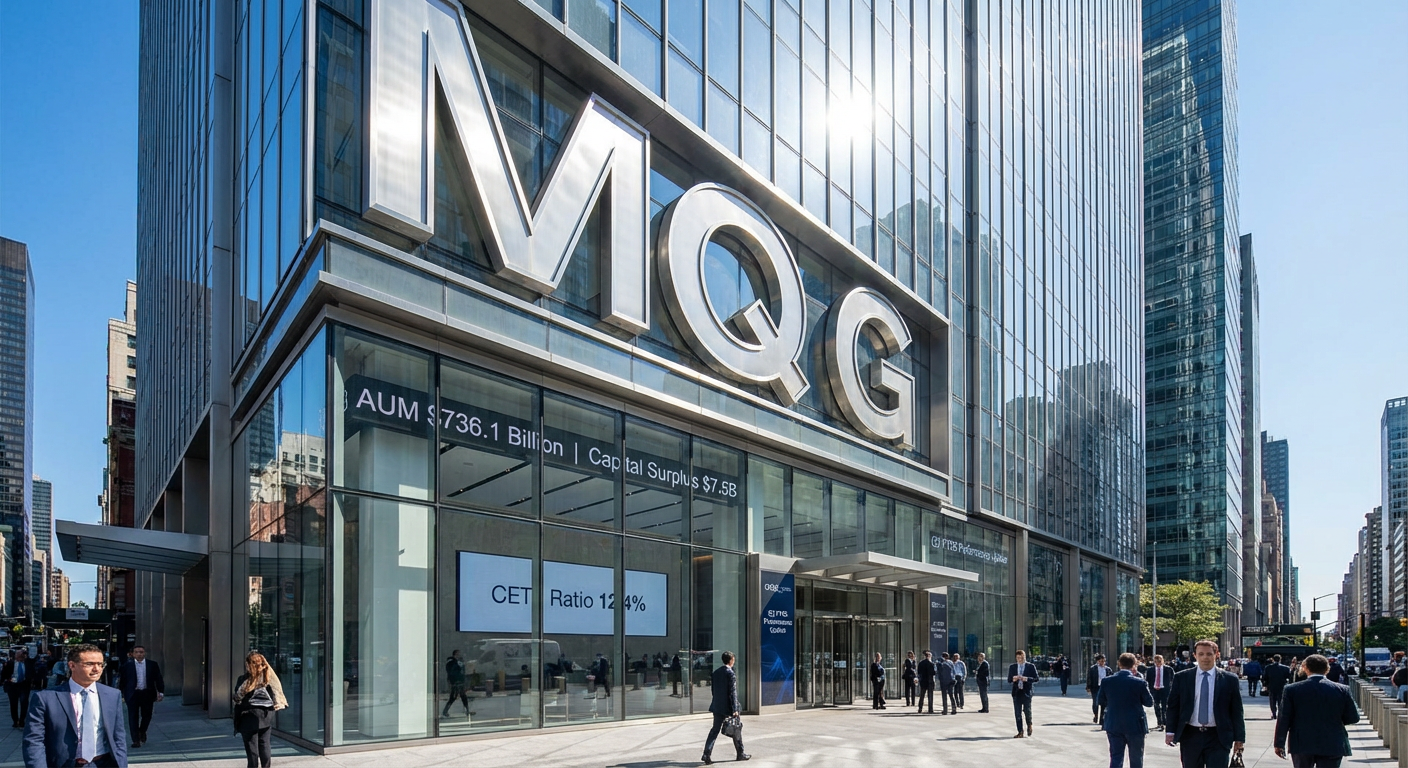
The diversified financial services group maintained a $7.5 billion capital surplus as at 31 December 2025, comfortably exceeding APRA’s Basel III regulatory requirements. The Bank Group’s Common Equity Tier 1 ratio stood at 12.4% (Harmonised: 17.1%), while the Liquidity Coverage Ratio reached 178%, demonstrating balance sheet strength across multiple metrics.
Macquarie’s ability to generate profit growth across multiple segments simultaneously, while maintaining capital well above regulatory minimums, reinforces the defensive characteristics of its diversified business model.
When big ASX news breaks, our subscribers know first
What is an operational briefing and why do investors watch them?
Quarterly trading updates provide investors with insight into business momentum between full results periods, offering a real-time assessment of conditions without the lag of audited accounts. These briefings reveal management’s view on whether the company is tracking toward or away from market expectations.
In Macquarie’s conservative communication style, the descriptor “satisfactory” typically signals steady performance rather than concern. Understanding this language helps investors gauge business trajectory more accurately than taking descriptors at face value.
Segment performance breakdown
Macquarie Asset Management leads with divestment gains
Macquarie Asset Management reported a net profit contribution substantially up on the prior corresponding period, primarily driven by the gain on sale from the divestment of the North American and European public investments business. The division’s FY26 year-to-date contribution also came in substantially up on the equivalent period last year, including performance fees.
Assets under management reached $736.1 billion at 31 December 2025, up 3% on the prior quarter. Public Investments AUM increased 5% to $314.2 billion, primarily driven by inflows in fixed income funds and favourable market movements. Private Markets AUM grew 1% to $421.9 billion, primarily driven by fund investments and increased net asset valuations, partially offset by unfavourable foreign exchange movements and fund divestments.
The combination of divestment gains and organic AUM growth positions MAM as a key earnings driver for the group in FY26.
Banking and Financial Services expands loan book
Banking and Financial Services reported a net profit contribution slightly up on the prior corresponding period, with FY26 year-to-date up on FY25 year-to-date. Volume growth in the loan portfolio and BFS deposits was partially offset by lower margins due to competition and changes in portfolio mix.
Total deposits reached $204.5 billion at 31 December 2025, up 6% on 30 September 2025. The home loan portfolio increased 7% to $172.2 billion, while the business banking loan portfolio grew 1% to $17.5 billion. Funds on platform decreased 1% to $164.6 billion.
The deposit and loan growth momentum demonstrates BFS’s ability to gain market share despite margin compression, though competitive pressures remain a near-term headwind.
Commodities and Global Markets and Macquarie Capital
Commodities and Global Markets reported a net profit contribution substantially up on the prior corresponding period, due to higher income across Asset Finance, partially offset by higher operating expenses. However, FY26 year-to-date contribution remained in line with FY25 year-to-date.
Macquarie Capital’s net profit contribution came in substantially up on the prior corresponding period, driven by higher investment-related income from asset realisations and the private credit portfolio, partially offset by lower fee and commission income. The division’s FY26 year-to-date contribution also substantially exceeded the prior year, due to higher investment-related income and fee and commission income.
The private credit portfolio reached $28.9 billion on a committed basis, with $5.7 billion deployed in Q3 FY26, demonstrating continued momentum in this growth area.
| Segment | Q3 FY26 vs pcp | FY26 YTD vs prior |
|---|---|---|
| MAM | Substantially up | Substantially up |
| BFS | Slightly up | Up |
| CGM | Substantially up | In line |
| Macquarie Capital | Substantially up | Substantially up |
Capital and outlook
Macquarie’s Group capital surplus stood at $7.5 billion at 31 December 2025, down marginally from $7.6 billion at 30 September 2025. The Bank Group’s Liquidity Coverage Ratio reached 178%, while the Net Stable Funding Ratio came in at 111%.
APRA has provided modest regulatory relief by partially removing certain liquidity add-ons effective from 5 February 2026, reducing the add-on to the Net Cash Outflow component from 25% to 15%, and removing the add-on applied to the Available Stable Funding component.
Shemara Wikramanayake, Managing Director and Chief Executive Officer
“Macquarie remains well-positioned to deliver superior performance in the medium term with established, diverse income streams; deep expertise across diverse sectors in major markets with structural growth tailwinds; patient adjacent growth across new products and new markets; ongoing investment in our operating platform; a strong and conservative balance sheet; and a proven risk management framework and culture.”
The combination of excess capital, strong liquidity ratios, and diversified profit drivers positions Macquarie to pursue growth opportunities while maintaining defensive characteristics in an uncertain environment.
The next major ASX story will hit our subscribers first
Key factors to monitor
Management has flagged several variables that may influence near-term performance:
- Global economic conditions, inflation and interest rate trajectory
- Significant volatility events and geopolitical developments
- Completion timing of period-end reviews and transactions
- Geographic income mix and foreign exchange impacts
- Potential tax or regulatory changes and tax uncertainties
Management’s cautious stance and conservative capital approach provide a buffer against these uncertainties while preserving optionality to deploy capital opportunistically should market conditions shift.
Want Financial Sector News Before the Market Moves?
Join 20,000+ investors receiving FREE breaking ASX finance news delivered within minutes of release, complete with in-depth analysis. Click the “Free Alerts” button at Big News Blast to get real-time alerts on market-moving announcements across banks, insurers, fintechs and diversified financials.