
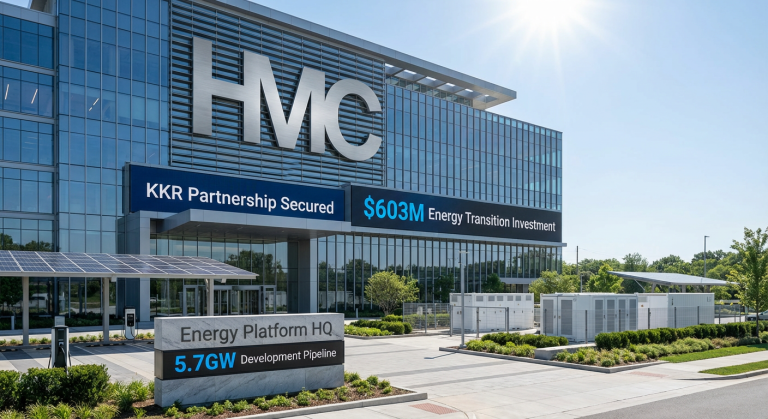
HMC Capital secures $603 million KKR partnership to scale energy transition platform
HMC Capital (ASX: HMC) has announced that KKR-managed funds will invest up to $603 million in the company’s Energy Transition Platform via a preferred equity structure. The investment, funded by KKR’s Global Climate Transition strategy, introduces the global infrastructure investor as a strategic partner in HMC’s existing 652MW operational renewable assets and its 5.7GW battery energy storage system (BESS) and wind development pipeline.
The funding comprises $355 million upfront at financial close, with a follow-on commitment of up to $248 million to fund 90% of the equity component of construction costs for the Platform’s first BESS development project. HMC will contribute the remaining 10%. The partnership validates HMC’s energy platform credentials and secures the capital runway to progress a substantial development pipeline without diluting ASX-listed shareholders.
Key deal metrics:
- Total investment: up to $603 million
- Upfront funding: $355 million
- Follow-on commitment: up to $248 million (for BESS construction)
- Existing operational capacity: 652MW
- Development pipeline: 5.7GW
David Di Pilla, HMC Capital Managing Director and CEO
“We are delighted to be working with an experienced global investor of KKR’s calibre. KKR’s investment validates the quality of the Platform we have built and sets the foundation for HMC to play a major role in Australia’s transition to net zero carbon by 2050. KKR’s capital will enable the Platform to materially grow operating capacity, cash flow and progress the strategically valuable development pipeline. The investment enables HMC to optimise its balance sheet exposure and fully participate in the value created whilst retaining flexibility to introduce new capital partners in the future.”
What is a preferred equity investment?
Preferred equity sits between debt and ordinary equity in a company’s capital structure. This hybrid instrument allows KKR to receive a fixed return before ordinary shareholders are paid, whilst ultimately converting to a minority ordinary equity stake upon repayment.
Under the terms of this transaction, KKR will receive a 14% annual return, comprised of 11% paid-in-kind (PIK) and 3% cash. The instrument has a 7-year term, though HMC retains the flexibility to repay before maturity. Upon repayment, KKR investors will convert to a minority ordinary equity position in the Platform, with the ultimate ownership percentage ranging between 20-35% depending on the timing of repayment and the extent to which KKR participates in any future equity raisings.
Critically, the preferred equity investment is non-recourse to HMC Capital, meaning the ASX-listed entity is not liable for repayment if the Platform underperforms. This structure allows HMC to retain control of the Platform whilst accessing growth capital without issuing ordinary shares to ASX investors.
How the instrument works:
- KKR invests up to $603 million via preferred equity
- KKR earns a 14% annual return (11% PIK, 3% cash) over a 7-year term
- Upon repayment, KKR converts to 20-35% minority ordinary equity in the Platform
Financial impact and capital efficiency for HMC shareholders
The transaction materially optimises HMC’s balance sheet exposure to the Energy Transition Platform. Post-completion, HMC’s invested capital will reduce to approximately $200 million (net of a $35 million capital charge to be recognised in FY26). HMC expects to generate an equity internal rate of return (IRR) above its 20% return on equity target and an indicative multiple on invested capital (MOIC) of 4x, based on the maturation of the development pipeline to Final Investment Decision (FID)-ready status, construction of the initial BESS project, and an eventual exit at comparable market benchmarks.
Proceeds from the upfront $355 million tranche will be used to repay the existing $200 million mezzanine facility and HMC’s corporate debt facility. HMC will also charge the Platform $5 million annually for the provision of corporate services support, providing a recurring revenue stream to the listed entity.
Post-completion, the Platform will be equity accounted (de-consolidated from HMC’s balance sheet) as HMC and KKR will have joint control. Under equity accounting, HMC will recognise income from the Platform after funding costs, predominantly relating to operating earnings from the existing portfolio. The operating assets formerly owned by Neoen generated operating EBITDA of $64 million in FY25, providing a baseline earnings profile.
| Metric | Pre-Transaction | Post-Transaction |
|---|---|---|
| HMC Invested Capital | ~$400 million | ~$200 million |
| Senior Debt Facility | $550 million | $550 million (non-recourse) |
| Preferred Equity | $0 | $355 million (KKR) |
| Expected Equity IRR | Target >20% | Above 20% ROE target |
The capital charge of $35 million in FY26 reflects the cost of the preferred equity structure. However, the balance sheet optimisation allows HMC to redeploy capital into new opportunities whilst retaining upside exposure to the Platform’s substantial value creation potential.
Platform capital structure post-completion
The Energy Transition Platform’s capital stack post-completion will consist of three layers:
- Senior debt facility: $550 million (non-recourse to HMC Capital)
- KKR preferred equity: $355 million (initial tranche, with up to $248 million follow-on)
- HMC invested capital: approximately $200 million
The non-recourse nature of the senior debt facility insulates HMC’s ASX-listed balance sheet from downside exposure, whilst the preferred equity structure provides a fixed-cost growth capital solution that preserves HMC’s upside participation.
Development pipeline and growth trajectory
The Platform’s 5.7GW development pipeline represents the primary value creation lever for HMC’s retained equity stake. Of this, 2.3GW is expected to reach FID within the next 12-18 months, with KKR’s capital securing the funding to progress these projects without further HMC balance sheet exposure.
Three near-term projects are at advanced stages of development:
| Project Name | Capacity | Target FID | Location | Key Development Status |
|---|---|---|---|---|
| Moorabool BESS / VBB2 | Up to 600MW (2H or 4H duration) | 2H CY26 | VIC (adjacent to existing Victorian Big Battery) | Land secured, Development Approval secured, OEM shortlisted, Grid connection in progress |
| Kentbruck Wind Farm | 600MW | 2H CY27 | Nelson, VIC (pine plantation) | Land secured, Planning Minister assessment underway, 42% capacity factor resource |
| Bawurra BESS | Up to 550MW (up to 4H+ duration) | 2H CY26 | Western Downs, QLD (near Columboola substation) | Land secured, Development Approval via SARA underway, OEM selected (Wartsila), Capacity Investment Scheme Agreement awarded Feb-25 |
HMC and KKR have committed funding for the equity component of the first BESS project’s construction costs (90% KKR, 10% HMC), with follow-on projects expected to reach FID-ready status shortly thereafter. The Platform’s potential enterprise value is estimated at up to $3 billion by FY28 (assuming one BESS project is constructed), scaling to up to $10 billion in assets under management by 2030 if the entire pipeline is constructed.
The maturation of the pipeline to FID-ready status and the construction of the initial BESS project represent the key value inflection points underpinning HMC’s expected 4x MOIC.
Australia’s energy transition opportunity
The HMC Capital KKR Energy Partnership is positioned to capitalise on a structural supply-demand imbalance in Australia’s electricity market. The country faces the retirement of 22GW of coal generation capacity (representing 50% of large-scale generation), with the majority of the coal fleet now over 40 years old. Simultaneously, electricity demand is projected to grow at a 4.4% compound annual growth rate (CAGR) from 2026-2035, driven by data centres and electric vehicle adoption.
To meet 2024 Integrated System Plan (ISP) “Step Change” targets, Australia needs to triple the rate of renewable capacity additions from 1.4GW per annum to 4.2GW per annum. BESS infrastructure is critical to grid reliability during this transition, as intermittent renewable generation requires flexible storage capacity to maintain system stability.
Key macro statistics:
- Coal retirement: 22GW (50% of large-scale generation)
- Demand growth: 4.4% CAGR 2026-2035
- Required renewables additions: 4.2GW p.a. vs current 1.4GW p.a.
The supply-demand imbalance increases the strategic value of operating and development-ready renewable assets, positioning HMC’s Platform as a scarce and strategically valuable infrastructure portfolio.
Transaction timeline and next steps
The transaction is subject to customary conditions to closing, including Foreign Investment Review Board (FIRB) approval. Completion is expected in mid-2026, meaning the FY26 financial impact will be partial, with full run-rate effect in FY27.
HMC retains flexibility to introduce additional third-party capital into the Platform over time, including via syndication of its retained interest. This optionality provides a pathway for further capital recycling whilst maintaining exposure to the Platform’s value creation trajectory.
Neil Arora, KKR Partner and Head of KKR’s Climate Transition strategy for Asia Pacific
“As renewable generation in Australia continues to expand, the country’s energy system is at a pivotal moment. Delivering Australia’s ambition will require investment in flexible infrastructure such as battery storage to keep the grid secure and reliable. We are pleased to support HMC Capital’s leading operating platform, and by leveraging KKR’s global network, operational expertise, and deep experience across our climate, energy and infrastructure teams, we are well positioned to scale this platform and contribute meaningfully to Australia’s decarbonization objectives.”
Want the Next Financial Sector Winner in Your Inbox?
Join 20,000+ investors receiving FREE breaking ASX news within minutes of release, complete with in-depth analysis. Big News Blast delivers market-moving announcements from Financials, Tech, Healthcare and more—before the market reacts. Click the “Free Alerts” button to get ahead on every major ASX development.