
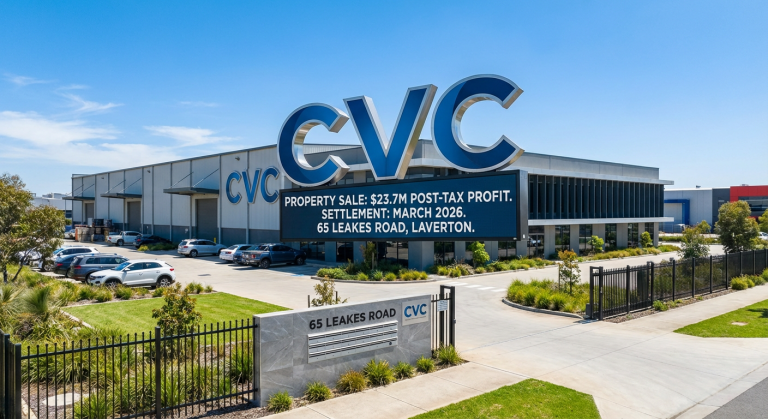
CVC Limited secures $23.7 million post-tax profit from Laverton property sale
CVC Limited has announced that its 70%-owned joint venture, Laverton Land Co Pty Limited, has entered into an unconditional contract to sell 65 Leakes Road, Laverton, Victoria. The CVC Laverton property sale to Nobelium Laverton Landowner Pty Ltd as trustee for Nobelium Laverton Landowning Trust is forecast to deliver approximately $23.7 million in post-tax profit attributable to CVC shareholders in FY 2026.
The sale price aligns with prior guidance on estimated target asset values referenced in the company’s 2024 Annual General Meeting presentation. Settlement is scheduled for on or about 6 March 2026, representing a near-term capital event with imminent profit recognition.
The joint venture originally contracted to purchase the property in December 2024 with settlement scheduled for 2026. This on-sale effectively completes a value-add cycle, delivering both accounting profit and meaningful cash inflow.
A deposit of 15% of the purchase price has been paid and is currently held in trust until the joint venture settles the original property acquisition. Approximately $20.2 million will be held in retention by the purchaser following settlement.
Join thousands of readers who start here
Our best articles, sent straight to your inbox. You can unsubscribe anytime.
Deal structure and retention terms explained
The unconditional nature of the contract means no outstanding conditions precedent remain for the sale to proceed, providing high certainty of completion. The retention funds held by the purchaser relate to specific commitments and guarantees:
- Cultural heritage approvals
- Works and services pertaining to pre-lease commitments
- Rental guarantee
- Ongoing warranties
The $20.2 million retention represents standard commercial practice for development-stage property transactions rather than a reduction in sale value. These funds are tied to future deliverables that the joint venture must complete under the sale contract.
The 15% deposit remains in trust until Laverton Land Co Pty Limited settles its original December 2024 contract to purchase the property. This structure ensures alignment between the joint venture’s acquisition and subsequent on-sale timeline.
What is an unconditional property sale?
An unconditional property sale contract means the buyer is legally committed to complete the purchase without needing to satisfy further conditions before settlement. Common conditions in property transactions include finance approval, due diligence outcomes, or regulatory consents.
Once a contract becomes unconditional, neither party can withdraw without facing potential breach of contract claims. This differs from conditional contracts where either party may terminate if agreed conditions are not met within specified timeframes.
For investors, an unconditional contract provides high certainty of completion, reducing execution risk for the expected $23.7 million profit recognition in FY 2026. The scheduled settlement date of 6 March 2026 is now approaching with no remaining hurdles to completion.
Capital redeployment and shareholder value
The Board emphasised that the transaction delivers dual benefits for (ASX: CVC) shareholders through both profit recognition and cash generation.
Board Statement
“The result provides both accounting profit and meaningful cash inflow which can be utilised by the business to further add value to CVC Shareholders.”
The sale validates management’s prior guidance on target asset values, demonstrating the company’s ability to execute on stated project valuations. This successful realisation at guidance-aligned pricing builds credibility for future property development initiatives and capital allocation decisions.
The meaningful cash inflow provides CVC with capital flexibility to pursue additional value-creation opportunities. With settlement imminent, the company will soon have enhanced financial capacity to evaluate new investments or return capital to shareholders.
Key transaction metrics at a glance
| Metric | Value |
|---|---|
| CVC Joint Venture Equity | 70% |
| Deposit Paid | 15% of purchase price |
| Funds in Retention | ~$20.2 million |
| Forecast Post-Tax Profit (CVC attributable) | ~$23.7 million |
| Expected Settlement | On or about 6 March 2026 |
The $23.7 million post-tax profit represents CVC’s 70% share of the joint venture’s gains from the CVC Laverton property sale. Final profit recognition remains subject to costs incurred up to and including the settlement date, plus any final adjustments under the sale contract.
Enjoyed this article?
We publish high-impact stories like this a few times a week. No spam.
What comes next for CVC
With settlement scheduled for on or about 6 March 2026, this capital event represents an imminent catalyst for FY 2026 results. The profit recognition of approximately $23.7 million is subject to final costs up to settlement and any contractual adjustments.
The transaction completes a value-add cycle that began with the joint venture’s December 2024 contract to purchase the property with 2026 settlement. The on-sale demonstrates CVC’s strategy of acquiring development-stage assets and realising value through strategic divestment.
Investors should watch for a settlement confirmation announcement in early March 2026, which will finalise the profit recognition and cash position impact. The release of retention funds will occur progressively as the joint venture completes its obligations relating to cultural heritage approvals, pre-lease works, rental guarantees, and warranties.
The Board has indicated the cash inflow will be utilised to further add value to CVC shareholders, suggesting potential for additional investment activity or capital management initiatives following settlement.
Want the Next Financials Winner in Your Inbox?
Join 20,000+ investors getting FREE breaking ASX news delivered within minutes of release, complete with in-depth analysis. Click the “Free Alerts” button at StockWire X to start receiving alerts the moment market-moving announcements drop across Tech, Healthcare, Finance, and Consumer sectors.