

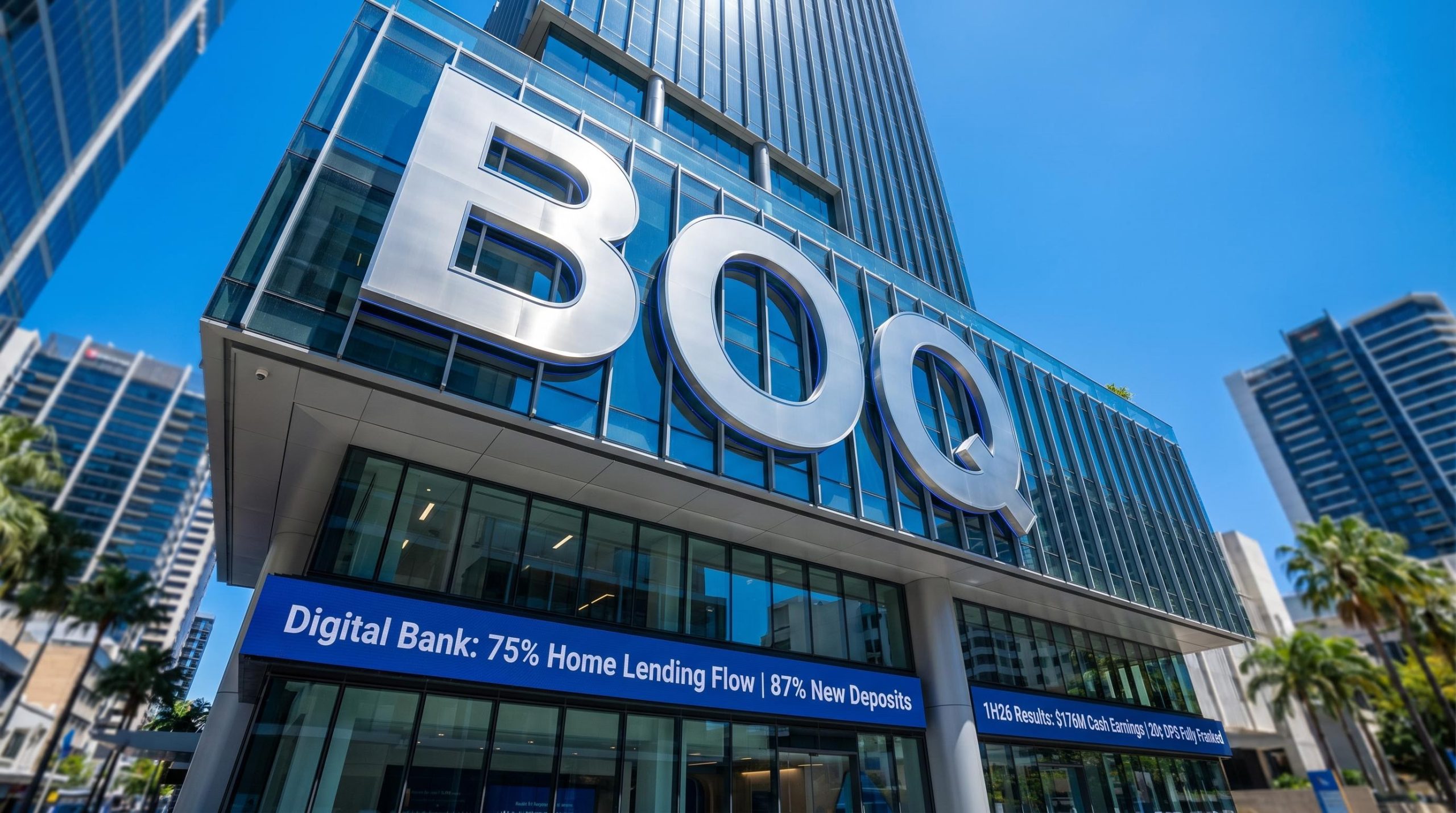
Bank of Queensland reports $176m cash earnings for 1H26 as digital transformation accelerates
Bank of Queensland has reported cash earnings after tax of $176 million for the first half of FY26, down 4% on the prior corresponding period, as the regional lender executed its digital transformation strategy amid heightened competition in Australian banking.
The result reflects disciplined execution during a challenging period. Total income rose 5% to $832 million, while operating expenses increased 6% to $553 million, producing underlying profit of $279 million (up 2%). The Board declared an interim dividend of 20 cents per share fully franked, representing an 11% increase on 1H25.
BOQ’s Common Equity Tier 1 (CET1) ratio strengthened to 11.18%, up 31 basis points on 2H25, providing surplus capital to support the bank’s strategic priorities. Return on average tangible equity came in at 7.4% (down 30 basis points), while the cost-to-income ratio rose 90 basis points to 66.5%.
The increased dividend and surplus capital position signal management confidence in the strategic path, despite near-term earnings pressure from competitive pricing and elevated loan impairment expense of $20 million (compared to $3 million in 1H25).
When big ASX news breaks, our subscribers know first
What is a digital banking transformation?
A digital banking transformation refers to the process of migrating a traditional bank’s operations — customer accounts, lending systems, and service channels — onto a modern cloud-based technology platform. For a regional lender like BOQ, this means replacing legacy banking systems with a single integrated platform that reduces operational costs and improves customer experience.
BOQ’s digital bank now processes 75% of home lending flow and 87% of new personal deposits, demonstrating substantial progress in shifting customers to the lower-cost platform. Key performance metrics include:
- 72% of active retail customers now operate on the digital bank
- 85% of ME customers have been migrated to the consolidated platform
- 4.4 average app store rating as at 14 April 2026
- 9x higher transaction balances for digital bank home loan customers compared to standalone accounts
The transformation is critical to improving BOQ’s retail banking economics. Management is targeting a 50% reduction in origination costs at scale, which would translate directly to improved margins over time as the digital platform matures and customer adoption increases.
Capital partnership with Challenger unlocks shareholder returns
BOQ announced a capital partnership with Challenger Limited involving a $3.7 billion whole-of-loan sale of equipment finance assets, representing a material reshaping of the bank’s business model. The transaction fully derecognises the equipment finance portfolio from BOQ’s balance sheet, with ownership, funding obligations, and credit risk transferring to Challenger.
Proceeds from the sale will be allocated to debt retirement ($3.4 billion) and shareholder returns (approximately $0.3 billion) through a special dividend and on-market share buy-back, subject to Board and regulatory approvals. Completion is anticipated between late April and early May 2026.
| Component | Amount | Purpose |
|---|---|---|
| Whole-of-loan sale | $3.7bn | Full derecognition of equipment finance assets |
| Debt retirement | $3.4bn | Reduce higher-cost funding |
| Shareholder returns | ~$0.3bn | Special dividend + on-market buy-back |
Under the forward flow agreement, BOQ continues originating and servicing new equipment finance assets, earning capital-light fee income while Challenger assumes funding and credit risk. This shifts BOQ away from a capital-intensive, cyclical portfolio toward scalable fee income — a structural improvement to the business model.
Management expects the transaction to be broadly neutral to FY26 cash earnings, with full return on equity (ROE) and earnings per share (EPS) benefits flowing through from FY27. The capital return is expected to boost cash return on average equity by 15 to 25 basis points, depending on completion timing and final execution parameters.
Remedial action plans progressing toward completion
BOQ has completed 61% of total remedial action plan activities under its Court Enforceable Undertakings with APRA and AUSTRAC. Both programs are transitioning into the “embed” phase, with 57% of Program rQ activities complete and 66% of AML First activities complete.
Completion of the remedial action plans is a prerequisite for APRA to remove the $50 million capital overlay currently applied to BOQ’s CET1 ratio, which would provide incremental capital relief once regulatory conditions are satisfied.
Productivity program delivers cost discipline
BOQ has delivered approximately 65% of its $250 million FY26 productivity program based on run rate benefits at February 2026. The program encompasses four pillars:
- Operating model: Cumulative reduction of approximately 850 FTEs; 11% cost reduction per customer operations FTE; exit from non-core portfolios
- Technology: 91% of target state IT applications now on the cloud; 24% reduction in technology assets; core banking systems reduced from 8 to 4
- Property & procurement: 42% reduction in corporate property space; optimised branch network; Capgemini partnership for IT and business processing
- Process & automation: Scaling responsible AI capability; core retail proposition live on digital platform; simplified distribution channels
Operating expenses remained flat half-on-half at $553 million despite inflationary pressures, demonstrating effective cost discipline. Full benefits from ME decommissioning and the Capgemini partnership are expected to flow through in FY27.
Outlook and investor considerations
BOQ acknowledged the highly unpredictable geopolitical environment and its impact on the economic and financial outlook. The bank is targeting growth at system in commercial lending, while home lending contraction is easing with a return to growth anticipated in FY27.
Management confirmed no change to the CET1 target range (10.25–10.75%) or dividend payout range (60–75% of cash earnings). However, the bank cautioned that historically low loan impairment expense may not persist given rising cash rates in the current economic climate.
Rod Finch, Managing Director & Chief Executive Officer
“The capital partnership positions us to improve returns once the transformation embed phase completes, while our surplus capital and strengthening digital platform support disciplined execution through an uncertain period.”
The combination of surplus capital, a strengthening digital platform, and the capital partnership positions BOQ to improve returns once the transformation embed phase completes. However, near-term earnings pressure from competition and potential credit normalisation warrants monitoring, particularly as loan impairment expense returned to 5 basis points of gross loans and advances in 1H26, up from 1 basis point in 1H25.
Get Financial Sector News Before the Market Moves
Join 20,000+ investors receiving FREE ASX financial sector alerts within minutes of release, complete with in-depth analysis. Click the “Free Alerts” button at StockWire X to start getting breaking bank, fintech, and financial services news the moment announcements hit the market.