
Bendigo Bank Targets $65-75M Annual Savings via Infosys and Genpact Partnerships
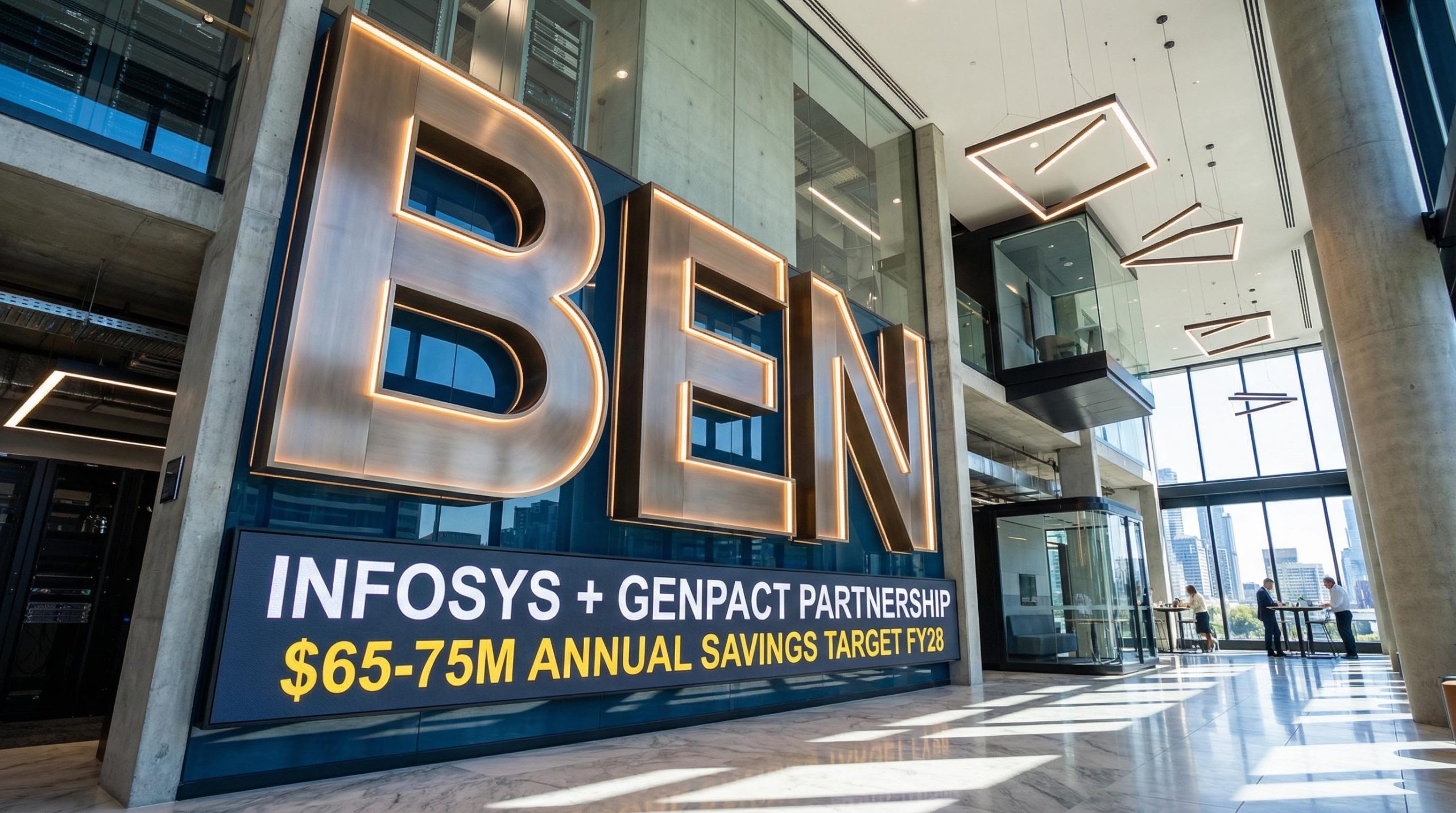
Bendigo Bank secures Infosys and Genpact partnerships to drive $65-75 million in annual savings
Bendigo and Adelaide Bank (ASX: BEN) has announced the Bendigo Bank Infosys Genpact Partnerships as part of the second phase of its Productivity Program, marking a structural shift in how the regional lender delivers technology and operational services. The bank has entered into a seven-year technology partnership with Infosys and a six-year business operations partnership with Genpact, which management expects will deliver annual run rate expense benefits of $65-75 million by FY28.
The partnerships follow the Google partnership announced in November and represent a deliberate strategy to access global capabilities whilst focusing internal resources on core strengths, including customer connection and the bank’s deposit franchise. The bank will incur upfront transition costs of $85-95 million, the majority of which will be recognised in FY27, resulting in an approximate 15-month payback period based on midpoint estimates.
CEO and Managing Director Richard Fennell
“The operational efficiencies delivered through this change will support our previous stated guidance of business as usual expenses to be no higher than inflation through the cycle.”
The announcement came alongside a Q3 FY26 trading update showing unaudited cash earnings of $137.9 million, up 7.6% on the first half quarterly average, indicating the underlying business is strengthening as the bank implements its 2030 strategy.
When big ASX news breaks, our subscribers know first
What do strategic technology partnerships mean for regional banks?
Mid-tier banks are increasingly partnering with global technology and operations specialists rather than building all capabilities in-house. This operating model evolution reflects the reality that regional banks face the same digital and regulatory demands as major banks but have smaller scale over which to spread development costs.
Partnerships with firms like Infosys and Genpact provide access to software engineering talent, AI capabilities, and process optimisation expertise that would be prohibitively expensive to replicate internally. Rather than maintaining large fixed-cost technology teams, banks can access variable capacity that scales with demand and includes continuous capability upgrades.
This model has been adopted across the global banking sector as institutions recognise that technology delivery is no longer a competitive differentiator in itself. The competitive advantage lies in how banks apply technology to serve customers, manage risk, and operate efficiently. By outsourcing technology delivery and business operations, Bendigo can concentrate capital and management focus on customer-facing activities and strategic decision-making.
For investors, this represents an operating model shift rather than simple cost reduction. The bank is trading fixed internal costs for partnership arrangements that provide flexibility and access to capabilities that evolve with industry requirements. The structure allows Bendigo to maintain operational control and oversight whilst accessing specialist delivery capability.
Q3 FY26 earnings rise 7.6% as lending momentum accelerates
Bendigo reported unaudited cash earnings of $137.9 million for the quarter ended 31 March 2026, up 7.6% on the first half quarterly average. Statutory net profit after tax came in at $109.4 million for the period. The quarterly result demonstrates improving operational momentum across both the lending book and margin performance.
Net interest margin expanded to 1.98%, up 6 basis points on Q2 FY26, reflecting ongoing benefits from deposit pricing and mix optimisation, two RBA rate rises, and higher swap rates on the replicating portfolio. Management noted the exit NIM was slightly higher than the Q3 average, though emerging headwinds related to higher funding costs to support lending growth will need to be monitored.
Lending growth continued to strengthen, with total lending growing at 5.6% annualised for the quarter. This reflected residential lending growth of 4.2% annualised and Business and Agribusiness lending growth of 12.7% annualised. The acceleration in business lending indicates improving confidence and activity amongst the bank’s commercial customer base.
Operating expenses declined 4.1%, driven primarily by reduced staff costs due to lower average FTE levels and fewer working days in the quarter. Credit expenses of $2.1 million were incurred during Q3, with management noting continued monitoring of geopolitical developments and potential credit risk impacts.
| Metric ($m) | Q3 FY26 | 1H26 Qtr Avg | Q3 FY25 | Change vs 1H26 |
|---|---|---|---|---|
| Net interest income | 433.2 | 435.6 | 416.2 | (0.6%) |
| Total income | 504.9 | 505.0 | 475.7 | (0.02%) |
| Operating expenses | (305.1) | (318.2) | (295.6) | 4.1% |
| Cash earnings (after tax) | 137.9 | 128.2 | 122.2 | 7.6% |
NIM tailwinds and emerging headwinds
The 6 basis point improvement in net interest margin during Q3 was driven by three primary factors: deposit pricing discipline and mix optimisation, the impact of two RBA rate rises flowing through the balance sheet, and higher swap rates on the replicating portfolio contributing to earnings.
The exit NIM position at quarter end was slightly above the Q3 average, suggesting momentum carried into early Q4. However, management has flagged that higher funding costs will be required to support the improving lending growth trajectory. As the bank increases its lending book at an annualised rate above 5%, it will need to compete more actively for deposits and wholesale funding, which will apply pressure to margin performance.
For investors, the NIM improvement is a genuine tailwind supported by structural changes in deposit pricing and the RBA’s rate movements. However, the sustainability of margin expansion depends on the bank’s ability to maintain deposit discipline whilst growing the loan book. The tension between volume growth and margin protection will be a key metric to monitor through FY27.
Partnership structure and implementation timeline
The strategic partnerships announced by Bendigo represent a fundamental change to how the bank delivers technology services and business operations. The structure has been designed to access specialist capabilities whilst maintaining operational oversight and strategic control.
The partnerships are structured as follows:
- Infosys partnership (seven years): Focuses on IT service delivery, software engineering, AI talent access, and innovation capacity to support the bank’s digital transformation objectives.
- Genpact partnership (six years): Concentrates on process optimisation, operational delivery, and risk management support across business operations functions.
- Expense benefit realisation: Annual run rate savings of $65-75 million expected by FY28 as processes are optimised and delivery models mature.
- Transition cost timing: Upfront costs of $85-95 million will be incurred, with the majority recognised in FY27 as workforce changes are implemented and systems transitioned.
Workforce changes will impact people in the bank’s technology and business operations teams. Substantial progress has been made on planning, but detailed design for all impacted areas is not yet finalised. Employees will be consulted on roles and team structures as the detailed design is completed.
CEO and Managing Director Richard Fennell acknowledged the impact on employees, stating “Decisions that impact our people are never easy. We acknowledge this will be a challenging time for our people and we are committed to lead these changes with care and respect.”
For investors, the FY27 financial profile will include significant one-off transition expenses before the structural cost benefits materialise. The partnerships provide a visible pathway to expense discipline, but investors should model for a temporary earnings headwind during the implementation phase. The 15-month payback period (based on midpoint estimates) suggests the investment will deliver acceptable returns once fully implemented.
The next major ASX story will hit our subscribers first
Outlook and expense guidance maintained
Management has maintained its previous guidance that business as usual expenses will be no higher than inflation through the cycle. The Infosys and Genpact partnerships represent the mechanism through which this commitment will be delivered, providing structural cost discipline whilst allowing the lending book to grow.
The annual run rate benefit of $65-75 million by FY28 will support operating leverage as revenue grows with the expanding loan book. This combination of revenue growth and disciplined cost management should drive improvement in return on equity over the medium term.
The bank continues to monitor geopolitical developments and potential impacts on credit risk, noting its commitment to supporting customers through periods of uncertainty. The operating environment remains subject to external factors including global trade dynamics, domestic economic conditions, and regulatory changes.
CEO and Managing Director Richard Fennell on workforce management
“Decisions that impact our people are never easy. We acknowledge this will be a challenging time for our people and we are committed to lead these changes with care and respect.”
For investors, the partnerships provide confidence that Bendigo can maintain expense discipline whilst competing effectively in lending markets. The visibility on cost savings, combined with improving lending momentum and NIM performance, suggests the bank is positioned to deliver sustainable earnings growth beyond the FY27 transition period. The ability to access global capabilities through partnerships rather than building them internally represents a capital-efficient approach that should support return metrics as the strategy matures.
Stay Ahead on Banking Sector News
Join 20,000+ investors receiving FREE breaking ASX news within minutes of release, complete with in-depth analysis. The Big News Blast delivers real-time alerts covering financials, tech, healthcare, and more the moment market-moving announcements hit. Click the “Free Alerts” button at StockWire X to get ahead of the market.