
Synlait Milk Delivers HY26 Result Alongside Three Phase Recovery Roadmap
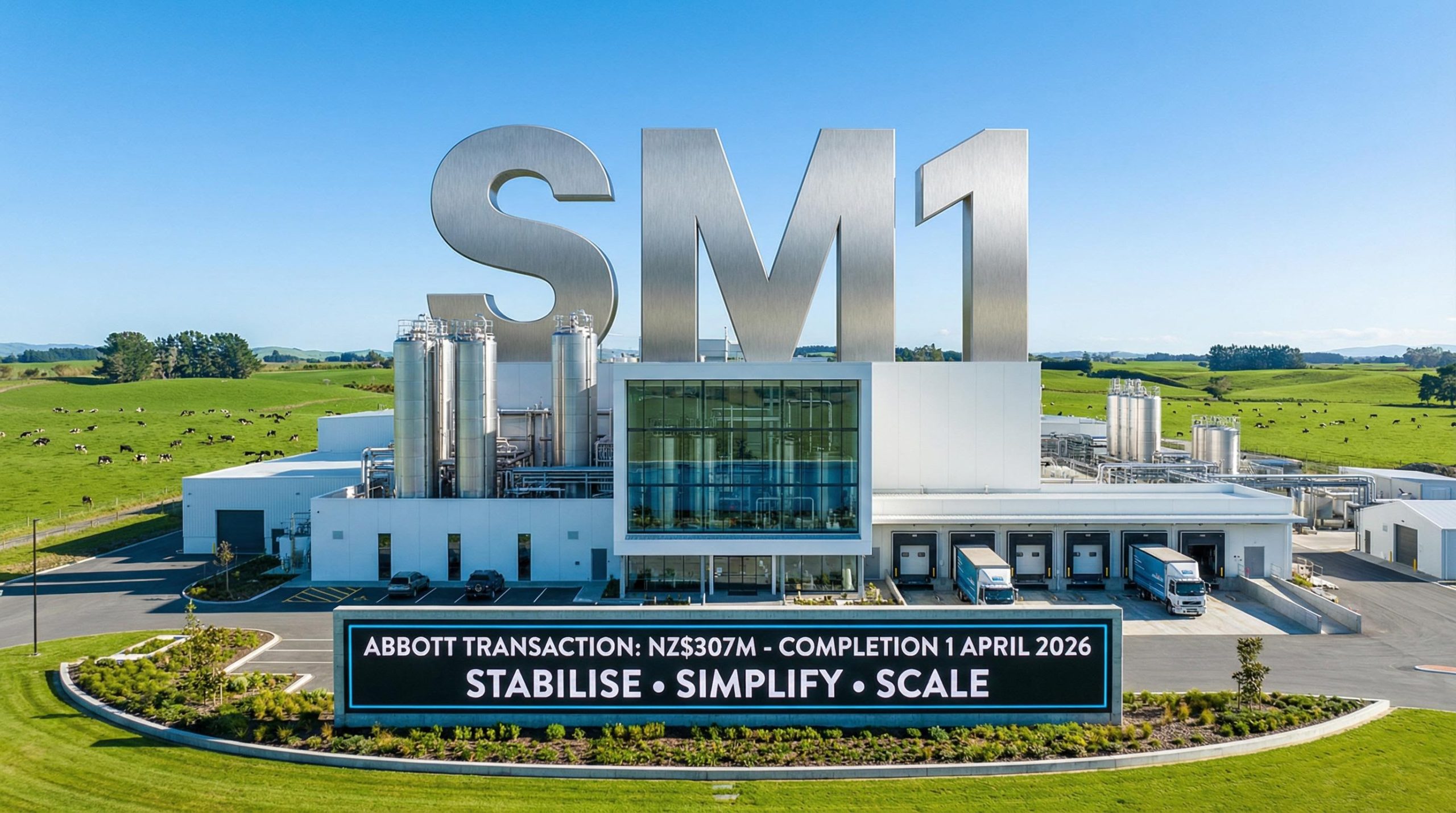
Synlait Milk delivers HY26 result alongside three-phase recovery roadmap
Synlait Milk (ASX: SM1) has released its half-year result for the six months ended 31 January 2026, alongside a Synlait Milk HY26 Recovery Roadmap designed to guide the company’s return to profitability. The announcement carries a dual message: whilst financial metrics show material deterioration against HY25, management has introduced a “Stabilise, Simplify, Scale” framework to execute recovery following the circa NZ$307 million North Island asset sale to Abbott, which completes 1 April 2026. Total group revenue declined $171.3 million versus HY25, with total group EBITDA down $97.8 million, reflecting what management describes as a period of “multiple headwinds with little choice as to how to deal with them.”
The company’s net debt position stands at $949.0 million, down $36.0 million from FY25. Management has framed this as a company in active turnaround mode rather than structural decline, with the Abbott transaction providing the balance sheet reset necessary to fund operational improvements and rebuild manufacturing optionality across its South Island facilities.
When big ASX news breaks, our subscribers know first
What drove HY26’s challenging result
The half-year result reflects a chain of interconnected operational and market challenges that constrained management’s ability to respond flexibly. Manufacturing issues from the second half of FY25 created an inventory shortfall that required catch-up production in HY26, limiting the company’s ability to adjust to changing market conditions. Customer inventory levels remained below target throughout the period, requiring continued focus on rebuilding stock positions rather than optimising product mix.
Manufacturing and inventory rebuild
Adjustments to Synlait’s manufacturing plan enabled teams to focus on catch-up production to address customer inventory shortfalls. The revised plan resulted in Synlait accumulating surplus milk, particularly during peak season when production capacity exceeded immediate customer requirements. Following an assessment of the inventory rebuild timeline, management elected to sell excess milk rather than process it into finished products.
Surplus milk and WMP pricing pressure
Milk sales did not always proceed according to plan, requiring teams to pause catch-up production to process the unsold milk. Whole milk powder (WMP) became the only ingredient the company could produce due to dryer configurations, limiting product mix flexibility at a critical time. WMP prices decreased sharply at the end of calendar year 2025, resulting in unfavourable Ingredients returns that compounded revenue and margin pressures.
The sequence of challenges unfolded as follows:
- Inventory shortfall from FY25 manufacturing issues
- Manufacturing plan adjustment to prioritise catch-up production
- Tactical milk sales to manage surplus during peak season
- Production pivot to WMP due to dryer configuration constraints
- WMP pricing downturn eliminating margin buffer
Each stage reduced management’s operational flexibility, with dryer configurations preventing the company from pivoting to higher-margin products when market conditions deteriorated.
Understanding dairy company turnarounds
Dairy processing businesses face unique recovery challenges due to the capital-intensive nature of manufacturing assets and the contractual structure of customer relationships. Rebuilding customer inventory levels can require 12 to 24 months in business-to-business dairy markets, as food manufacturers and infant nutrition producers maintain strict quality control protocols and supply chain visibility requirements that prevent rapid stock adjustments.
Manufacturing optionality, the ability to switch between product types based on market conditions, represents a critical competitive advantage for dairy processors. Companies locked into producing a single ingredient type (such as WMP) cannot respond to pricing volatility by shifting production to specialty proteins, nutritional powders, or value-added ingredients. This lack of flexibility amplifies exposure to commodity price movements and limits margin recovery potential.
Balance sheet resets through asset sales or capital raises provide the financial headroom to invest in manufacturing improvements, rebuild customer relationships, and weather extended periods of margin compression. Investors should monitor three key metrics during dairy turnarounds: customer inventory rebuild progress, manufacturing yield improvements, and product mix evolution from commodities toward specialised ingredients.
HY26 financial snapshot
The half-year figures reflect the operational constraints detailed above, with revenue, profitability, and cash flow all declining materially against HY25 comparatives.
| Metric | HY26 | Change vs HY25 |
|---|---|---|
| Total group revenue | Not disclosed | Down $171.3M |
| Total group EBITDA | Not disclosed | Down $97.8M |
| Total underlying group NPAT | Not disclosed | Down $85.4M |
| Total reported group NPAT | $3.1M | Down $83.9M |
| Total group gross profit | Not disclosed | Down $64.4M |
| Operating cash flow | ($80.6M) | Down $32.2M |
| Net debt | $949.0M | Down $36.0M vs FY25 |
FY26 milk price forecast
The company has set its forecast base milk price at $9.50 per kilogramme of milk solids, with a forecast average Synlait milk incentive of $0.30 and a Synlait Secured Milk Premium of $0.10. This results in a forecast total average milk payment of $9.90 per kilogramme of milk solids.
Competitive milk pricing helps secure the supply base critical for recovery execution. Farmers committed to supply Synlait without a cease notice in place are eligible for additional secured milk premium payments in FY26, FY27, and FY28, averaging $0.08 per kilogramme of milk solids when spread across the entire milk pool.
The Stabilise, Simplify, Scale roadmap
Management has introduced a three-horizon framework as the strategic blueprint for recovery, with each phase building on the achievements of the prior stage. The roadmap provides measurable milestones beyond headline financial metrics, allowing investors to track operational improvements even during periods of margin compression.
Horizon 1 (Stabilise):
- Deliver operational stability that meets customer expectations
- Strengthen financial resilience
- Build greater optionality
Horizon 2 (Simplify):
- Align priorities and sharpen capability
- Grow high-margin products from existing assets
- Lift profitability
Horizon 3 (Scale):
- Expand markets, channels, and customers
- Execute future growth opportunities
The framework positions manufacturing stability and balance sheet strength as prerequisites for margin improvement. Only after achieving consistent operational delivery does management plan to pursue market expansion and channel diversification.
The next major ASX story will hit our subscribers first
Abbott sale completion unlocks next phase
The 1 April 2026 completion of the North Island asset sale represents the inflection point enabling recovery execution. The circa NZ$307 million proceeds will deliver what management describes as a “wholesale reset for Synlait’s balance sheet,” removing uncertainty and providing the capital structure to execute the roadmap. The transaction enables focus on world-class South Island manufacturing assets without the operational complexity of managing geographically separated facilities.
George Adams, Chair, and Richard Wyeth, CEO
“Behind our roadmap sits a real determination to ensure the coming 12 to 24 months will be looked back on as a period where Synlait under promised and over delivered.”
Management has acknowledged that returning to profitability will take time, with the Stabilise, Simplify, Scale framework already being activated. The company expects the completion of the North Island sale to provide the financial headroom necessary to uplift operational stability and create greater manufacturing optionality across its South Island asset base.
Get Food & Beverage News Before the Market Reacts
Join 20,000+ investors receiving FREE breaking ASX alerts delivered within minutes of release, complete with in-depth analysis. Click the “Free Alerts” button at Big News Blast to start getting Consumer Staples news the moment it hits the market.