
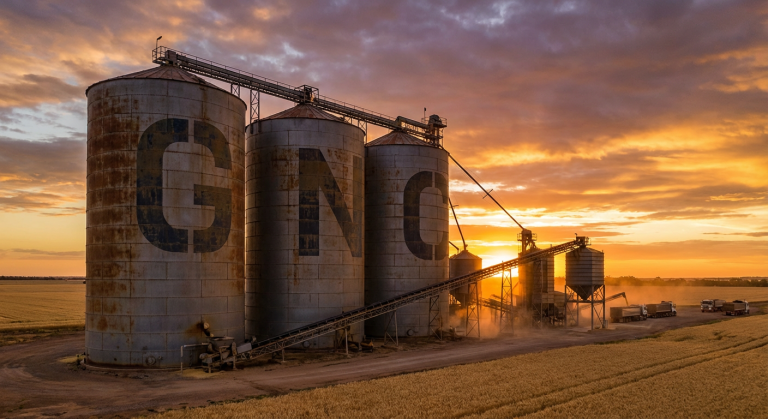
GrainCorp Limited has issued GrainCorp FY26 Earnings Guidance, forecasting Underlying EBITDA of $200-240 million compared to $308 million in FY25, representing a material decline as the company navigates cyclical headwinds in global grain markets. The agribusiness operator expects Underlying NPAT of $20-50 million for the year ahead, down from $87 million in FY25, with the guidance excluding Business Transformation costs and impacts from the GrainsConnect Canada sale.
The earnings revision reflects the company’s position within a challenging commodity cycle characterised by global oversupply and low prices. Despite solid regional production volumes, grain export margins have fallen to multi-year lows as growers respond to weak commodity prices by delaying grain deliveries to market. Management has emphasised operational discipline and cost management whilst maintaining service quality for its grower network.
The company’s AGM is scheduled for Wednesday 18 February 2026 at 10am AEDT in Sydney, where investors will receive further strategic updates on navigating the current market environment.
What’s driving the earnings shift
Global oversupply reshapes the playing field
Record global grain production has created a fundamental supply-demand imbalance that is pressuring margins across the entire agribusiness value chain. The abundance of supply has outpaced demand growth, pushing commodity prices lower and reducing grower incentives to deliver grain to processors and exporters like GrainCorp (ASX: GNC).
Despite ABARES estimating the 2025-26 East Coast Australia winter crop at 31.2 million tonnes, the company faces a more challenging revenue environment than strong regional harvests might suggest. GrainCorp anticipates FY26 receivals of 11.0-12.0mmt compared to 13.3mmt in FY25, with expected exports of 5.5-6.5mmt versus 7.0mmt in the prior year.
CEO Commentary
“Record global production has created an oversupply of grain, outpacing demand growth and placing downward pressure on commodity prices for the whole market,” said Robert Spurway, Managing Director and CEO.
The combination of volume compression and margin pressure explains the significant earnings gap despite solid regional production fundamentals. Grain export margins have fallen to multi-year lows as the company processes grain in an environment where handling costs remain relatively fixed whilst commodity values decline.
The slow pace of grower selling across East Coast Australia has compounded these dynamics, as producers wait for more favourable pricing conditions before releasing stored grain.
For investors, this represents a transparent acknowledgement of cyclical headwinds rather than operational underperformance. The earnings guidance provides clear parameters for evaluating the company’s ability to manage through a challenging phase of the commodity cycle.
Understanding grain commodity cycles and their impact on agribusiness earnings
Grain commodity cycles operate on a fundamental supply-demand dynamic that directly affects agribusiness margins. When global production exceeds consumption requirements, commodity prices decline as markets adjust to absorb the surplus. This creates a cascading effect throughout the value chain that impacts companies like GrainCorp differently than simple harvest volume data might suggest.
The current cycle illustrates this mechanism clearly. Growers facing low commodity prices have reduced incentive to sell immediately, choosing instead to store grain on-farm whilst waiting for better pricing. This behaviour slows the flow of grain through processors and exporters, reducing volumes and compressing margins simultaneously.
Processing companies face a particular challenge because many operational costs remain fixed regardless of commodity prices, creating margin pressure when grain values fall.
Strong local harvests do not automatically translate to strong earnings for grain handlers. Whilst regional production volumes provide the raw material for operations, profitability depends on the interaction between global pricing, grower selling behaviour, and processing margins. In oversupplied markets, handlers may see ample grain available but struggle to secure attractive margins on exports or domestic sales.
The cyclical nature of these dynamics means current weakness typically represents a temporary rather than permanent condition. As global inventories normalise and production eventually moderates, pricing improves and grower selling accelerates, restoring margins throughout the chain. Understanding this cycle is critical for investors assessing whether current share price levels reflect attractive entry points during a cyclical trough or structural challenges requiring different evaluation frameworks.
Segment performance expectations
GrainCorp’s diversified business structure provides partial buffer against the Agribusiness headwinds, with the Nutrition and Energy segments expected to deliver more stable contributions. The company’s operations span grain handling, oilseed processing, animal nutrition, and biofuels, creating different exposure profiles to current market conditions.
| Segment | FY26 Outlook | Key Driver |
|---|---|---|
| Agribusiness | Lower margins | Global oversupply, slow grower selling |
| Oilseed Crush | In line with FY25 | Stable average crush margins |
| Animal Nutrition | In line with FY25 | Consistent demand patterns |
| Agri Energy | Below FY25 | US biofuels policy uncertainty |
The Agribusiness segment remains the dominant swing factor in earnings performance, with grain export margins at multi-year lows creating the primary drag on group results. Oilseed crush margins are anticipated to remain stable, providing consistent contribution from processing operations.
Animal Nutrition is expected to perform in line with FY25 as livestock feed demand patterns remain relatively steady despite broader agricultural sector pressures.
Agri Energy represents a secondary headwind, with contribution expected below prior year levels due to ongoing uncertainty around US biofuels policy settings. This policy environment creates margin volatility in renewable fuels markets, affecting the company’s biofuels feedstock operations.
For investors, the diversified earnings base demonstrates the value of GrainCorp’s integrated platform. Whilst Agribusiness faces near-term headwinds, the stability in Nutrition segments provides some offset and positions the company to capture upside when commodity cycles turn. This structure differentiates the company from pure-play grain handlers with concentrated exposure to single market dynamics.
Management’s response and balance sheet position
Accelerated cost initiatives underway
Management has responded to the earnings environment with proactive cost discipline whilst preserving the service quality that underpins grower relationships. The company’s approach balances near-term margin protection with maintaining the operational capabilities required to capitalise when market conditions improve.
- Accelerating cost management initiatives across operations to align the cost base with current revenue environment
- Maintaining high-quality service delivery to grower network to preserve market position and customer relationships
- Preserving balance sheet strength for strategic optionality during the commodity cycle
The company’s balance sheet remains strong, providing capacity to invest in strategic opportunities that may emerge during the downturn whilst protecting dividend sustainability. This financial flexibility differentiates well-capitalised operators from leveraged competitors facing potential distress during cyclical troughs.
Management’s emphasis on operational discipline during the downturn reflects a pragmatic approach to commodity cycle management. Cost reductions protect near-term margins without compromising the asset base or service capabilities that generate returns when conditions normalise.
For investors evaluating cyclical businesses, this balance between tactical cost management and strategic positioning represents a critical capability.
Companies that maintain service quality and relationships through downturns typically capture disproportionate upside when cycles turn, as distressed competitors exit markets or reduce service levels. GrainCorp’s approach suggests management is positioning for this dynamic rather than simply cutting costs to defend short-term earnings.
Key variables investors should monitor
The GrainCorp FY26 Earnings Guidance is subject to several market variables that will determine where within the forecast range actual results ultimately land. These factors provide clear signposts for tracking performance through quarterly updates and assessing whether conditions are improving or deteriorating relative to current assumptions.
- Sorghum receivals and total grain volumes as grower selling patterns evolve
- Timing and volume of grain exports as global demand conditions develop
- Supply chain margin trajectory relative to current multi-year lows
- Oilseed crush margin movements in processing operations
- New season opportunities emerging in Q4 as planting decisions approach
Management has flagged the AGM scheduled for Wednesday 18 February 2026 at 10am AEDT in Sydney as the next formal update opportunity. This timing allows investors to assess first-half trading performance and gain insight into management’s evolving view of full-year outcomes.
These variables create potential for both upside and downside relative to current guidance. Improved grower selling or stronger export demand could support margins recovering from current lows, whilst further deterioration in global pricing or extended selling delays could pressure results toward the lower end of the range.
Oilseed crush margins represent a potential positive offset if processing spreads improve beyond current stable assumptions.
For investors, monitoring these factors through the year provides early indication of whether the FY26 result will track toward $200 million or $240 million EBITDA. The magnitude of this range reflects genuine uncertainty in commodity market dynamics rather than management hedging. Each quarterly update should provide incremental clarity on grain volumes, export timing, and margin trends, allowing progressive refinement of earnings estimates as the year unfolds.
Want more Non-Resource ASX Analysis?
The guidance from GrainCorp illustrates the margin compression dynamics that affect agribusiness operators during commodity downturns—but similar cyclical patterns play out across Tech, Healthcare, Finance, and Industrial sectors. Understanding how ASX-listed companies navigate sector-specific headwinds requires access to timely breaking news and comprehensive analysis that connects market developments to earnings implications.
StockWire X delivers Big News Blasts covering these Non-Resource sectors to over 20,000+ Australian investors—completely free. These alerts provide breaking announcements alongside detailed sector context, helping readers identify whether market movements represent temporary cyclical pressure or structural shifts requiring portfolio reassessment. Click the “Free Alerts” button in the menu to receive these analyses directly as ASX companies release material updates affecting Non-Resource sectors.