
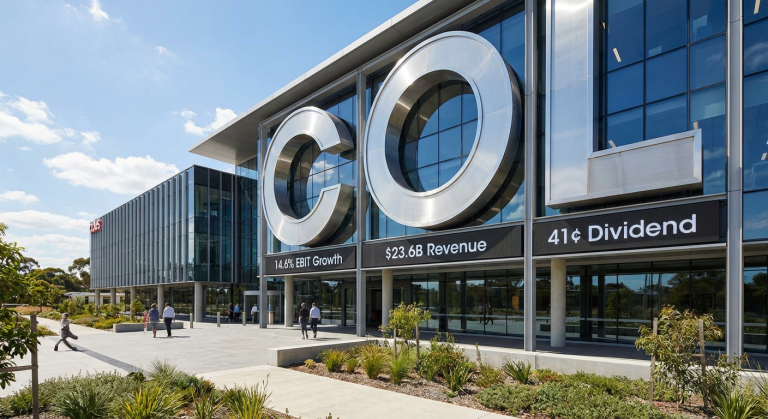
Coles Group delivers 14.6% supermarkets EBIT growth in half year results
Coles Group has reported strong Coles Group half year results for 1H FY26 (July–December 2025), with supermarkets EBIT climbing 14.6% alongside consistent sales momentum across its core retail operations. The ASX-listed retailer posted Group sales revenue of $23.6 billion (up 2.5%), while EBIT excluding significant items reached $1,231 million (up 10.2%). NPAT excluding significant items rose 12.5% to $676 million, prompting the Board to declare an interim dividend of 41 cents per share fully franked—a 10.8% increase on the prior corresponding period.
The results underscore Coles’ ability to expand margins through operational discipline despite a competitive pricing environment. Supermarkets EBIT growth of 14.6% was underpinned by 55 basis points of margin expansion, reflecting efficiencies from automation, strategic sourcing, and the absence of major project implementation costs that weighed on the prior year. However, the liquor segment faced headwinds, with EBIT declining 37.3% to $42 million, impacted by subdued market conditions and $13 million in one-off banner conversion costs.
CEO Leah Weckert emphasised the company’s commitment to value: “We know value remains front of mind for our customers and we are well placed to deliver great value through our Exclusive to Coles range, as well as our seasonal value campaigns, weekly promotions and loyalty offers.”
| Metric | 1H26 | 1H25 | Change |
|---|---|---|---|
| Group Sales Revenue | $23.6 billion | $23.0 billion | +2.5% |
| Group EBIT (excl. SI) | $1,231 million | $1,117 million | +10.2% |
| NPAT (excl. SI) | $676 million | $601 million | +12.5% |
| Interim Dividend | 41 cps | 37 cps | +10.8% |
Join thousands of readers who start here
Our best articles, sent straight to your inbox. You can unsubscribe anytime.
What drives supermarket profitability for ASX retailers?
Supermarket profitability hinges on two primary levers: gross margin and cost of doing business (CODB). Gross margin represents the difference between what a retailer pays suppliers for goods and the price at which those goods are sold to customers. CODB encompasses the operational expenses required to run stores—wages, rent, utilities, and logistics. For large-scale operators like Coles, small improvements in these metrics translate to substantial dollar gains due to the sheer volume of transactions.
Tobacco sales present a unique challenge for reported metrics. Industry-wide declines in tobacco volumes skew growth figures, as tobacco carries high absolute revenue but low margins. Analysts often examine “ex-tobacco” figures to assess underlying performance. In Coles’ case, excluding tobacco reveals adjusted sales growth of 6.1%, compared to 3.6% on a reported basis. This adjustment strips out the drag from declining tobacco volumes and provides a clearer view of core grocery trends.
Coles achieved 55 basis points of EBIT margin expansion in its supermarkets division during 1H26, lifting the margin to 5.8%. This improvement reflects strategic initiatives including automated distribution centre (ADC) benefits, reduced tobacco mix effects, and operational efficiencies captured through the Simplify and Save to Invest (SSI) programme.
Supermarkets segment breakdown
The supermarkets division delivered revenue of $21.4 billion (up 3.6% reported; 6.1% adjusted ex-tobacco), with EBIT rising 14.6% to $1,234 million. The EBIT margin expanded by 55 basis points to 5.8%, driven by a 65 basis point increase in gross margin to 27.8%.
Key drivers of margin improvement included:
- Lower tobacco sales mix, which reduced the dilutive effect of low-margin products
- Annualised benefits from automated distribution centres (ADCs)
- Strategic sourcing initiatives delivering cost savings
- SSI programme efficiencies across store operations
- Growth in Coles 360 retail media income (up 10.3%)
The absence of major project costs provided additional tailwinds. In 1H25, Coles incurred $92 million in implementation, dual running, and transition costs related to the Kemps Creek ADC and Customer Fulfilment Centre (CFC) rollouts. These costs did not recur in 1H26, contributing 10 basis points to gross margin improvement and 34 basis points to CODB efficiency.
eCommerce sales surged 27%, with penetration reaching 13.1% (up from 10.7% in the prior period). Double-digit growth was recorded across all shopping missions, supported by expanded same-day delivery, improved app functionality, and operational automation within CFCs.
Liquor segment faces headwinds
Coles’ liquor division reported revenue of $1.9 billion (down 3.2%), with EBIT falling 37.3% to $42 million. The decline was amplified by $13 million in one-off costs related to the Simply Liquorland banner conversion programme. Excluding these costs, EBIT fell 16.7%, reflecting subdued consumer demand and intensified competitive activity.
The convenience store portfolio—excluding the 93 Liquorland Warehouse outlets—delivered positive sales growth during the period. Banner simplification is now complete, removing future conversion drag. Coles expects approximately $7 million in additional one-off costs during 2H26 as final process adjustments are implemented.
Digital acceleration drives 27% eCommerce growth
Coles’ digital transformation remains a strategic priority, with eCommerce sales penetration rising to 13.1% from 10.7% in the prior corresponding period. Monthly active app visitors increased 32%, while the app’s share of eCommerce revenue reached 54%. Tell Coles Online Net Promoter Score (NPS) improved by 5.3 points, reflecting enhanced customer satisfaction across fulfilment and product availability.
The company expanded its Customer Fulfilment Centre (CFC) capabilities in Melbourne and Sydney, introducing same-day delivery and installing On Grid Robotic Pick (OGRP) arms alongside auto frame loading technology. These enhancements improved operational efficiency while supporting higher order volumes. Coles also expanded its partnership with Uber Eats, increasing product availability to over 17,000 items.
Coles 360, the company’s retail media platform, delivered income growth of 10.3%. Retail media represents an emerging high-margin revenue stream that requires minimal incremental capital expenditure and flows largely to profit.
Key Digital Enhancements:
- Same-day delivery expansion in Melbourne and Sydney CFCs
- Installation of On Grid Robotic Pick (OGRP) arms
- Auto frame loading technology for improved throughput
- Windowless Click & Collect Rapid expanded to 255 stores nationally
- App share of eCommerce revenue reached 54%
Simplify and Save to Invest program delivers $133 million
Coles’ SSI programme generated $133 million in benefits during 1H26, bringing cumulative benefits delivered to approximately $700 million since inception. The company remains on track to achieve its four-year target of over $1 billion in total benefits. The programme focuses on self-funded efficiency gains that enable price investment while protecting margins.
SSI initiatives during the period included:
- Leveraging technology to optimise store operations through process improvements
- Reducing waste and markdowns via store-specific ranging and range reviews
- Front-end service transformation, including trolley-assisted checkouts
- Supply chain efficiencies such as optimised pallet fill and transport systems
- Above-store operating model efficiencies within store support centres
Capital allocation and shareholder returns
Coles declared an interim dividend of 41 cents per share fully franked, representing a 10.8% increase from the prior corresponding period. The dividend increase outpaces reported earnings growth, signalling Board confidence in cash generation sustainability despite near-term working capital pressures.
Operating capital expenditure totalled $476 million, with full-year guidance maintained at approximately $1.2 billion. Key investments included 35 supermarket renewals, 127 liquor store renewals (inclusive of Simply Liquorland conversions), and six new supermarkets. The company also progressed construction of its Victorian ADC and continued rollout of front-end transformation initiatives.
Net property capital expenditure delivered an inflow of $126 million during the period, reflecting disciplined portfolio management. The leverage ratio remained conservative at 0.9x (debt) and 2.6x (lease plus debt), with investment-grade credit ratings maintained (Moody’s Baa1, S&P BBB+).
Cash realisation was affected by payment timing. An additional payment run in the final week of the half resulted in an outflow of approximately $560 million, temporarily depressing the cash realisation ratio to 69%. Adjusted for this timing effect, the ratio was 94%, with full-year cash realisation forecast at approximately 100%.
CEO Leah Weckert
“We know value remains front of mind for our customers and we are well placed to deliver great value through our Exclusive to Coles range, as well as our seasonal value campaigns, weekly promotions and loyalty offers.”
Enjoyed this article?
We publish high-impact stories like this a few times a week. No spam.
Outlook and trading update
For the first seven weeks of Q3, supermarkets sales revenue increased 3.7% (5.3% ex-tobacco) as Coles continued to cycle the impacts of competitor industrial action from the prior year. Customers remain value-oriented, with strong engagement across the Exclusive to Coles range, which now includes over 500 products launched during 1H26.
The liquor sales decline moderated to 2.5% in the first seven weeks, with the convenience portfolio continuing to deliver positive growth. Management expects the market to remain highly competitive, with focus on delivering a seamless omnichannel experience and streamlining operations.
Strategic priorities for the second half include:
- Delivering an omnichannel experience across all customer touchpoints
- Driving sales momentum through range expansion, value investment, and product innovation
- Streamlining operations to capture further efficiency gains
Legal and regulatory matters remain under management. Coles is defending ACCC and class action proceedings related to discount representations on 245 products between February 2022 and May 2023. A $235 million provision ($165 million after tax) was recognised during 1H26 following a Federal Court judgment in relation to Fair Work Ombudsman proceedings.
Don’t Miss the Next Consumer Staples Winner
Join 20,000+ investors getting FREE breaking ASX news delivered to your inbox within minutes of release, complete with in-depth analysis. Click the “Free Alerts” button at StockWire X to start receiving consumer staples alerts the moment market-moving announcements hit the ASX—before the market reacts.