
Bioxyne Delivers Record $31.3M Revenue as Cannabis Demand Surges 149%
Bioxyne delivers record $31.3 million revenue as medicinal cannabis demand surges
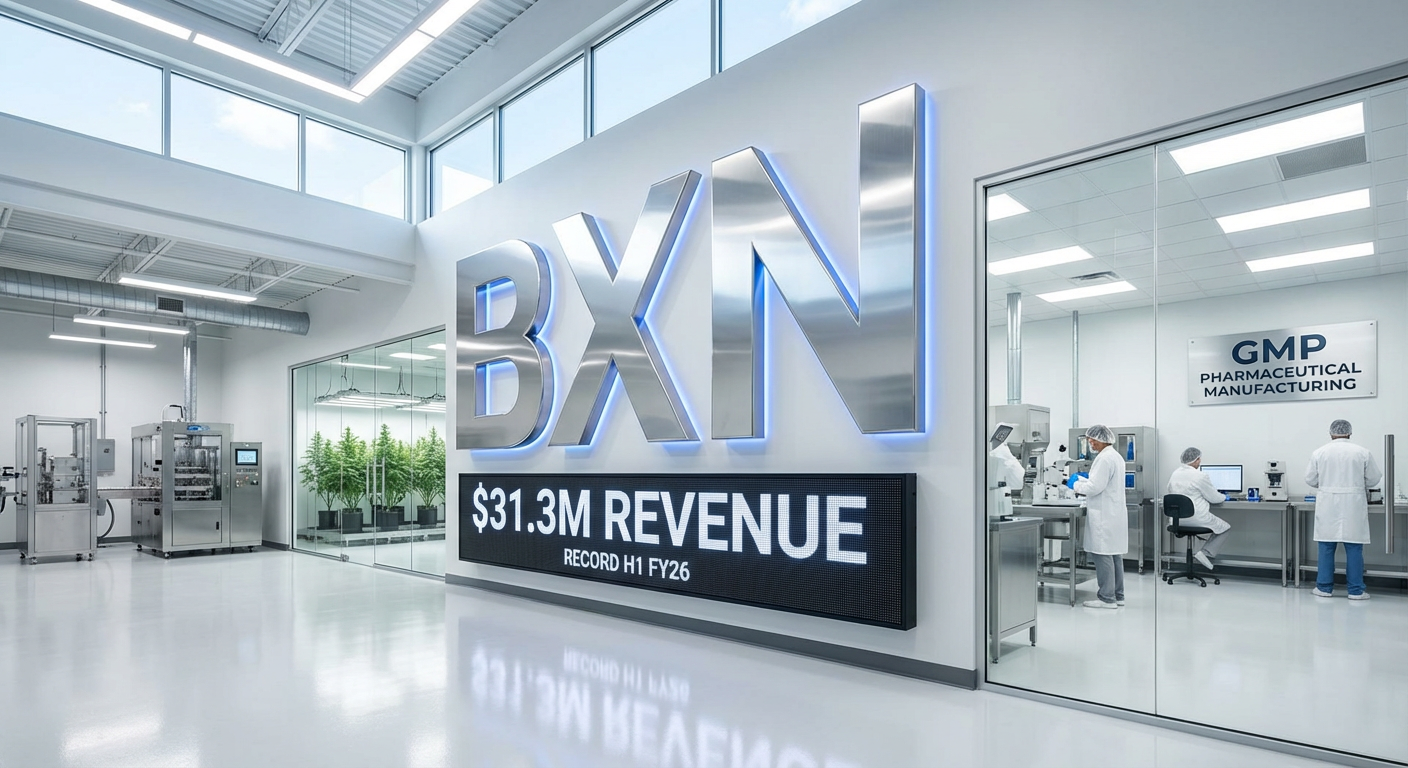
Bioxyne Limited has reported record H1 FY2026 results, with revenue reaching $31.3 million, representing 149% growth on the prior corresponding period. The GMP pharmaceutical manufacturer, which specialises in medicinal cannabis, MDMA, and psilocybin products for patients with unmet clinical needs, has reaffirmed full-year revenue guidance of $65-$75 million and upgraded EBITDA guidance to $16.5-$19 million (previously $11.5-$13.5 million).
The company’s half-year performance was driven by sustained demand for GMP-manufactured medicinal products across its key therapeutic categories. Net profit before tax reached $7.3 million (up 121% on pcp), whilst Adjusted EBITDA came in at $8.3 million (up 137% on pcp). (ASX: BXN) closed the period with $7.6 million cash on hand and net assets of $20 million, an increase of $8 million on the prior corresponding period.
When big ASX news breaks, our subscribers know first
What is GMP manufacturing and why does it matter for medicinal cannabis?
GMP certification refers to Good Manufacturing Practice standards, which ensure pharmaceutical-grade quality, consistency, and safety for medicinal products. Whilst many cannabis products globally are manufactured without pharmaceutical-level oversight, GMP certification requires strict protocols for production, testing, and documentation that mirror traditional pharmaceutical manufacturing.
For medicinal cannabis patients and prescribing clinicians, GMP certification provides assurance that products meet the same rigorous standards as conventional medicines. This distinction is particularly important for regulated medical markets in Australia, the United Kingdom, and across Europe, where GMP certification is often required for product approval and reimbursement eligibility.
Bioxyne operates the world’s largest GMP-certified cannabis pastilles manufacturing facility, with capacity to manufacture up to 6 million individual pastilles per month. This scale advantage positions the company to capture growing demand in a market segment where edibles and pastilles are projected to grow from 1% to over 20% of Australian prescriptions by 2027.
Financial performance reflects operational scale
The company’s revenue growth was underpinned by increasing demand for GMP-manufactured cannabis, MDMA, and psilocybin products, combined with demonstrated ability to scale manufacturing capacity efficiently. Adjusted EBITDA margin reached 26.3% in H1 FY26, reflecting improving profitability as scale benefits emerge across the business.
Operating cash outflow of $1.6 million during the half was attributable to strategic inventory investment, with stock levels increasing to $11.7 million (from $3.6 million at 30 June 2025) to support forecast demand in H2 FY26. This inventory build is designed to drive white-label manufacturing sales and improve unit economics on key product lines. The company’s cash position was supported by a $1.1 million R&D tax offset.
| Metric | H1 FY26 | H1 FY25 | Growth |
|---|---|---|---|
| Revenue | $31.3m | $12.6m | +149% |
| Adjusted EBITDA | $8.3m | $3.5m | +137% |
| NPBT | $7.3m | $3.3m | +121% |
Financial performance also reflected operational efficiency gains, with commissions as a percentage of sales decreasing significantly, and freight and transport costs declining as a percentage of revenue. Trade receivables increased 142% to $5.8 million, reflecting the expanded customer base and revenue scale.
Capacity expansion positions Bioxyne for continued growth
Operational capacity increased substantially during the half, with GMP clean rooms expanded by 100% and storage capacity increased by 200%. Four new clean rooms became operational in December 2025, supporting the company’s ability to meet rising demand across Australian and international markets.
Flower processing capacity is being boosted by 150%, positioning Bioxyne to supply both domestic and export markets with Australian-made finished medicines and GMP materials. The company’s manufacturing footprint now supports production of approximately 8.2 million finished medicine products per year, with estimated total revenue capacity of $250 million annually.
Current manufacturing capacity by product category:
- 889+ product SKU variants manufactured across all categories
- Over 240,000 finished products delivered per month (Q2 average)
- Pastilles capacity: 1.6 million units per year (~$57.2 million revenue capacity)
- Flower processing: 5 million units per year (~$182 million revenue capacity)
International expansion unlocks multi-billion dollar addressable market
Bioxyne’s international strategy accelerated during H1 FY26, with market entry into the United Kingdom, Germany, and Latin America. Initial shipments to German distribution partner Adrex Pharma GmbH generated $2.7 million in H1 FY26 revenue, establishing commercial momentum in Europe’s largest medicinal cannabis market.
In the United Kingdom, the company secured £848,250 (~$1.6 million) in non-dilutive funding from South of Scotland Enterprise to establish a GMP manufacturing facility in the Scottish Borders. Construction is scheduled to commence in February 2026, with completion targeted by end of FY26. The UK facility is expected to receive licensing by approximately December 2026, enabling local manufacturing and distribution to capture forecast market growth.
Latin American expansion commenced with a distribution agreement with Remidose for Costa Rica and Panama, positioning Bioxyne as an early entrant with projected annual revenue potential exceeding $1 million (subject to regulatory clearance). The company also completed its dual listing on the Frankfurt Stock Exchange (ticker: PR8.F) in October 2025, enhancing liquidity and capital markets access for European investors.
| Market | Est. Monthly Patients | Avg. Spend/Year | Est. Market Size | Growth Rate |
|---|---|---|---|---|
| Germany | 350,000 | $4,285 | $1.5 billion | 60-120% |
| UK | 80,000 | $6,250 | $0.5 billion | 40-90% |
| Australia | 250,000 | $4,000 | $1.0 billion | >26% |
Combined, these three markets represent a total addressable market exceeding $3.5 billion in 2026 for medicinal cannabis alone, with Bioxyne establishing local manufacturing presence to capture forecast growth.
Australian market momentum continues
The Australian medicinal cannabis market continues to demonstrate explosive growth, with prescriptions increasing from 963,000 in 2024 to 1.3 million in 2025, trending toward 1.74 million. This growth is being driven by expanding prescriber networks, increasing patient awareness, and broader acceptance of medicinal cannabis as a therapeutic option for conditions including chronic pain, anxiety, and sleep disorders.
Bioxyne’s Australian customer base increased 104% year-on-year, with new contract wins including Curaleaf, Remidose, Adrex, and additional partners. The company is scaling its Dr Watson branded prescription medicines via clinics and pharmacies, whilst expanding white-label manufacturing partnerships with medicine brands and wholesalers supplying patients across the country.
Key domestic growth drivers include:
- Capacity expansion for flower processing to meet rising demand
- Improved unit economics on white-label product lines through scale efficiencies
- Significant inventory investment to support H2 FY26 demand
- Dr Watson branded prescription medicines scaling via clinic and pharmacy channels
Major milestone achieved with Australian-made GMP MDMA capsules
A significant milestone during H1 FY26 was the commercial release and supply of the first Australian-made GMP-certified MDMA capsules. This achievement positions Bioxyne as one of the few manufacturers globally with demonstrated capability across cannabis, psilocybin, and MDMA production under pharmaceutical-grade standards.
The diversification into MDMA and psilocybin manufacturing provides multiple growth vectors beyond cannabis, particularly as clinical research into psychedelic-assisted therapies advances. Bioxyne’s MDMA and psilocybin capsules capacity stands at 126,000 units per year, with revenue capacity exceeding $10 million.
Psychedelic Medicine Manufacturing
Bioxyne’s GMP-certified facility enables production of controlled substances including MDMA and psilocybin under pharmaceutical manufacturing standards, positioning the company to supply clinical trials and, subject to regulatory approvals, future therapeutic use.
The next major ASX story will hit our subscribers first
Outlook and guidance
The Board has reaffirmed FY26 revenue guidance of $65-$75 million and upgraded FY26 Adjusted EBITDA guidance to $16.5-$19 million (previously $11.5-$13.5 million). The upgraded EBITDA guidance signals improving profitability as scale benefits emerge across the business, with margins supported by operational efficiencies, improved unit economics, and continued automation investments.
Near-term catalysts include completion of the UK manufacturing facility by end of FY26, continued scaling of international distribution partnerships, and ongoing assessment of EU manufacturing site opportunities. Management continues to evaluate establishing manufacturing operations in Germany to support European market access.
Strategic priorities for the remainder of FY26:
- Increasing market share in Australia through new manufacturing contracts and white-label growth
- Scaling UK and Germany distribution ahead of company-owned manufacturing
- UK GMP facility licensing targeted by approximately December 2026
- Assessing opportunity to establish manufacturing in Germany
As of February 2026, (ASX: BXN) shares traded at $0.052, representing a market capitalisation of $116.5 million. The company’s 52-week trading range was $0.019 to $0.060, with Directors holding 31% and the Top 20 shareholders controlling 69% of the register.
Don’t Miss the Next Healthcare Breakthrough
Join 20,000+ investors getting FREE breaking ASX news delivered to your inbox within minutes of release, complete with in-depth analysis. Click the “Free Alerts” button at Big News Blast to start receiving healthcare sector alerts the moment market-moving announcements drop.