
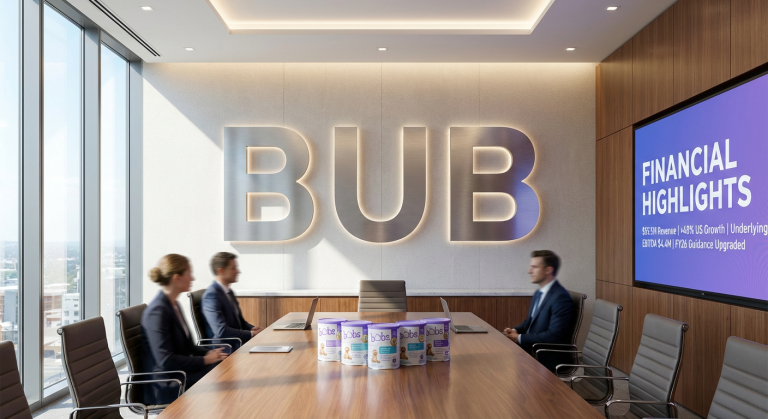
Bubs Australia delivers positive underlying EBITDA as US growth accelerates
Bubs Australia has reported its 1H FY26 results, marking a return to underlying profitability with $55.5M in revenue (up 14% on the prior corresponding period), a gross profit margin of 48%, and underlying EBITDA of $4.4M. The infant formula company has upgraded its full-year FY26 guidance, signalling confidence in its strategic execution across key markets.
Management attributed the turnaround to three factors: strategic clarity, focused growth in the US market, and disciplined cost control. The result represents a material shift from the -$0.7M underlying EBITDA loss recorded in 1H FY25.
Key 1H FY26 highlights:
- Revenue: $55.5M (+14% on pcp)
- Gross profit margin: 48%
- Underlying EBITDA: $4.4M (vs -$0.7M in 1H FY25)
- FY26 revenue guidance upgraded to $120M-$125M (22-27% growth)
The shift to positive underlying EBITDA demonstrates operating leverage is emerging as revenue scales, a key inflection point for growth-stage consumer companies.
Join thousands of readers who start here
Our best articles, sent straight to your inbox. You can unsubscribe anytime.
US market powers 48% revenue surge with major retail expansion
The US market delivered $34.2M in revenue, representing 48% growth on the prior corresponding period and establishing itself as Bubs’ primary growth engine. The company secured significant retail ranging wins across Walmart, Target, Sam’s Club, Amazon and Sprouts, expanding its store count from 5,558 currently to a projected 8,841 by the end of FY26.
Bubs has positioned itself within the premium natural infant formula segment, which grew 44% versus total market growth of 3%. The company holds 8% share of the premium natural category, compared to 1% of the total US market, demonstrating its niche positioning in a structurally growing segment.
The company maintained service levels throughout the period despite supply constraints by implementing an air freight programme. Marketing spend has been reweighted toward TikTok and Reddit, with a hyper-geographical focus on target consumer segments through digital, traditional, health care professional and retail trade channels.
| Channel | Current Store Count | Projected End FY26 |
|---|---|---|
| Grocery | 3,301 | 3,301 |
| Mass | 1,067 | 4,732 |
| Club | 477 | 2,257 |
| Natural | 713 | 551 |
| Total | 5,558 | 8,841 |
Retail ranging wins with major US chains create recurring shelf presence and long-term revenue visibility, critical for building brand equity in the world’s largest infant formula market.
What is the US infant formula opportunity?
The US infant formula market presents a significant opportunity for Australian manufacturers, particularly within the premium natural segment. This category targets parents seeking clean-label products with organic or grass-fed credentials, and is growing at 44% annually compared to 3% for the total market.
Bubs entered the US market during the 2022 infant formula shortage, when the FDA granted emergency access to address supply shortfalls. The company is now progressing toward permanent FDA market access, which would secure its long-term position in the market. Management has identified permanent FDA approval as a strategic priority.
The premium natural segment is growing at 14 times the rate of the total market. Bubs’ positioning in this niche provides outsized growth exposure with structural tailwinds driven by shifting consumer preferences toward clean-label nutrition products.
Financial results show operating leverage emerging
Bubs Australia’s half-year results demonstrate revenue growth outpacing operating cost increases, with operating expenses declining 3% to $24.5M while revenue grew 14%. Gross profit increased 9% to $26.6M, reflecting stronger product mix from higher-margin US sales, despite additional airfreight and tariff costs incurred on non-Australian sourced goat milk solids.
The company delivered underlying EBITDA of $4.4M, a significant uplift from the -$0.7M loss in the prior corresponding period. The turnaround reflects both revenue scaling and cost discipline, with distribution expenses declining 3% as FDA growth studies were completed.
Balance sheet movements reflect inventory investment to support growth. Inventory increased to $28.1M (up from $20.1M at June 2025) to meet growing sales in the US and ensure supply continuity across all markets. Cash position stood at $9.9M at December 2025, reflecting the working capital investment required to support sales growth.
| Metric | 1H FY26 | 1H FY25 | Change |
|---|---|---|---|
| Revenue | $55.5M | $48.5M | +14% |
| Gross Profit | $26.6M | $24.4M | +9% |
| Gross Margin | 48% | 50% | -2pp |
| Operating Expenses | $24.5M | $25.2M | -3% |
| Underlying EBITDA | $4.4M | -$0.7M | $5.1M |
Operating leverage is the key metric for growth companies transitioning to profitability. Bubs’ ability to grow revenue faster than costs validates the scalability of its model and indicates the business is entering a phase where incremental revenue delivers higher profit contribution.
Working capital investment positions business for growth
Net cash used in operating activities was -$5.7M, driven by inventory rebuild to meet demand across key markets. This represents deliberate capital allocation to secure supply for growth markets, rather than operational inefficiency. Average net working capital as a percentage of sales improved despite higher absolute levels, indicating disciplined working capital management.
Inventory as a percentage of revenue stood at 34%, within healthy ranges for a consumer goods business experiencing rapid growth. The company increased payments to suppliers to fund the inventory position, with trade and other payables rising $5.4M due to increased raw material purchases.
China showing green shoots despite headline revenue decline
China revenue declined 27% to $7.5M, reflecting completed stock rationing and inventory rebalancing rather than underlying demand weakness. Channel-level metrics reveal a different picture: O2O (offline-to-online) sell-through grew 50% on the prior corresponding period, while CBEC (cross-border e-commerce) sales increased 30%.
O2O store count expanded 77% to 1,783 stores, concentrated in lower-tier cities where parents are shifting toward premium products. The company’s Tmall Global Flagship Store ranked #1 in the CBEC Goat Infant Milk Formula category, and management launched a Douyin (TikTok) Flagship Store to drive brand equity and customer acquisition.
Marketing and portfolio enhancements included new product extensions in growing-up kids and China-label CapriLac for adults. Stock rationing was completed during the period, allowing sell-in and sell-out inventory to rebalance. The company increased investment in TikTok to drive brand equity and customer acquisition.
Tmall Global Performance
Bubs’ Tmall Global Flagship Store ranked #1 in the CBEC Goat Infant Milk Formula category, demonstrating strong brand positioning within China’s cross-border e-commerce channel.
Channel-level growth metrics suggest the China business is repositioning for sustainable growth rather than declining. The headline revenue figure reflects deliberate inventory management rather than demand weakness, with O2O and CBEC channels showing robust sell-through momentum.
FY26 guidance upgraded as management lifts outlook
Management upgraded full-year FY26 guidance across all key metrics, with revenue guidance increasing to $120M-$125M (representing 22-27% growth on the prior year). Gross margin guidance of 40-45% reflects the impact of temporary airfreight and tariff costs, which management estimates at approximately $5.8M for the full year.
Underlying EBITDA guidance of $9M-$11M represents significant full-year profitability and demonstrates confidence in sustained execution. EBITDA guidance of $4M-$6M incorporates the $5.8M impact of airfreight and penalty tariffs, with management noting these costs as temporary headwinds expected to normalise in the second half.
Strategic priorities include securing permanent US FDA market access and entering the Canadian market in FY27. The company outlined initiatives to accelerate digital marketing, expand warehouse capacity, and extend quality assurance and track-and-trace capabilities.
FY26 Guidance:
- Revenue: $120M-$125M (22-27% growth vs FY25)
- Gross margin: 40-45%
- EBITDA: $4M-$6M
- Underlying EBITDA: $9M-$11M
CEO Commentary
Management attributed the upgraded guidance to “strategic clarity, focused growth and disciplined execution,” with results reflecting deployment of initiatives aligned with the company’s 2030 Strategy pillars.
The upgraded guidance and pathway to underlying EBITDA of $9M-$11M signals management confidence in sustained execution. Investors should monitor continued US retail wins and normalisation of airfreight costs as catalysts for further margin expansion.
Enjoyed this article?
We publish high-impact stories like this a few times a week. No spam.
Strategic roadmap targets 2030 growth ambitions
Bubs outlined its strategic framework across three pillars: Brand & Consumer, Portfolio Optimisation, and Supply Chain. Current initiatives include accelerated digital marketing across TikTok and Reddit, new channel partnerships (Sam’s Club, Sprouts, Ole in China), and warehouse capacity extensions delivering approximately $400,000 in annual export container packing savings.
The company has invested in high-performing team members and conducted its inaugural employee engagement survey. US ingredient sourcing and supply network development is progressing, alongside AI procurement partnerships and accelerated operations excellence. Quality assurance and track-and-trace capabilities are being extended across the supply chain.
Canada market entry is planned for FY27, adding a third strategic growth market to the US and China. Portfolio optimisation includes new product development for key target consumers in priority markets, with management discontinuing its food portfolio in Australia to streamline operations.
Strategic initiatives currently in progress:
- Digital marketing acceleration (TikTok, Reddit, Meta, Google)
- US retail ranging expansion (Walmart, Target, Sam’s Club, Sprouts, Amazon)
- Warehouse capacity extension and container packing efficiencies
- US ingredient sourcing and supply network development
- Canada market entry preparation (FY27)
- Quality assurance and track-and-trace capability extensions
The 2030 strategy provides a framework for evaluating execution over coming years. Investors should monitor retail ranging wins, gross margin progression toward normalised levels (excluding temporary airfreight costs), and geographic expansion as leading indicators of strategic progress. Key catalysts to watch include permanent FDA access timing, second-half normalisation of supply constraints, and continued US retail expansion driving operating leverage.
Want the Next Consumer Growth Stock in Your Inbox?
Join 20,000+ investors receiving FREE breaking ASX news within minutes of release, complete with in-depth analysis. Click the “Free Alerts” button at Big News Blast to get consumer sector announcements delivered to your inbox the moment market-moving news breaks.