
AACo Loses Just 1.5% of Herd Despite Massive Floods Across Three Queensland Stations
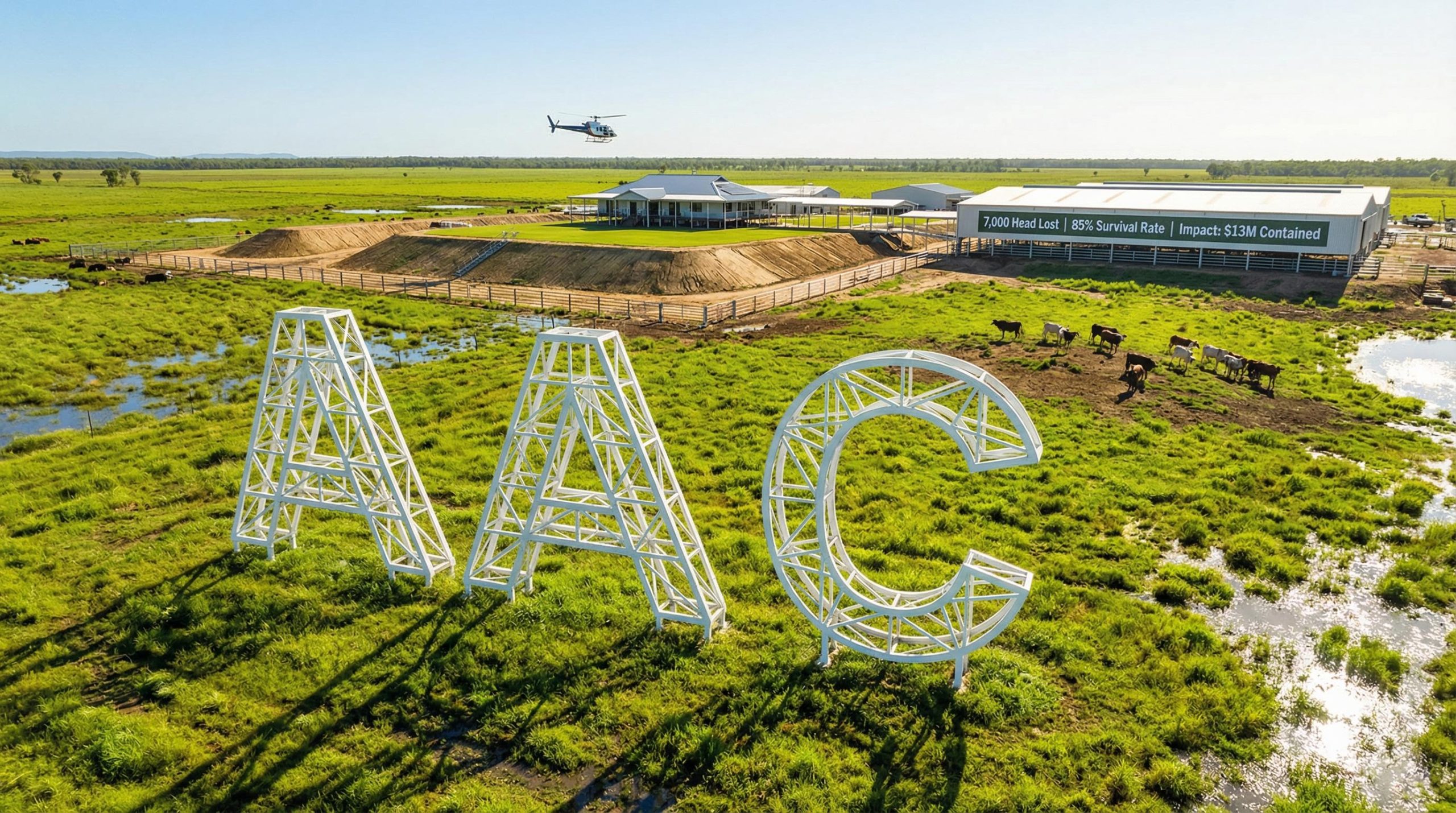
AACo confirms limited flood impact with cattle losses below initial fears
Australian Agricultural Company (ASX: AAC) has reported the AACo North Queensland Flood Impact resulted in approximately 7,000 head of cattle lost, valued at roughly $13 million, representing only 1.5% of the company’s total herd. The losses follow significant flooding across 280,000-300,000 hectares of managed land in north-western Queensland, affecting three properties: Carrum Station, Dalgonally Station, and the Canobie aggregation.
The flood event commenced in late December 2025 following monsoon trough activity. Despite the scale of the flooding, impacts were lower than expected, demonstrating the effectiveness of infrastructure improvements implemented after the 2019 flood event.
For investors, the contained impact represents a material test of operational resilience. A major weather event affecting such a large land area resulted in losses representing just 1.5% of the herd, validating management’s capital allocation decisions for flood mitigation infrastructure.
When big ASX news breaks, our subscribers know first
Proactive flood mitigation delivers measurable protection
Infrastructure improvements undertaken after the 2019 flood event directly reduced cattle losses during the recent flooding. AACo constructed flood refuge mounds and reconstructed buildings at raised elevations across the affected properties.
The company’s operational response included relocating machinery and mobile equipment ahead of the flooding, preventing equipment losses. Most mobile assets escaped damage through proactive relocation.
The mitigation measures represent capital deployed specifically to protect against extreme weather risks. The outcome demonstrates tangible returns on that investment, with cattle losses materially lower than they would have been without the infrastructure improvements. For shareholders, this validates management’s forward planning and risk mitigation approach following the 2019 event.
Property-by-property survival rates
AACo provided a breakdown of cattle numbers and survival rates across the three affected properties. Total head numbers exclude new calves.
| Property | Total Head (Pre-Flood) | Estimated Survival Rate |
|---|---|---|
| Canobie aggregation | ~40,000 | 85% |
| Dalgonally | ~9,500 | 90% |
| Carrum | ~5,000 | 98% |
The property-level data shows high survival rates across all three locations, with Carrum achieving 98% survival despite being in the flood zone. The Canobie aggregation, representing the largest herd exposure at approximately 40,000 head, achieved an 85% survival rate. Dalgonally recorded 90% survival across approximately 9,500 head.
The granular breakdown allows investors to assess risk distribution across AACo’s portfolio. The highest losses occurred at Canobie, which also held the largest pre-flood cattle numbers, demonstrating the correlation between herd size and absolute loss numbers despite relatively strong survival rates.
Understanding flood risk in Australian cattle operations
Northern Queensland’s cattle country faces seasonal monsoon activity during the summer wet season. Large-scale operations like AACo’s manage this through geographic diversification, infrastructure investment, and emergency response protocols.
Cattle operations in flood-prone regions typically invest in raised ground areas (refuge mounds) where livestock can move to safety during rising waters. Building infrastructure at elevated positions reduces damage risk. Emergency protocols include aerial monitoring, helicopter mustering, and fodder drops when ground access becomes impossible.
AACo’s scale provides natural hedging through diversification. The company’s total herd far exceeds the cattle on any single property, meaning a localised weather event cannot materially impact the entire operation. The AACo North Queensland Flood Impact affected three properties but left the majority of the company’s holdings unaffected.
For investors new to the agricultural sector, understanding these operational risks is essential. Weather-related livestock losses are an inherent part of large-scale cattle operations in northern Australia. What matters is how companies prepare for and respond to these events.
Infrastructure costs contained below $5 million
Total expected costs for repairs, helicopter mustering, and emergency fodder drops are anticipated to remain below $5 million. The primary damage was limited to fencing across the affected properties.
AACo has applied for joint federal-state emergency fodder funding, which could offset some costs if granted. Due to the company’s size, it is not typically eligible for other emergency or relief funding.
The cost breakdown includes:
- Infrastructure repairs (primarily fencing)
- Helicopter mustering operations
- Emergency fodder drops
An initial review suggests most infrastructure damage will be to fencing, with full assessment still underway as flood waters fully recede. Preliminary assessments based on aerial inspections during and after the flooding have been supported by further (mostly aerial) inspections.
The contained capital expenditure requirements mean minimal strain on AACo’s balance sheet. Infrastructure repair costs below $5 million represent a manageable expense for a company of AACo’s scale, requiring no external funding.
The next major ASX story will hit our subscribers first
Financial outlook remains intact for FY26
AACo anticipates the AACo North Queensland Flood Impact on livestock losses will be offset by expected increases in cattle valuations across the balance of the herd this financial year. The flood-related effects are expected to have limited impact on the company’s overall FY26 financial position.
The company’s balance sheet and financial position remain strong. AACo confirmed it remains able to fulfil supply obligations to key markets and will continue to progress its Better Beef strategy with limited disruption.
A further update will be released as part of the company’s full-year financial results in May 2026.
Key takeaways for investors:
- Livestock losses expected to be offset by herd valuation uplift
- Supply obligations to key markets maintained
- Better Beef strategy on track with limited disruption
- Full assessment with FY26 results in May 2026
The net financial impact approaches neutral, positioning this as an operational incident rather than a balance sheet event. The offset from cattle valuation increases across the remaining herd means the $13 million in livestock losses will not flow through as a direct hit to financial performance.
For investors, the maintenance of supply obligations to key markets is material. AACo’s ability to continue fulfilling existing contracts despite the flood impact demonstrates operational depth and the benefit of geographic diversification across the herd.
What comes next
Final livestock loss assessments won’t be available until after the full cattle muster is completed. Full infrastructure assessment remains ongoing as access to affected areas improves.
Investors can expect a comprehensive update with FY26 financial results in May 2026, when AACo releases its full-year results. The company has committed to transparency through the assessment process, providing updates as final data becomes available.
The timeline sets clear expectations for when complete information will be available, allowing the market to price in the known impacts while awaiting final verification through the formal muster process.
Get Agriculture News Before Market-Moving Events
Join 20,000+ investors receiving FREE breaking ASX announcements within minutes of release, complete with in-depth analysis. The agriculture sector moves fast when weather events hit—stay ahead by clicking the “Free Alerts” button at Big News Blast to receive real-time alerts the moment news breaks.