
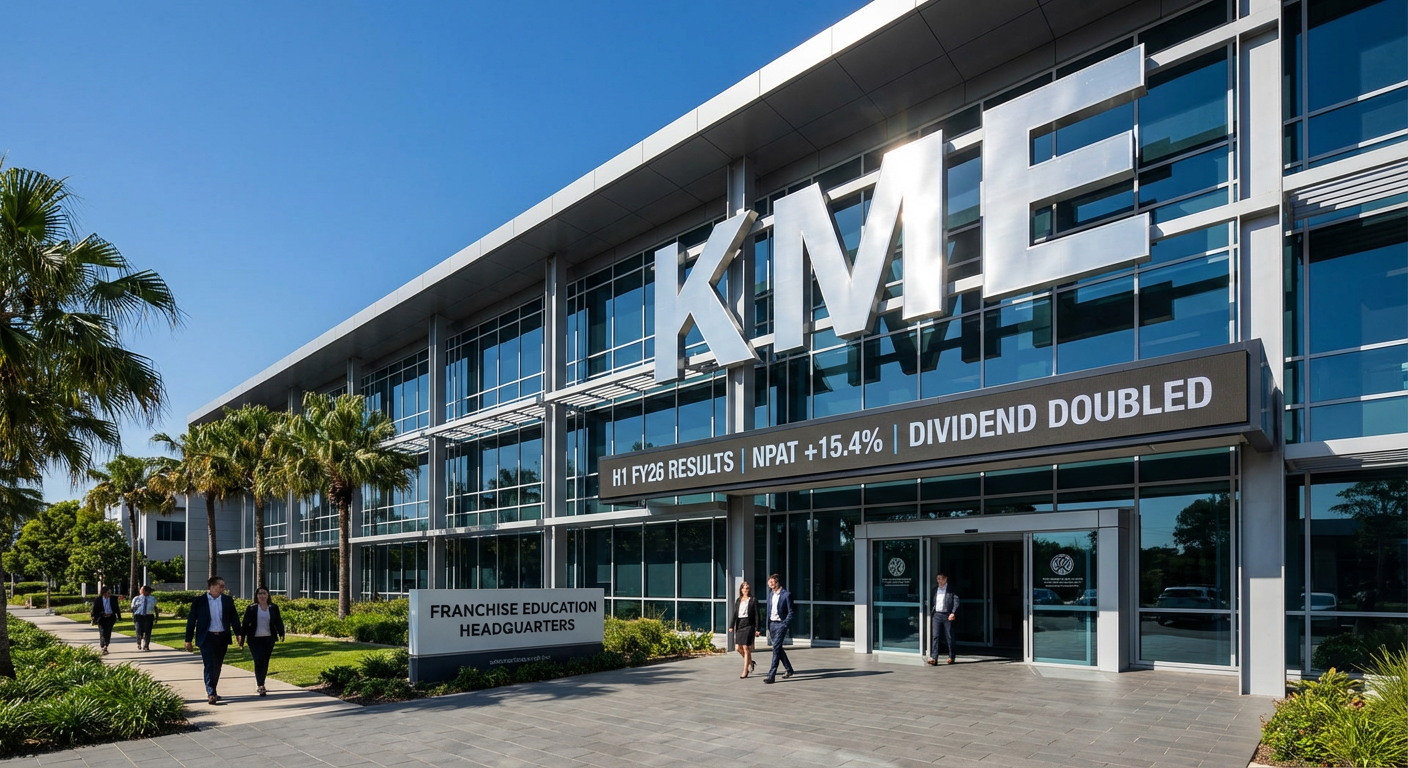
Kip McGrath delivers profit growth and doubles dividend in H1 FY26
Kip McGrath Education Centres has reported its Kip McGrath FY26 Half-Year Results for the six months ending 31 December 2025, demonstrating operational resilience through double-digit profit expansion and a 100% dividend increase. Net profit after tax (NPAT) grew 15.4% to $1.5 million, while the board declared an interim dividend of 1.0 cent per share, up from 0.5 cents in the prior corresponding period.
Revenue increased 1.6% to $15.2 million (or 1.2% in constant currency terms), reflecting steady demand across the tutoring network despite modest top-line growth. Earnings before interest, tax, depreciation and amortisation (EBITDA) rose 3.9% to $4.3 million, driven by cost discipline and improved operating leverage. Basic earnings per share climbed 16.1% to 2.71 cents.
The company’s ability to deliver profit growth ahead of revenue growth signals improving margin performance and efficient capital allocation. Management’s decision to double the dividend reflects confidence in the sustainability of operating cash flows and the strength of the franchise-based business model.
Shareholder Return Milestone
The interim dividend of 1.0 cent per share represents a 100% increase from H1 FY25, marking a significant step in capital returns to shareholders while maintaining a debt-free balance sheet.
When big ASX news breaks, our subscribers know first
Understanding franchise economics: why Kip McGrath’s model scales
Kip McGrath generates revenue through a franchise model that captures recurring income from franchisees as a percentage of their lesson revenue. This structure creates operating leverage, as the company increases its share of network-wide sales without proportionally increasing costs.
The franchise fee percentage increased from 17.9% in H1 FY25 to 18.1% in H1 FY26, representing a 20 basis point improvement. Management has stated it aims to lift this metric to between 18.5% and 19.2% over the medium term. Network revenue (total system sales across all centres) grew 2.9% to $54.1 million, demonstrating the breadth of the tutoring network’s commercial activity.
For investors, the franchise fee percentage is a critical metric. Higher percentages mean Kip McGrath retains more revenue from each lesson delivered across the network, without bearing the operational costs of delivering those lessons. This creates scalability and margin expansion potential as the network matures.
The company’s revenue model comprises three streams:
- Franchise fees: Fees collected from franchisees based on their lesson revenue, calculated as a percentage of sales
- Corporate centre revenue: Revenue from company-owned centres that deliver lessons directly to students
- Network-wide metrics: Total lesson revenue generated across both franchise and corporate centres, providing a measure of system-wide activity
Revenue breakdown: APAC stability offsets UK currency headwinds
Regional performance in H1 FY26 reflected divergent trends across Kip McGrath’s two core markets. The Asia-Pacific (APAC) region delivered revenue of $8.1 million, up 0.7%, while the United Kingdom contributed $6.7 million, representing 3.6% growth in reported terms and 2.6% in constant currency.
Currency translation effects dampened UK revenue growth, as the strengthening Australian dollar reduced the translated value of UK earnings. Lesson numbers across the two regions also moved in opposite directions. APAC lesson numbers remained virtually flat, declining 0.1%, while UK lesson numbers fell 8.6%.
Despite lower lesson volumes, total network revenue increased due to pricing strength. The average lesson charge across the network rose 8.5%, from $57.50 in H1 FY25 to $62.40 in H1 FY26, underscoring the value parents place on Kip McGrath’s tutoring services.
Pricing power demonstrates brand strength
The 8.5% increase in average lesson charge represents a significant real-terms price rise and reflects the company’s ability to pass through cost pressures without materially affecting demand. In a competitive tutoring market, sustained pricing power is a key indicator of brand strength and service differentiation.
For investors, this metric signals that Kip McGrath operates in a segment of the education market where parents prioritise quality and outcomes over price sensitivity. The ability to raise prices while maintaining demand supports margin expansion and provides a buffer against inflationary cost pressures.
| Metric | H1 FY25 | H1 FY26 | Change |
|---|---|---|---|
| Revenue | $14.9m | $15.2m | +1.6% |
| EBITDA | $4.1m | $4.3m | +3.9% |
| NPAT | $1.3m | $1.5m | +15.4% |
| Average lesson charge | $57.50 | $62.40 | +8.5% |
Centre consolidation drives efficiency gains
Total centre numbers declined from 469 at December 2024 to 437 at December 2025, representing a reduction of 32 centres. Gold centres (the network’s premium tier) fell from 328 to 321, while Silver and Other centres decreased from 88 to 79. Corporate centres remained steady at 37.
The reduction in centres reflects a deliberate network optimisation strategy rather than a sign of business decline. Average weekly lesson numbers per centre increased 1.9%, from 75.0 to 76.4, demonstrating improved throughput at remaining locations. This suggests the company has closed underperforming or subscale centres while maintaining or growing lesson volumes at higher-quality sites.
Key centre movements during H1 FY26:
- Gold centres: 328 to 321 (-7 centres)
- Silver & Other centres: 88 to 79 (-9 centres)
- Corporate centres: 37 to 37 (no change)
- Total centres: 469 to 437 (-32 centres)
For investors, the combination of fewer centres and higher average weekly lesson numbers per centre indicates improving network efficiency. Consolidating weaker-performing locations while growing lesson volumes at remaining centres supports margin expansion and capital efficiency.
Strong balance sheet with no debt and active capital return
Kip McGrath reported cash of $6.2 million at 31 December 2025, excluding $2.0 million in restricted cash. The company has no debt and maintains an undrawn bank facility, providing financial flexibility for both growth investment and shareholder returns.
Operating cash flow remained strong, driven by solid EBITDA performance. During H1 FY26, the company allocated capital across three areas: share buybacks totalling $861,000, lease payments of $683,000, and payment of the FY25 final dividend of $285,000. Investing outflows were primarily directed towards technology capital expenditure.
The debt-free balance sheet and strong operating cash flow provide the financial capacity to support both organic growth initiatives and shareholder distributions. Management’s decision to double the interim dividend while simultaneously conducting an on-market share buyback demonstrates confidence in the business’s ability to generate surplus capital.
FY26 full-year outlook: profit growth expected despite revenue headwinds
Management has provided guidance for the full FY26 financial year, indicating that profit growth is expected to continue even as revenue remains flat. The outlook reflects the impact of H1 centre closures, currency translation effects, and ongoing cost discipline.
Key guidance points for FY26:
- Lesson numbers: Expected to decline by mid-single digits, driven by the impact of H1 centre closures on the full-year result
- Revenue: Expected to remain flat, as business mix and price increases are offset by the impact of a strengthening Australian dollar on UK revenue translation and lower lesson volumes
- Expenses: Expected to decrease by low-single digits, reflecting cost control measures and the favourable translation effect of a stronger Australian dollar on UK expenses
- NPAT: Expected to increase by early double digits, continuing the profit growth trend demonstrated in H1
- Capital expenditure: Approximately $1.4 million, comprising technology investment ($1.0 million), centre acquisitions ($0.2 million to $0.3 million), and other expenditure ($0.1 million)
The guidance reflects management’s confidence in the company’s ability to expand margins through operating leverage, despite a challenging top-line environment. The continuation of early double-digit NPAT growth suggests improving profitability per centre and enhanced capital efficiency.
Strategic initiatives targeting franchisee satisfaction and growth
In response to feedback from a franchisee survey, management has outlined several strategic initiatives aimed at improving franchisee satisfaction, increasing lesson numbers, and supporting retention. These initiatives are positioned to address the operational challenges identified in H1 FY26, particularly the decline in lesson volumes.
The five key initiatives include:
- MPC policy review: A comprehensive review of policy settings and implementation frameworks to ensure alignment between franchisor and franchisee interests
- Curriculum review and refresh: An update to tutoring programmes and resources to maintain educational relevance and competitive positioning
- Lead generation and nurturing systems: Enhanced systems and resources to support franchisees in converting enquiries into enrolled students
- Improved customer service and communication: Strengthened communication protocols to enhance the franchisee and parent experience
- Franchisee collaboration: Increased engagement with franchisees to incorporate feedback and foster network cohesion
For investors, these initiatives signal management’s responsiveness to franchisee feedback and its focus on improving the operational foundations of the network. Franchisee satisfaction is a critical driver of network stability, retention, and growth. Addressing these areas is expected to support lesson number recovery and strengthen the long-term sustainability of the franchise model.
Want the Next Education Stock Winner in Your Inbox?
Join 20,000+ investors getting FREE breaking ASX news delivered within minutes of release, complete with in-depth analysis. Click the “Free Alerts” button at StockWire X to start receiving alerts the moment market-moving announcements hit the ASX across Consumer, Healthcare, Tech and other non-resource sectors.