
Southern Cross Media delivers audio earnings surge as Seven merger takes shape
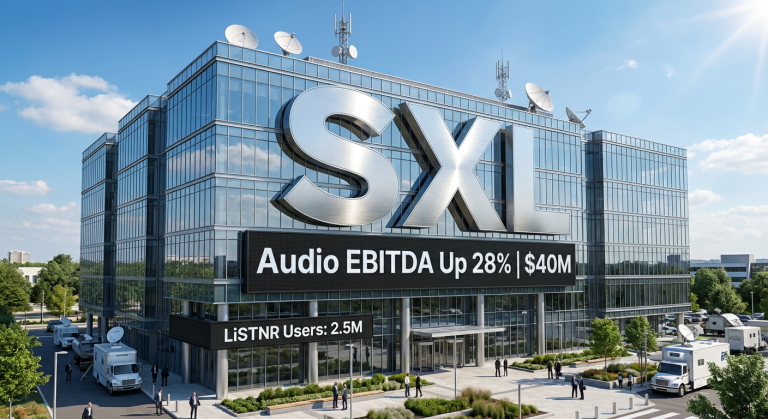
Southern Cross Media Group (ASX: SXL) has reported underlying EBITDA of $40 million in its audio division for H1 FY26, up 28% on the prior corresponding period, despite metro radio advertising markets declining 7%. The result marks the company’s first market update since completing the Southern Cross Media Seven merger on 7 January 2026, with management providing pro forma guidance of $200-$220 million in group EBITDA for FY26.
The audio business delivered underlying NPAT growth of 252% to $12.8 million whilst maintaining disciplined cost management, with underlying expenses down 1.2% to $176.4 million. SCA’s metro radio revenue share reached 29.8%, an increase of 2.3 percentage points year-on-year, demonstrating market share gains in a contracting advertising environment.
Chairman Heith Mackay-Cruise stated this represents the first update since the Southern Cross Media Seven merger completed in January, positioning the combined entity to maximise integration benefits across television, audio, streaming, publishing and digital platforms.
Audio business outperforms declining market
SCA’s standalone audio division generated revenue of $216.5 million in H1 FY26, up 3.2% on the prior year, against a metro radio market that declined 7%. The performance was underpinned by audience leadership, with SCA winning the 25-54 demographic for 36 consecutive surveys according to GfK Radio Share Ratings.
Operating expenses fell 1.2% to $176.4 million, with non-revenue related costs down 2% as management implemented further efficiency measures. The company’s digital audio platform LiSTNR reached 2.5 million signed-up users, representing 14% year-on-year growth, whilst digital EBITDA reached $2.8 million compared to $0.1 million in H1 FY25, now cashflow positive.
| Audio Division Metrics | H1 FY26 | H1 FY25 | Change |
|---|---|---|---|
| Revenue | $216.5M | $209.8M | +3.2% |
| Underlying Expenses | $176.4M | $178.5M | -1.2% |
| Underlying EBITDA | $40.0M | $31.3M | +28% |
| Digital EBITDA | $2.8M | $0.1M | +2700% |
| LiSTNR Users | 2.5M | 2.2M | +14% |
The digital division reaching cashflow positive status represents a milestone in SCA’s transformation strategy. Digital audio platforms typically require significant upfront investment in technology and content before reaching profitability, making this achievement significant for the merged entity’s earnings profile.
LiSTNR growth accelerates post-merger
The company reported approximately 70,000 new LiSTNR sign-ups between mid-December and mid-January, representing approximately three times the pre-merger run rate according to Chairman commentary. The acceleration was attributed to cross-promotion integration with Seven’s television coverage, particularly sports programming.
Management indicated television activity is accelerating growth in audio and digital audiences through extensive integration into Seven’s sport coverage. The early evidence suggests merger synergies are materialising through audience cross-pollination faster than the baseline integration timeline.
Understanding media merger synergies
Media merger synergies typically fall into two categories: cost synergies and revenue synergies. Cost synergies involve eliminating duplicate corporate functions, consolidating office locations, and streamlining operational expenses. These savings are generally faster to realise because they involve direct actions such as restructuring or renegotiating supplier contracts.
Revenue synergies develop over longer timeframes and include cross-selling advertising packages across multiple platforms, expanding client relationships, and leveraging combined audience reach. In SCA’s case, the $30 million cost synergy target represents identifiable savings from corporate consolidation and operational integration, expected to materialise within FY27.
Revenue synergies build gradually as sales teams integrate client relationships and advertisers recognise the value of combined audience reach across television, radio, streaming and digital platforms. Management’s reference to regional market opportunities, where client overlap between television and audio exists, illustrates one pathway for revenue synergy development.
Investors typically track synergy realisation against stated targets as a key measure of merger execution success. The phased nature of synergy delivery means near-term financial performance may not fully reflect the combined entity’s long-term earnings potential.
Seven’s television division holds share in weak market
Seven’s television division achieved a record revenue share of 44.1% of total TV advertising in H1 FY26, up 2.7 percentage points year-on-year according to ThinkTV data. The division generated revenue of $712 million, down 2.1%, whilst the broader total TV advertising market declined 10.1%.
Seven’s total TV audience grew 3.4% overall and 4.7% in the 25-54 demographic during the half, driven by 55% year-on-year growth in the 7plus streaming platform. The digital platform’s daily active users increased 26% to 551,000, whilst digital publishing audiences grew 27% year-on-year.
Key audience and digital metrics included:
- 7plus growth of 55% year-on-year (excluding Olympic Games comparison)
- Daily active users on 7plus reached 551,000 (up 26%)
- Digital publishing audiences increased 27% year-on-year
- Total TV audience growth of 3.4% overall and 4.7% in 25-54 demographic
Operating expenses of $645 million increased 1.6%, below the AGM guidance of approximately 3% growth. Underlying EBITDA of $67 million declined 27%, in line with AGM guidance, reflecting the combination of market weakness and strategic investments in digital platforms.
Seven’s ability to gain revenue share whilst the market contracted demonstrates competitive positioning within the television advertising sector. The margin compression reflects the industry-wide transition to digital platforms, where monetisation rates remain below traditional broadcast television.
Merged group targets $30 million in cost synergies
Management confirmed a cost synergy target of at least $30 million, expected to be delivered within FY27. Integration activities are already underway, with corporate savings and regional office consolidation in progress during H1 FY26.
The company identified an early opportunity in regional markets, where client overlap between television and audio platforms represents potential for new business growth across both channels. Management expects meaningful audience and revenue synergies will build over time as integration continues.
Pro forma net debt of $338 million was reduced by $16 million during the half, with a leverage ratio of 1.77x under the syndicated facility agreement calculations. The board declared no interim dividend, prioritising debt reduction in the near term.
Chairman Heith Mackay-Cruise
“We are targeting cost synergies of at least $30 million and expect to deliver these within FY27. Our teams are collaborating to maximise the cost synergy opportunities across our core functional areas and geographic locations and synergies are already being delivered, with corporate savings and regional office consolidation underway.”
The debt reduction focus reflects management’s prioritisation of balance sheet strength during the integration period. The 1.77x leverage ratio provides headroom under typical banking covenant structures, which often include leverage ratio tests between 2.5x and 3.5x EBITDA.
FY26 outlook and near-term trading
The company provided a Q3 trading update showing audio revenue for January up 4% on the prior corresponding period, with strong digital growth offsetting ongoing challenges in the national regional radio market. Management currently expects audio revenue for Q3 to be broadly flat on the prior year.
Total TV advertising revenue for January increased 3% on the prior corresponding period, driven by premium sport and digital growth. The company expects Q3 revenue to decline 2-3% on the prior year whilst holding market share.
FY26 guidance metrics include:
- Pro forma group revenue target of $1.91-$1.92 billion
- Pro forma costs expected at approximately $1.70 billion, down from $1.71 billion in FY25
- Audio EBITDA range of $78-$83 million (reaffirmed from previous guidance)
- Group pro forma EBITDA target of $200-$220 million, compared to $233 million in FY25
The guidance implies continued margin compression at the group level in FY26, with the cost synergy benefits expected to flow through more significantly in FY27. The audio division’s reaffirmed EBITDA guidance of $78-$83 million for the full year implies H2 performance broadly consistent with H1 results.
Management’s commentary on regional market opportunities and accelerating digital audience growth suggests potential upside to revenue synergies beyond the quantified $30 million cost synergy target, though these benefits typically take longer to materialise and are harder to forecast with precision.
Stay Ahead on Media Sector Merger News
Join 20,000+ investors receiving FREE breaking ASX news within minutes of release, complete with in-depth analysis. Click the “Free Alerts” button at Big News Blast to get media sector announcements and expert coverage delivered straight to your inbox the moment market-moving developments unfold.