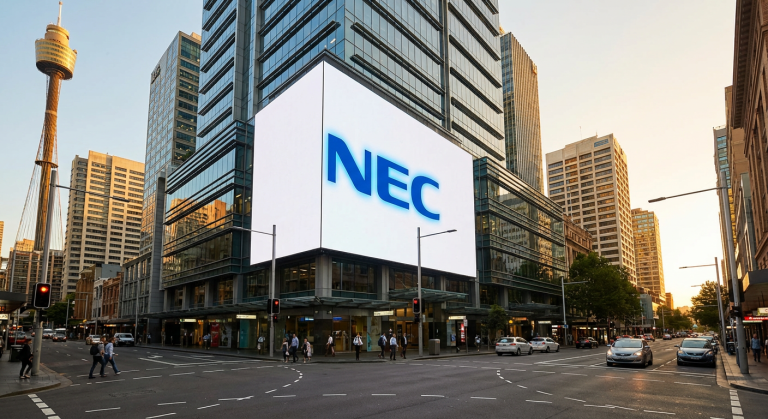
Nine Entertainment Co. (ASX: NEC) has announced an $850 million acquisition of QMS Media, marking a material shift in the company’s strategic direction. The Nine Entertainment QMS Media Acquisition forms part of a broader portfolio restructure that will see digital growth assets account for more than 60% of revenue from FY27, up from approximately 45% in FY25. The transaction is expected to complete prior to 30 June 2026, subject to customary conditions including ACCC approval.
The acquisition comes alongside two divestments that simplify Nine’s portfolio. Nine Radio has been sold to the Laundy Family Office for $56 million, while regional television station NBN (Northern NSW) will transition to an affiliate owned and operated by WIN Network for $15 million. Combined with cash tax loss benefits totalling approximately $178 million, Nine’s net investment across all transactions sits at approximately $601 million.
Management has guided that the restructure will deliver low double-digit EPS accretion on a FY26 pro forma basis, inclusive of identified cost synergies. QMS is expected to contribute $105 million in EBITDA during CY26 (pre-AASB16), with Nine targeting $20 million in annual pre-tax cost synergies by FY29.
CEO Commentary
“Today’s announcements mark a critical milestone in our Nine2028 transformation. These transactions will create a more efficient, higher-growth, and digitally powered Nine Group for our consumers, advertisers, shareholders and people,” said Matt Stanton, Group Chief Executive Officer.
The strategic rationale centres on positioning Nine as what Stanton described as offering a “Sofa to Street” advertising proposition, combining the company’s streaming, broadcast and publishing assets with QMS’s outdoor platform.
What is digital outdoor advertising and why does it matter?
Outdoor advertising refers to visual marketing displayed in public spaces. This includes billboards, street furniture such as bus shelters, transit media within transport hubs, and digital signage at high-traffic locations. The sector has increasingly shifted toward digital formats, which allow advertisers to change content remotely, target specific times of day, and run multiple campaigns across the same physical location.
The outdoor segment has materially outperformed other traditional media channels over the past decade. According to Outdoor Media Association data, the market has grown approximately 9% annually from CY14 to CY25, expanding its share of the Australian advertising market from 10% to 18% over that period. This growth trajectory contrasts sharply with declining revenue trends across traditional broadcast television and radio.
QMS operates a predominantly digital portfolio, with approximately 95% of its Australian revenue derived from digital formats. This compares favourably to the national average of 76% digital penetration across the broader outdoor market. QMS has grown its share of the Australian outdoor market from approximately 10% in CY19 to approximately 15% in CY25, underpinned by a three-year revenue CAGR of 15% (CY22-CY25).
The outdoor sector’s resilience stems from several structural advantages:
- Physical presence: Outdoor assets occupy real-world space that cannot be bypassed by ad-blocking software or subscription models
- Digital platform immunity: The sector faces limited competition from global digital platforms that dominate online advertising
- AI disruption resistance: Physical advertising infrastructure is less vulnerable to AI-driven disruption affecting digital content creation and distribution
- Audience reach: Outdoor captures consumers during daily commutes and activities when they may not be actively consuming digital media
The rollout of Move 2.0 by the Outdoor Media Association in H1 calendar 2026 is expected to enhance the sector’s measurement capabilities. The upgraded system will provide more granular audience data, including hour-by-hour breakdowns and expanded geographic coverage across all major formats.
When big ASX news breaks, our subscribers know first
Inside the QMS acquisition economics
Nine has agreed to acquire 100% of QMS Media’s issued capital from Quadrant Private Equity for an enterprise value of $850 million on a cash and debt-free basis. The transaction will be funded through Nine’s existing debt facilities and cash reserves. When accounting for cash tax loss benefits of approximately $32 million, the effective acquisition cost reduces to $818 million.
QMS is expected to generate EBITDA of approximately $105 million in CY26 (pre-AASB16), which includes estimated lease costs of $125 million. This represents double-digit percentage growth on CY25 performance, reflecting recent contract wins, price increases and new contracted sites. The business operates at an operating margin of approximately 26% (pre-AASB16).
Nine has identified approximately $20 million in annual pre-tax cost synergies, expected to be fully realised by FY29. These savings will be driven through consolidation of back-office functions, technology infrastructure integration, procurement efficiencies and the reallocation of marketing expenditure to QMS inventory. After accounting for pro forma synergies and tax benefits, the acquisition represents an effective 6.5x CY26 EBITDA multiple.
| Metric | Value |
|---|---|
| Enterprise value | $850m |
| Cash tax benefit | $32m |
| CY26 EBITDA | $105m |
| Cost synergies (by FY29) | $20m |
| Effective multiple | 6.5x |
QMS’s Australian portfolio demonstrates strong contract visibility, with more than 80% of contracts (by revenue) extending through December 2028. Key contracts include the City of Sydney agreement (secured through 2032), Auckland Transport (10-year term from October 2025), the M2 Motorway Sydney contract (renewed June 2025), and Transport for NSW signage (renewed January 2025).
The company’s revenue mix is concentrated in Australia (approximately 80%), with the remaining 20% derived from New Zealand operations. Within Australia, roadside billboards account for 52% of revenue, street furniture 28%, Sydney digital landmarks 16%, and other capital city digital landmarks 4%.
Portfolio optimisation unlocks additional value
Nine has finalised agreements to divest its broadcast radio assets and restructure its regional television operations. Nine Radio, comprising 2GB, 3AW, 4BC, 6PR, 2UE, Magic1278 and 4BH, has been sold to the Laundy Family Office for an enterprise value of $56 million. The transaction includes a cash tax benefit of approximately $51 million, which will offset capital gains tax from Nine’s recent Domain stake sale. The sale is expected to result in a Specific Item gain of approximately $10 million in Nine’s H2 result, inclusive of transaction costs.
The NBN (Northern NSW) television operation will transition from a wholly-owned business to an affiliate model, operated by WIN Network. Key terms include:
- Enterprise value of $15 million plus cash consideration of $14.8 million
- Cash tax benefit of approximately $95 million
- Expected EBITDA impact of approximately ($7 million) in FY26 (pro forma basis)
- Affiliate agreement term of at least five years, consistent with Nine’s existing WIN arrangement
- Completion subject to shareholder approval and ACCC clearance
The Laundy Family Office, owner of more than 90 hospitality venues across NSW, is expected to maintain strategic partnerships with Nine. These include utilising Nine News journalists on radio, showcasing Stan Sport content through Laundy venues, advertising sales collaboration, and increased advertising spend by Laundy on Nine properties. Nine has emphasised its continued commitment to digital audio opportunities through podcasts, text-to-audio and vodcast formats distributed across 9Now, Stan and publishing platforms.
Financial impact and investment thesis
Across all announced transactions, Nine will deploy approximately $779 million in net enterprise value. After accounting for approximately $178 million in realised cash tax losses, the net investment totals approximately $601 million. These tax benefits will substantially offset the previously calculated capital gains tax of $254 million from the Domain stake sale.
The combined transactions are expected to contribute approximately $113 million in EBITDA (pre-AASB16) on a pro forma basis, inclusive of full run-rate cost synergies. This equates to an implied multiple of 5.3x on the net investment. On an FY26 pro forma basis, the initiatives are expected to be marginally EPS accretive pre-synergies, rising to low double-digit percentage EPS accretion inclusive of cost synergies.
Nine’s net leverage ratio is expected to increase temporarily to approximately 1.8x on a FY26 pro forma basis (including QMS and excluding Radio and NBN for the full year). Management has guided that enhanced EBITDA from the combined entity, coupled with the realisation of tax losses in January 2027, will reduce leverage back to the company’s target range of 1.0x to 1.5x by the end of FY27.
The utilisation of cumulative tax losses will reduce available franking credits. As a result, Nine expects its FY26 interim and final dividends, as well as the FY27 interim dividend, will be unfranked. The company has reaffirmed its commitment to a dividend payout ratio of 60-80% of Net Profit before Specific Items.
Key investment considerations include:
- Earnings accretion: Low double-digit EPS growth on pro forma basis with synergies realised
- Revenue quality improvement: Digital growth assets rising from 45% to over 60% of revenue
- Leverage trajectory: Temporary increase to 1.8x with clear pathway back to target range by end FY27
- Market positioning: Creation of integrated “Sofa to Street” advertising proposition spanning streaming, broadcast, publishing and outdoor
The next major ASX story will hit our subscribers first
What comes next for Nine
The QMS Media acquisition is expected to complete prior to 30 June 2026, subject to satisfaction of customary conditions including ACCC approval. The Nine Radio sale to Laundy Family Office is also expected to complete before 30 June 2026, pending ACCC clearance. The NBN transaction requires Nine shareholder approval in addition to ACCC approval, with completion similarly targeted before 30 June 2026.
Management has scheduled an investor call for 30 January 2026 at 9:30am AEDT to discuss the transactions. In terms of near-term financial performance, Nine continues to expect EBITDA growth in H1 FY26 compared to H1 FY25, with the half-year result scheduled for announcement on 24 February 2026.
Integration priorities centre on realising the identified $20 million annual cost synergies through back-office consolidation, technology platform integration and procurement optimisation. Revenue synergies are expected to emerge through bundled cross-platform advertising packages, enhanced targeting capabilities using Nine’s first-party data and 9Tribes segmentation, and expanded access to QMS’s outdoor inventory through Nine’s Ad Manager platform.
The restructured portfolio positions Nine with exposure to outdoor advertising (a resilient traditional media segment), streaming and digital publishing (high-growth digital channels), and retained free-to-air broadcast assets focused on metro markets. This composition represents a material shift from Nine’s historical positioning as primarily a broadcast television company toward a digitally-led, cross-platform media business.
Want the Next Media Sector Play Before the Market Reacts?
Nine Entertainment’s $850 million QMS acquisition signals a fundamental shift in traditional media strategy—but it’s far from the only move happening across Communication, Finance, Tech and Healthcare sectors right now. Readers tracking this space are already ahead; the question is how to stay that way when the next material transaction, regulatory approval or earnings surprise hits.
StockWire X delivers breaking ASX news from non-resource sectors direct to inboxes through its free Big News Blasts service—trusted by over 20,000 active investors. Each alert includes comprehensive analysis of what the announcement means, why it matters, and how it fits within broader sector trends. To receive these updates before they move share prices, click the “Free Alerts” button located in the site header and join subscribers already monitoring the next wave of corporate restructures, capital deployments and strategic pivots across Australia’s growth sectors.