
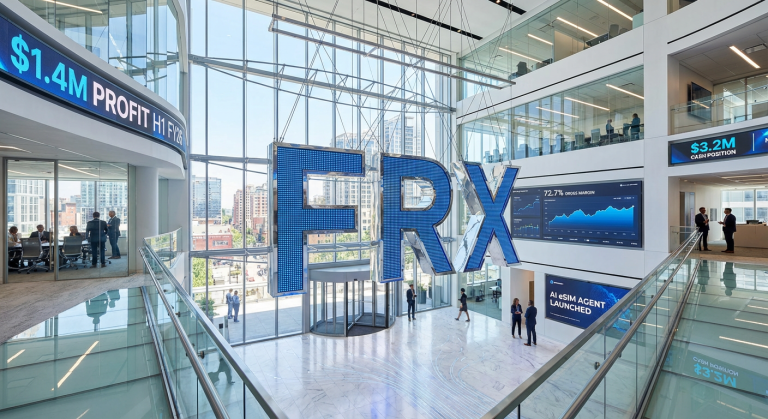
FlexiRoam Limited has reported its Flexiroam first half-year profit, posting a statutory net profit of $1.4 million for the six months ended 31 December 2025. The result represents a $3.5 million turnaround from the $2.1 million loss recorded in the prior corresponding period, validating the operational restructure initiated in H2 FY25.
The H1 FY26 result marks the first time the AI-powered connectivity platform has reported a statutory NPAT profit in a half-year report. The company (ASX: FRX) also delivered record operating cash flow of $1.9 million, compared to an outflow of $0.9 million in H1 FY25, marking the second consecutive quarter of positive operating cash flow.
Underlying EBITDA reached $2.0 million, a $3.0 million improvement from the negative $1.0 million recorded in the prior period. The turnaround was driven by structural operating expense reductions and gross margin expansion, demonstrating the scalability of the restructured cost base.
Margin expansion and cost discipline drive profitability
Revenue mix strategy lifts gross margin by 19 percentage points
FlexiRoam reported revenue of $5.9 million, down 21.7% from $7.6 million in H1 FY25. The decline reflects a deliberate shift in revenue mix, with the company exiting low-margin transactional revenue streams to prioritise higher-margin, recurring B2B and partner (B2B2C) revenue alongside improved unit economics in direct-to-consumer distribution.
Despite lower revenue, gross profit increased 6.4% to $4.3 million from $4.1 million. Gross margin expanded 19.2 percentage points to 72.7% from 53.5%, achieved through disciplined cost-of-sales management, pricing optimisation (including the company’s AI pricing engine), and the strategic exit from unprofitable revenue lines.
| Metric | H1 FY26 | H1 FY25 | Change |
|---|---|---|---|
| Revenue | $5.9m | $7.6m | -21.7% |
| Gross Profit | $4.3m | $4.1m | +6.4% |
| Gross Margin | 72.7% | 53.5% | +19.2pp |
| Underlying EBITDA | $2.0m | -$1.0m | +$3.0m |
| Net Profit/(Loss) | $1.4m | -$2.1m | +$3.5m |
| Operating Cash Flow | $1.9m | -$0.9m | +$2.7m |
| Cash Balance | $3.2m | $1.2m | +165% |
The higher margins on lower revenue signal pricing power and a strategic pivot toward recurring B2B and partner revenue streams, which typically generate more predictable cash flows with lower customer acquisition costs than direct-to-consumer models.
Operating expenses slashed by more than 50%
The company implemented a structural cost reduction programme, reducing total underlying operating expenses by 52.9% to $2.4 million from $5.1 million in the prior corresponding period. The cost reset was driven by a shift to organic and partner-led distribution, AI-enabled automation, and disciplined cost management.
Key operating expense reductions included:
- Selling and marketing expenses decreased to $828,162 from $2.5 million
- Staff costs reduced to $1.0 million from $1.5 million, supported by increased automation of customer service and operational workflows
- Depreciation fell to $244,000 from $1.2 million, primarily because several intangible assets became fully amortised in prior periods
- Administration and operating expenses declined to $478,000 from $872,000
The leaner cost base positions future revenue growth to flow through to profit with minimal incremental cost, improving operating leverage as the company scales its enterprise partnerships and AI platform.
Join thousands of readers who start here
Our best articles, sent straight to your inbox. You can unsubscribe anytime.
What EBITDA turnarounds reveal about company health
EBITDA, or Earnings Before Interest, Taxes, Depreciation, and Amortisation, is a profitability measure that shows how much cash a company generates from its core operations before accounting for financing costs, tax obligations, and non-cash charges.
For investors assessing small-cap companies, EBITDA turnarounds are particularly significant. A shift from negative to positive EBITDA indicates that a company’s core business operations are generating cash rather than consuming it, reducing the need for external capital and dilutive equity raisings.
“Underlying EBITDA” removes one-off items such as foreign exchange gains or losses, asset impairments, and non-cash share-based payments to provide a clearer picture of sustainable operational performance. FlexiRoam’s $3.0 million underlying EBITDA turnaround in H1 FY26 suggests the operational restructure has created a structurally profitable business model rather than a temporary improvement driven by exceptional items.
For ASX microcaps, positive EBITDA often precedes sustained profitability and reduced dilution risk. The ability to self-fund growth from operating cash flow shifts the investment risk profile, particularly for early-stage technology companies transitioning from growth-at-all-costs strategies to sustainable scaling.
Balance sheet strengthened as cash position nearly triples
FlexiRoam’s cash balance at 31 December 2025 stood at $3.2 million, up 165% from $1.2 million at 31 December 2024 and up from $1.6 million at 30 June 2025. The improvement was driven by positive operating cash flow of $1.9 million, representing a turnaround of $2.7 million from the $0.9 million outflow in the prior corresponding period.
Net current assets returned to positive territory at $0.3 million, compared to a net current liability position of negative $1.3 million at 30 June 2025. This represents the first time in over eight years that the company has reported a positive net current asset position, eliminating near-term solvency concerns.
Board Confidence Statement
“The Board is confident that the operational reset completed over the past 13 months, including returning to profitability, delivering positive operating cash flow, strengthening the balance sheet, and launching the AI platform, positions the Group well to scale brand and enterprise partnerships while maintaining financial discipline.”
The positive net current asset position provides runway to pursue partnerships without immediate capital raise pressure, reducing dilution risk for existing shareholders. The combination of profitability, positive cash flow, and an improved balance sheet creates optionality for management to invest in growth initiatives from internally generated funds.
AI platform launch anchors growth strategy
World’s first WhatsApp-based AI eSIM Agent goes live
On 17 December 2025, FlexiRoam launched its AI eSIM Agent, described by the company as the world’s first AI-powered agent enabling travellers to discover, purchase, activate, and manage eSIM connectivity entirely within WhatsApp, with no app download required.
Since its commercial launch, the AI eSIM Agent has grown to over 15,000 users, validating the company’s AI-first approach to distribution and customer engagement. The “zero-integration” proposition enables brand partners to deploy connectivity programmes more quickly and reduces implementation timeframes, lowering the barrier to partnership adoption.
The WhatsApp-based platform eliminates the friction typically associated with app downloads and account creation, potentially improving conversion rates and customer acquisition economics. The early user traction provides proof of concept for the AI-driven distribution model.
Enterprise partnerships validate B2B2C model
FlexiRoam has secured several enterprise partnerships that leverage the AI eSIM Agent platform:
-
On 22 December 2025, the company secured a partnership with Generali, one of the world’s largest insurance companies, to deploy the AI eSIM Agent as a value-added travel benefit for policyholders.
-
On 8 January 2026, the company secured a partnership with Dialog for a national IoT connectivity rollout in Sri Lanka, expanding the company’s B2B Solutions segment.
-
The company’s Mastercard partnership continued across 410 banks, 78 countries, and 1,187 card programmes as of 5 February 2026.
Enterprise partnerships derisk revenue concentration and provide recurring revenue channels with lower customer acquisition costs than direct-to-consumer approaches. The B2B2C model allows FlexiRoam to access large customer bases through established distribution partners, leveraging existing brand relationships rather than building consumer awareness from scratch.
Enjoyed this article?
We publish high-impact stories like this a few times a week. No spam.
Outlook and near-term catalysts
FlexiRoam will continue to invest in AI-driven product development, with management stating that significant new capabilities for the Travel direct-to-consumer channel are expected to be announced before the end of FY26.
On the enterprise side, the brand and partnership pipeline continues to strengthen, building on the Generali and Dialog relationships secured during and subsequent to the period, and the company’s longstanding Mastercard partnership.
Key upcoming milestones and focus areas include:
- Launch of new AI capabilities for the Travel direct-to-consumer channel before end of FY26
- Expansion of brand and enterprise partnership pipeline
- Continued scaling of existing partnerships (Mastercard, Generali, Dialog)
- Maintenance of financial discipline whilst pursuing growth
The profitable base allows reinvestment in growth without immediate dilution, representing a structural improvement in the investment case. The company’s ability to fund AI development and partnership expansion from operating cash flow reduces execution risk compared to the previous growth model, which relied on external capital to fund losses whilst building scale.
Want the Next Tech Turnaround in Your Inbox?
Join 20,000+ investors receiving FREE breaking ASX news with expert analysis delivered within minutes of release. StockWire X covers every major sector across the market. Click the “Free Alerts” button to get real-time alerts the moment companies announce results like this.