
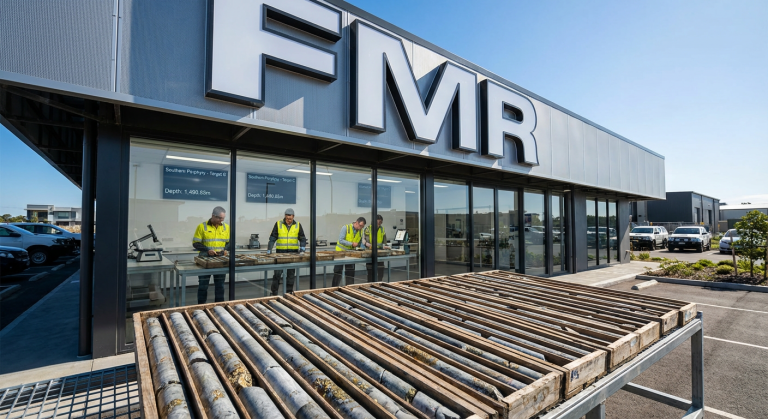
FMR Resources has reported visual chalcopyrite and molybdenite mineralisation at its Southern Porphyry target in Chile, marking the second drillhole in the Phase I programme to confirm systematic exploration progress. Drillhole 25LHDD071 at Target C was extended beyond the planned 1,400m depth to a final depth of 1,490.65m after encountering visible mineralisation between 1,335.7m and 1,437.65m downhole.
The mineralisation occurs within the zone associated with the primary magnetotelluric (MT) anomaly. Target C is located approximately 545m west-south-west of Target A within the Llahuin Project Joint Venture, a partnership with Southern Hemisphere Mining Limited (ASX: SUH).
Visual mineralisation at depth, combined with extensive phyllic alteration and veining throughout the drillhole, validates the exploration model and targeting methodology employed by the company. The geological observations suggest the drillhole has entered the outer alteration zone proximal to the porphyry core.
Managing Director Commentary
“Completion of only our second drillhole at Southern Porphyry at Target C has yielded visual copper and molybdenite mineralisation associated with the MT anomaly, within an alteration assemblage suggesting we are closer to the core of this extensive porphyry system. The FMR team is further encouraged by this latest drillhole, believing we are closing in on the main mineralised core of the system. This drillhole has added critical geological, structural, and geophysical information that refines our understanding of the Southern Porphyry system, and focuses targeting of the next drillhole in the program,” said Oliver Kiddie, Managing Director.
Understanding porphyry copper exploration
Porphyry copper deposits represent large-scale mineralised systems characterised by zoned alteration patterns surrounding a magmatic-hydrothermal core. Geologists use these alteration assemblages as vectors to navigate toward higher-grade mineralisation at the deposit centre.
The typical alteration zones in a porphyry copper system progress from outer to inner as follows:
- Propylitic alteration zone (outermost): Characterised by chlorite, epidote and carbonate minerals, representing the coolest and most distal zone
- Phyllic alteration zone (intermediate): Dominated by quartz, sericite and pyrite, indicating proximity to the mineralised core
- Potassic alteration zone (innermost): Featuring biotite and potassium feldspar, typically hosting the highest copper grades within the ore shell
The presence of chalcopyrite-molybdenite mineralisation within phyllic alteration at Target C suggests the drilling has intersected the intermediate zone, positioning the next drillhole to potentially intersect higher-grade mineralisation within the potassic core. This geological framework, known as the Lowell & Guilbert porphyry model, serves as the industry-standard reference for exploration targeting.
Geological observations point toward the porphyry core
Geological logging of drillhole 25LHDD071 identified multiple sulphide assemblages indicating proximity to a large magmatic-hydrothermal system. Visual molybdenite associated with quartz-pyrite veining was first encountered at approximately 1,354m downhole depth.
Between 1,388m and 1,437m, the drillhole intersected chalcopyrite-pyrite mineralisation within structurally controlled veinlets. Portable X-ray fluorescence (pXRF) readings recorded elevated copper values within these mineralised zones, providing immediate field confirmation of copper enrichment.
Throughout the mineralised intervals, sulphide percentages averaged 5-7% pyrite-dominant assemblages. Below the mineralised zone, the drillhole entered a pyrite-dominant phyllic-altered domain consistent with the peripheral halo zone surrounding the porphyry core.
| Interval (From-To) | Length (m) | Sulphide Type | Visual Estimate (%) | Notes |
|---|---|---|---|---|
| 1,335.7m – 1,376.2m | 40.5 | Pyrite, Chalcopyrite, Molybdenite | 5% pyrite dominant | Disseminated sulphide with vein sulphide |
| 1,376.2m – 1,403.0m | 26.8 | Pyrite, Chalcopyrite | 7% pyrite dominant | Disseminated sulphide with vein sulphide |
| 1,403.0m – 1,418.0m | 15.0 | Pyrite, Chalcopyrite | 7% pyrite dominant | Disseminated sulphide with vein sulphide |
| 1,418.0m – 1,424.0m | 6.0 | Pyrite, Chalcopyrite | 7% pyrite dominant | Disseminated sulphide with vein sulphide |
| 1,424.0m – 1,437.65m | 13.65 | Pyrite, Chalcopyrite | 6% pyrite dominant | Disseminated sulphide with vein sulphide |
The extensive phyllic alteration and veining observed throughout the drillhole indicates the exploration programme has successfully intersected the outer alteration envelope of a sizeable porphyry system. The geological interpretation positions the next drillhole to potentially intersect the higher-grade potassic core, where copper and molybdenum grades typically increase significantly.
Visual mineralisation estimates serve as preliminary indicators only and are not a substitute for laboratory assays. Final copper and molybdenum grades will be determined following receipt of analytical results.
Geophysical integration refines targeting
Downhole geophysical logging has been completed for drillhole 25LHDD071, incorporating induced polarisation (IP), electromagnetic (EM) conductivity, magnetics and spectral gamma measurements. This dataset is being integrated with existing surface geophysical models to refine the interpreted position of the porphyry system.
The combined geological, structural and geophysical data from Targets A and C will collectively guide the design of the third drillhole in the Phase I programme. Multi-disciplinary data integration demonstrates a systematic, de-risked approach to exploration targeting, reducing the risk of missing the core of the mineralised system.
Next steps and exploration timeline
The third drillhole will be designed following complete integration of all datasets collected from Targets A and C. Assay results for drillhole 25LHDD071 are expected later this quarter, providing quantitative confirmation of copper, gold and molybdenum grades within the visual mineralisation zones.
Whole-rock geochemistry and thin-section petrography work is ongoing to characterise alteration zoning and mineral paragenesis. This analytical work will further refine the geological model and assist in vectoring toward the highest-grade portions of the porphyry system.
The Southern Porphyry target sits within a six-kilometre mineralised corridor at the Llahuin Project, which hosts multiple copper-gold-molybdenum porphyry centres. The systematic exploration approach employed across this extensive system positions FMR Resources to potentially define multiple discrete mineralised zones.
Near-term catalysts include the receipt of assay results and commencement of the third drillhole targeting the interpreted core of the porphyry system. Key upcoming milestones include:
- Complete geophysical data integration from Targets A and C
- Finalise third drillhole design based on integrated datasets
- Commence next drillhole in Phase I programme
- Receive assay results for drillhole 25LHDD071
The company has confirmed that visual mineralisation estimates provided in this announcement are preliminary indicators only and should not be considered a proxy for laboratory analytical results. Final copper, gold and molybdenum concentrations will be determined through industry-standard assay techniques following sample preparation and analysis.
Want the Next Mining Discovery in Your Inbox?
Join 20,000+ investors receiving FREE breaking ASX news within minutes of release, complete with expert analysis. Big News Blast delivers real-time alerts on mining exploration, resource updates and market-moving announcements. Click the “Free Alerts” button to start receiving instant notifications the moment drilling results break.