
FMR Resources Intersects Broad Copper Molybdenum Porphyry System in Chile Drilling
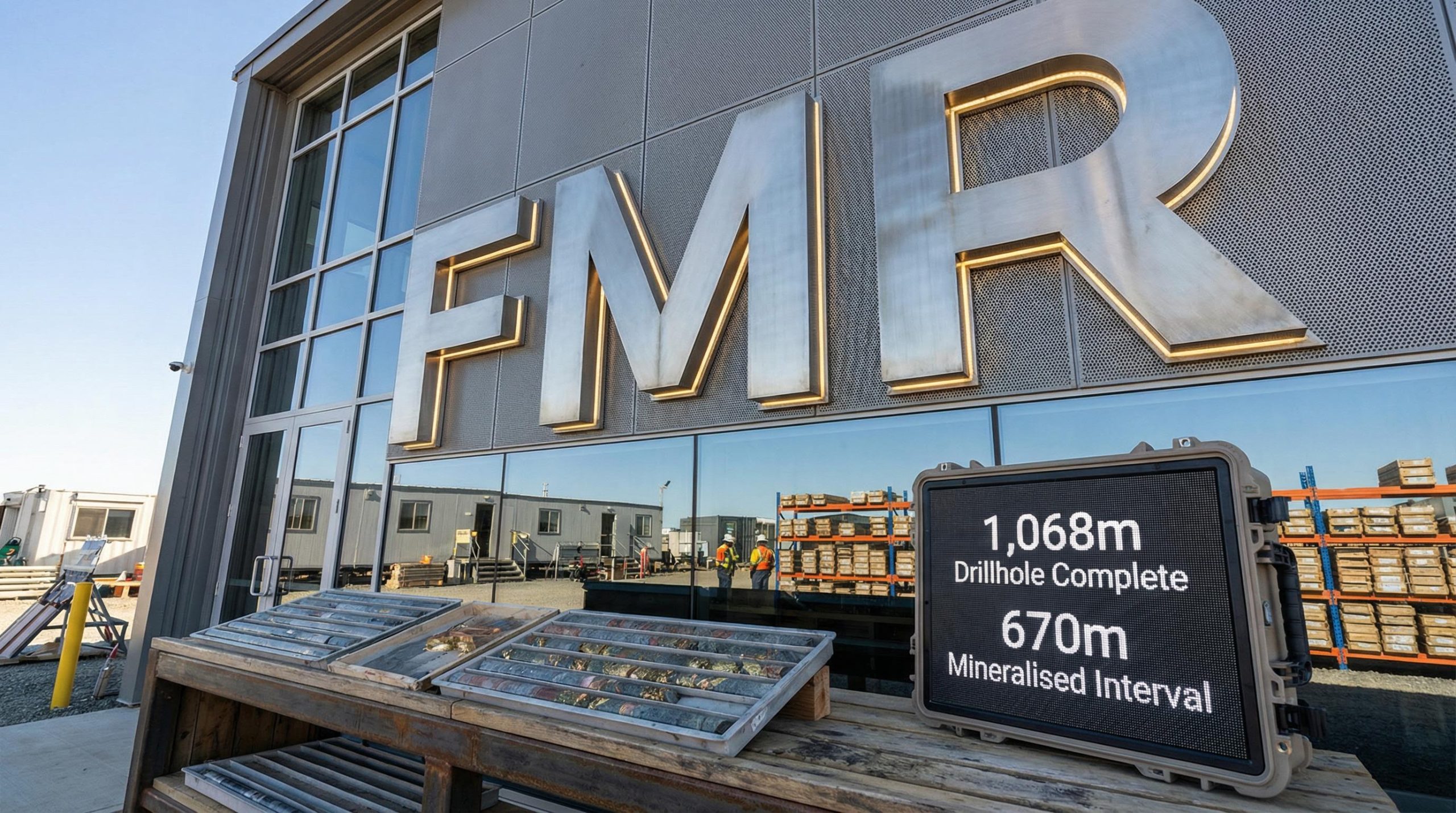
FMR Resources has completed drillhole 26LHDD073 to a final depth of 1,068.0m at Target L within the Southern Porphyry prospect, intersecting broad mineralised intervals between 144m and 815m downhole depth. The company reports visible copper (chalcopyrite) and molybdenite observed within quartz-sulphide veinlets, anhydrite veinlets, and disseminations in and around porphyry intrusions.
What is porphyry copper mineralisation and why does it matter?
Porphyry copper deposits are large-scale, bulk-tonnage mineral systems representing the world’s primary source of copper and significant sources of molybdenum and gold. These deposits form when mineral-rich fluids from magma intrusions create stockwork veining and alteration zones in the surrounding rock. Geologists use stockwork breccia and alteration zoning to identify potential high-grade zones within these systems.
The geological indicators observed at Target L—chalcopyrite (copper sulphide), molybdenite (molybdenum sulphide), pyrite, and silicification—are classic signatures of a porphyry system. When economic, porphyry deposits can support decades-long mining operations due to their scale. Early identification of mineralised footprints is critical to reducing exploration risk.
When big ASX news breaks, our subscribers know first
Geological observations point toward an elongate mineralised intrusive corridor
Drillhole 26LHDD073 intersected multiple intrusive phases including Andesitic Porphyry, Quartz-Diorite, and Granodiorite Porphyry. These intrusive units are associated with stockwork veinlets, pervasive silicification, and breccia development, interpreted as porphyry-style hydrothermal fluid phases.
Sulphide observations include chalcopyrite in quartz-sulphide, calcite-sulphide, and magnetite-sulphide veinlets, with molybdenite hosted in quartz and anhydrite veins. Sooty chalcocite was observed at 49.7m depth, indicating supergene enrichment (weathering processes that concentrate copper near surface). Copper anomalism was confirmed using portable X-ray fluorescence (pXRF) analysis.
| Interval From (m) | Interval To (m) | Width (m) | Sulphide Type | Visual Estimate (%) |
|---|---|---|---|---|
| 27 | 58.4 | 31.4 | Pyrite ± Chalcocite | ~7% |
| 58.4 | 67 | 8.6 | Pyrite ± Chalcopyrite | ~7% |
| 67 | 135 | 68 | Pyrite | ~7% |
| 251.1 | 317.9 | 66.8 | Pyrite ± Chalcopyrite ± Molybdenite | 3-4% |
| 317.9 | 366.4 | 48.5 | Pyrite | 4-5% |
| 366.4 | 425.5 | 59.1 | Pyrite | 4-5% |
| 425.5 | 440.8 | 15.3 | Pyrite | ~2% |
| 440.8 | 488.6 | 47.8 | Pyrite | 4-5% |
| 502 | 540 | 38 | Pyrite ± Molybdenite | ~5% |
| 654.7 | 839 | 184.3 | Pyrite ± Chalcopyrite ± Molybdenite | 4-6% |
| 887.5 | 968.6 | 81.1 | Pyrite | ~5% |
| 968.6 | 1040 | 71.4 | Pyrite | ~3% |
The drilling is interpreted to have intersected the edges of an elongate mineralised porphyry intrusive corridor, first identified at Target K. Management noted that the visible copper and molybdenite sulphide, combined with alteration and brecciation textures, mark the edge of this corridor.
Structural vectoring narrows the target
Vein orientation measurements are being used to vector toward the fluid source at depth. Structural measurements from 26LHDD073 show a shallow structural set dipping southeast transitioning to a deeper northwest trend downhole. This transition indicates the vein sets may represent different intrusion-related fluid pulses, or that drilling may have traversed above and across the fluid source.
The shift in vein orientation is interpreted to reflect increasing structural complexity toward a fluid source, providing a vector to the south, east, and at depth relative to Target K. Structural complexity near fluid sources is a positive indicator that drilling is approaching the core of the system.
Phase I program exceeds expectations, Phase II drilling to target the porphyry core
The Phase I program was originally planned for approximately 4,000m but has now exceeded 5,000m drilled across four targets (A, C, K, and L). The program has delivered a dual discovery: a shallow mineralised epithermal system and an extensive mineralised porphyry system at depth.
Managing Director Oliver Kiddie
“The next critical step in additional drillhole targeting requires full-suite assays, specifically the multi-element geochemistry, to fingerprint alteration signatures to vector to the core of this extensive, mineralised system.”
Next steps include:
- Complete integration of geological and downhole geophysical datasets from Targets A, C, K, and L
- Refine three-dimensional interpretation of the porphyry system
- Assay results expected in the June 2026 quarter
- Design Phase II drilling programme to target the mineralised core
The transition from Phase I to Phase II represents a meaningful de-risking milestone. Management’s confidence in designing a follow-up programme signals the geological model is being validated through drilling. The integration of geological, geochemical, and geophysical datasets will inform Phase II drill targeting.
The next major ASX story will hit our subscribers first
Strategic context within the Llahuin Project
The Southern Porphyry target is located within a six-kilometre-long mineralised corridor within the Llahuin Project, a Joint Venture with Southern Hemisphere Mining Limited (ASX: SUH) in Chile. The project hosts multiple copper-gold-molybdenum porphyry centres across the concession area.
Field mapping completed in June and July 2025 identified argillic alteration, silicification, and epithermal quartz veining at surface, along with zones of secondary copper mineralisation assemblages typical of upper levels of a copper porphyry system. Re-logging of historic drillholes confirmed hydrothermal alteration, silicification, and disseminated chalcopyrite-pyrite mineralisation at depth, suggesting a telescoped system with epithermal-style veining preserved above a deeper porphyry core.
The Llahuin Project offers district-scale exploration potential, with Southern Porphyry representing one of multiple prospective targets within the broader mineralised corridor.
Want the Next Copper Discovery in Your Inbox?
Join 20,000+ investors getting FREE breaking ASX news delivered within minutes of release, complete with in-depth analysis. Click the “Free Alerts” button at Big News Blast to receive alerts the moment market-moving announcements hit the ASX, with expert coverage already done for you.